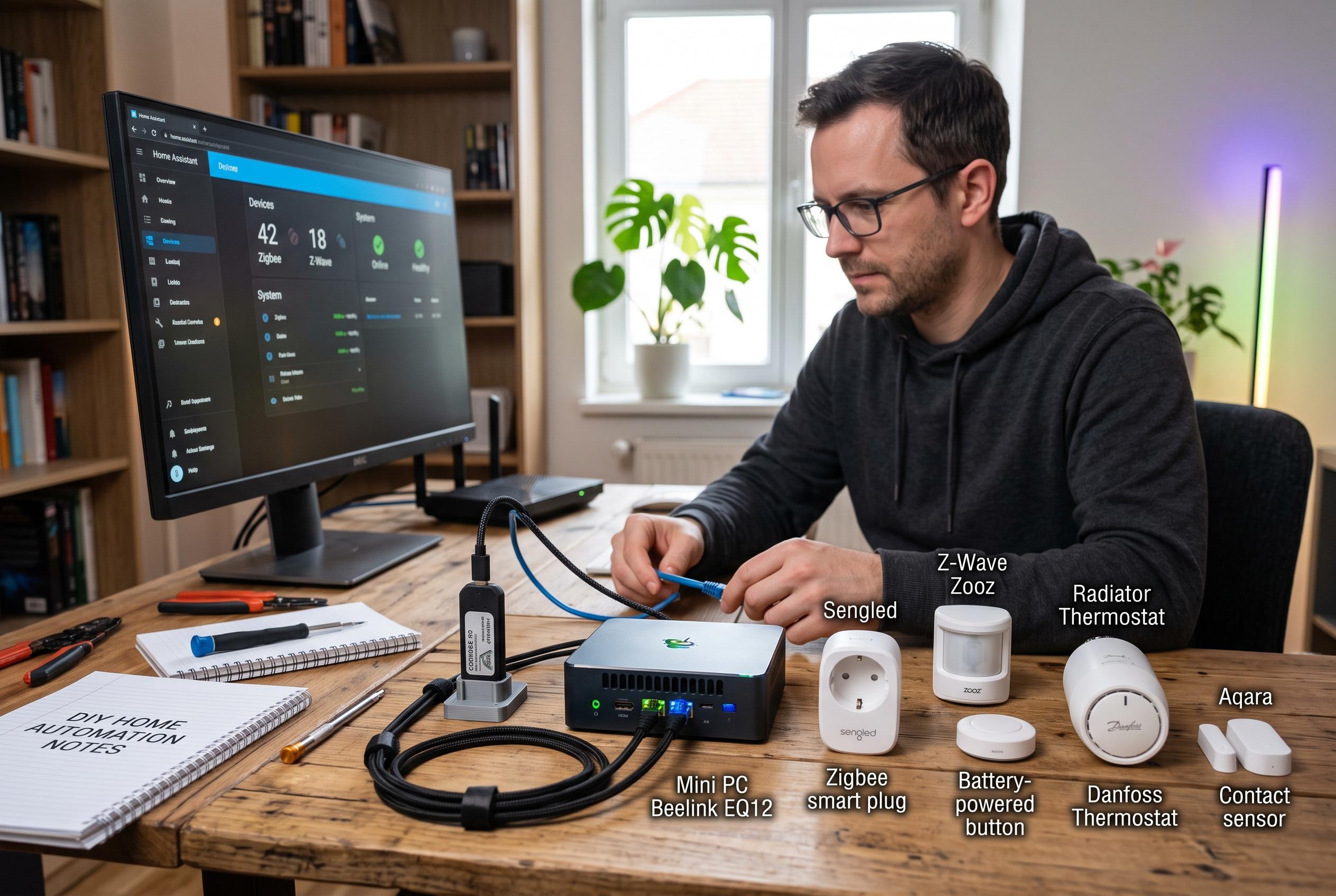

An enthusiast revisits home automation using a mini PC, local Zigbee and Z-Wave devices, and AI-driven automations to create a resilient, efficient smart home system focused on practicality and stability.
A move to a smaller house, an idle mini PC and a drawer full of Zigbee and Z-Wave gear have pushed the author back into home automation, this time with a more practical setup centred on Home Assistant. According to the Home Assistant installation guide, the project’s OS image is designed for dedicated hardware and is commonly flashed to USB media or storage before the interface is reached through a browser. The appeal here is less the software itself than the move away from fragile SD cards and towards a solid-state drive, which is far better suited to constant writes.
The chosen machine is a compact NiPoGi Pinova P1, fitted with a Ryzen 3 4300U, 16GB of RAM and a 1TB SSD. That is far more power than home automation needs, but the extra headroom is useful when the system is also expected to manage add-ons, backups and integrations. The key BIOS requirements are enabling UEFI, disabling Secure Boot and setting the machine to power back on after an outage, so the controller does not remain offline after a brief cut in mains supply.
For Zigbee devices, the setup uses Zigbee2MQTT rather than Home Assistant’s native Zigbee integration. The official Zigbee2MQTT documentation explains that the add-on relies on a 64-bit system and an MQTT broker such as Mosquitto, but it rewards the extra setup with broader device control and deeper configuration. That mattered here because the author wanted to tune a Sonoff USB coordinator properly, and the stable serial path under /dev/serial/by-id/ proved more reliable than a changing /dev/ttyUSB0 device name after reboot.
Local control was also essential for Wi-Fi gear that had previously been tied to cloud apps. The Sonoff LAN approach is designed to keep compatible devices controllable over the local network rather than through the manufacturer’s servers, which is the same direction taken by Meross LAN and similar community components used inside Home Assistant. That local-first approach is more resilient when a vendor’s cloud service fails or the internet link drops, and it avoids the common trap of discovering cloud dependence only after purchase.
The more ambitious part of the project is the use of Claude Code through an MCP server to generate Home Assistant automations from plain French prompts. The author says this removes the friction of manual YAML editing and makes it feasible to create far more rules than would normally be written by hand. That idea fits with recent academic work such as AdaHome, which argues that local language models can help smart homes make more stable, personalised decisions without relying on the cloud. Home Assistant itself now supports an MCP server, but in this case the goal is the reverse: the assistant writes the configuration rather than merely exposing devices to another tool.
Most of the resulting rules focus on air quality and heat management in a room with no air conditioning. A Dyson purifier now starts when particulate levels stay high for several minutes, then runs quietly when the author is present and at full speed when the room is empty. Window-opening advice is only issued when indoor heat, outdoor temperature, humidity and outdoor air quality all line up in favour of ventilation. The use of dew point, rather than simple relative humidity, is a sensible detail: it better reflects whether outside air will actually feel drier indoors.
A mmWave presence sensor turned out to be one of the most useful additions. Unlike a basic PIR motion detector, it can see a person who is sitting still, which makes it better suited to a desk or workstation. With Zigbee2MQTT exposing the internal parameters, the author could tune detection range and sensitivity precisely, then use that data to trigger lighting and desk equipment only when someone is actually in the right part of the room. The downside is that radar-style sensors can produce ghost detections, so the installation now includes a safety rule to switch lights off if the target remains out of range for long enough.
The overall result is less a polished smart home than a system that is finally useful. Tailscale has been added for secure remote access without opening router ports, and ESP32 and Z-Wave hardware are next on the list. The broader lesson is familiar to anyone who has tried to automate a house: local control, stable storage and careful sensor placement matter more than gadget count. The AI helps, but only because it reduces the time spent wiring up rules, not because it removes the need to understand how the house actually behaves.
Disclaimer: This content is intended for informational purposes only. Readers are advised to exercise their own judgement, conduct due diligence, or consult a qualified expert before acting on any information provided.