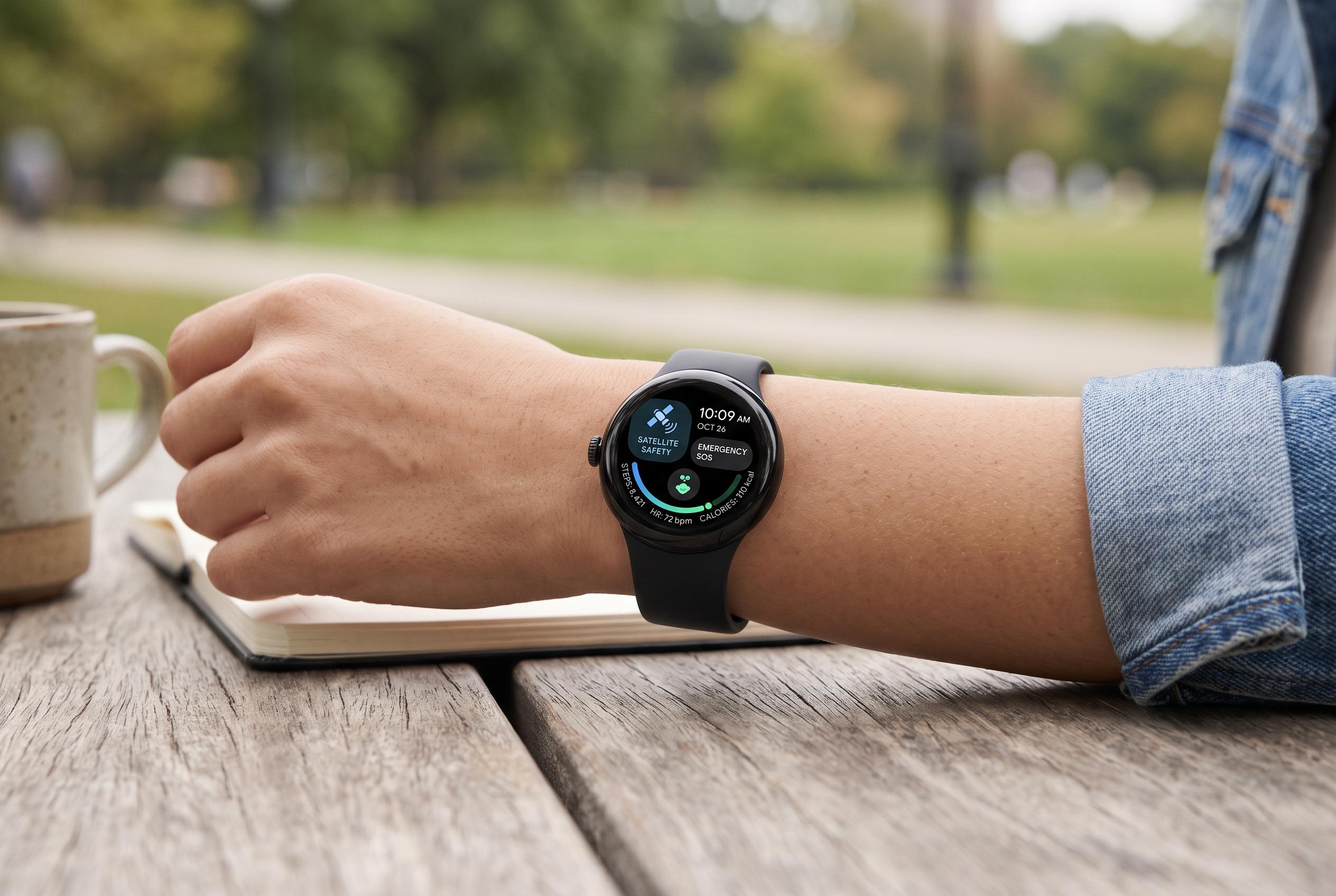

Google’s Pixel Watch 5 enters a tight competition with Apple’s latest Series 11, offering enhanced health tracking, longer battery life, and satellite safety features, challenging the dominance of the iPhone-exclusive device.
Google’s Pixel Watch 5 arrives as a direct challenge to the Apple Watch Series 11, and on paper the contest is unusually tight. Apple’s official specifications confirm that the Series 11 remains an iPhone-only watch with a familiar aluminium-or-titanium split, while Google’s new model targets Android users with a stronger push into health tracking, longer battery life and satellite safety features. The result is a comparison shaped less by raw ambition than by how much each platform is willing to give users at the same price.
The two watches take clearly different design paths. Apple keeps its rounded-rectangle case in 42mm and 46mm sizes, while Google uses a circular body in 41mm and 45mm versions. Apple’s official data shows the Series 11 is thinner and available in aluminium or titanium, whereas the Pixel Watch 5 is only sold in aluminium. That matters in practical use: Apple gives buyers a wider materials choice, but Google counters with a watch that is smaller on the wrist than its thickness suggests.
Display is another area where the watches separate more by philosophy than by capability. Apple’s Series 11 uses an LTPO3 OLED panel rated at up to 2,000 nits, while Google’s Actua 360 AMOLED LTPO display reaches 3,000 nits and should be easier to read outdoors. TechRadar’s comparison notes that both panels support always-on operation and similar adaptive refresh behaviour, but the Pixel Watch 5’s round face naturally offers fewer usable pixels than Apple’s shape. In short, Google wins on brightness, while Apple’s layout is more space-efficient.
Performance is less decisive, which is typical for smartwatches. Apple uses its S10 SiP, while Google has moved to Qualcomm’s Snapdragon W5 Gen 2 with a Cortex-M55 co-processor. Both models offer 64GB of storage, which is ample for offline music and apps. Neither watch is built for heavy computing, so the more relevant question is efficiency and responsiveness during health tracking, notifications and voice features.
Health and fitness are where the rivalry is most serious. Apple’s Series 11 includes its third-generation optical heart sensor, ECG, temperature sensing and blood oxygen tracking, plus hypertension notifications, which Apple says analyse trends over 30-day periods. Google matches the core wellness stack and adds a cEDA sensor, along with Fitbit-powered readiness and sleep tools. TechRadar has also reported that the Pixel Watch 5 edges ahead in a few specialist areas, including satellite communication, GPS performance and some health functions, though some Google features rely on Fitbit Premium, which raises the long-term cost. Separate TechRadar reporting has also raised concerns about the Google Health app’s AI Health Coach, with users complaining about inaccurate or misleading outputs.
Battery life and connectivity may prove the clearest practical difference. Apple now quotes up to 24 hours of normal use for the Series 11, or 38 hours in Low Power Mode. Google claims up to 30 hours on the 41mm Pixel Watch 5 and 40 hours on the 45mm model, with far longer endurance in Battery Saver mode. On connectivity, Apple offers 5G on cellular models, while Google stops at 4G LTE but adds satellite SOS, which TechRadar highlights as one of the watch’s most notable advantages over the Series 11.
Price does little to separate them. Apple’s entry model starts at $399, and Google’s begins at $399.99, so the real decision comes down to ecosystem. Apple Watch still belongs with the iPhone, and Pixel Watch still belongs with Android. For buyers already committed to one camp, that may settle the issue immediately. For everyone else, the comparison is close enough that battery life, subscription costs, materials and safety features are likely to decide it.
Disclaimer: This content is intended for informational purposes only. Readers are advised to exercise their own judgement, conduct due diligence, or consult a qualified expert before acting on any information provided.