
Insta360 enters the competitive handheld gimbal market with the Luna Ultra, offering dual lenses, detachable touchscreen, 8K recording, and versatile filmmaking capabilities, challenging DJI’s dominance.
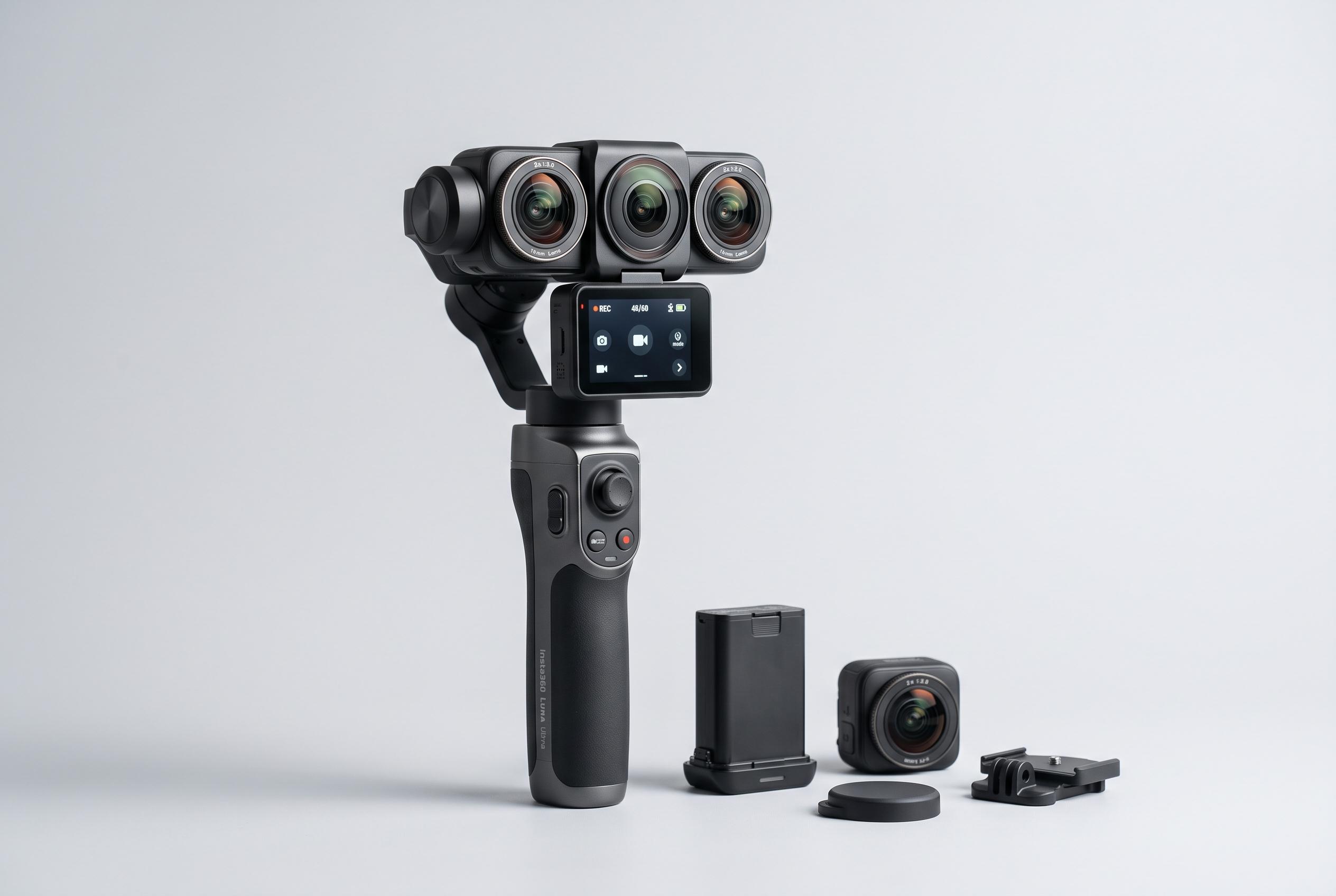
Insta360 has entered the handheld gimbal camera race with a clear aim: challenge DJI on its own turf. The Luna Ultra is positioned as a more ambitious alternative to the Osmo Pocket line, pairing a dual-lens setup with a detachable touchscreen controller and a strong emphasis on solo shooting and flexible framing.
Its hardware is the main point of distinction. According to Mashable’s review, the Luna Ultra combines a Leica Summicron main lens with a one-inch 8K sensor and a telephoto lens with a 1/1.3-inch sensor. TechRadar’s review adds that the camera offers a 20mm f/1.8 ultra-wide view alongside a 60mm f/2.0 telephoto lens, giving creators two very different perspectives from a single compact device. The result is a camera that is not just about stabilisation, but about composition and versatility.
The detachable two-inch OLED touchscreen is another major selling point. It can be removed from the body and used as a remote control, letting users start recording, adjust zoom and move the gimbal without touching the camera itself. Mashable found this especially useful for solo filming, though the design comes with practical limits: the remote must stay attached to charge, has a modest battery, and is not sold separately. Even so, it gives the Luna Ultra a degree of operational flexibility that stands out in this category.
On paper, the video specification is aggressive. Mashable says the camera records up to 8K at 30fps and 4K at 120fps, while TechRadar notes 10-bit colour support and 4K slow motion at 120fps. The camera also supports I-Log, Leica colour profiles and Dolby Vision, which places it closer to a creator-focused tool than a simple point-and-shoot vlogging device. Gizmochina and other comparison coverage note that the Luna Ultra is available globally at $769.99, including in the United States, while DJI’s Pocket 4P is not officially sold there because of FCC restrictions.
Performance is broadly strong, but not flawless. Mashable said image quality is sharp and dependable, with low-light results that remain usable even if the on-screen preview can look noisy and overly brightened. Focus, however, can be inconsistent, particularly with close subjects or in dim conditions. TechRadar’s review was more complimentary, highlighting subject-tracking autofocus and the camera’s triple-chip processing system, which helps explain why the Luna Ultra handles difficult lighting better than its compact size might suggest.
The broader comparison with DJI is telling. The Osmo Pocket 4P still appears to have the edge in some areas, including stronger background blur and more mature accessory support. But Insta360 has made a credible case for users who value modularity, a detachable remote, internal storage, and 8K capture from a pocketable camera. At $769.99, the Luna Ultra is not inexpensive, yet it is clearly designed for buyers who want more than the basics from a handheld gimbal.
Disclaimer: This content is intended for informational purposes only. Readers are advised to exercise their own judgement, conduct due diligence, or consult a qualified expert before acting on any information provided.