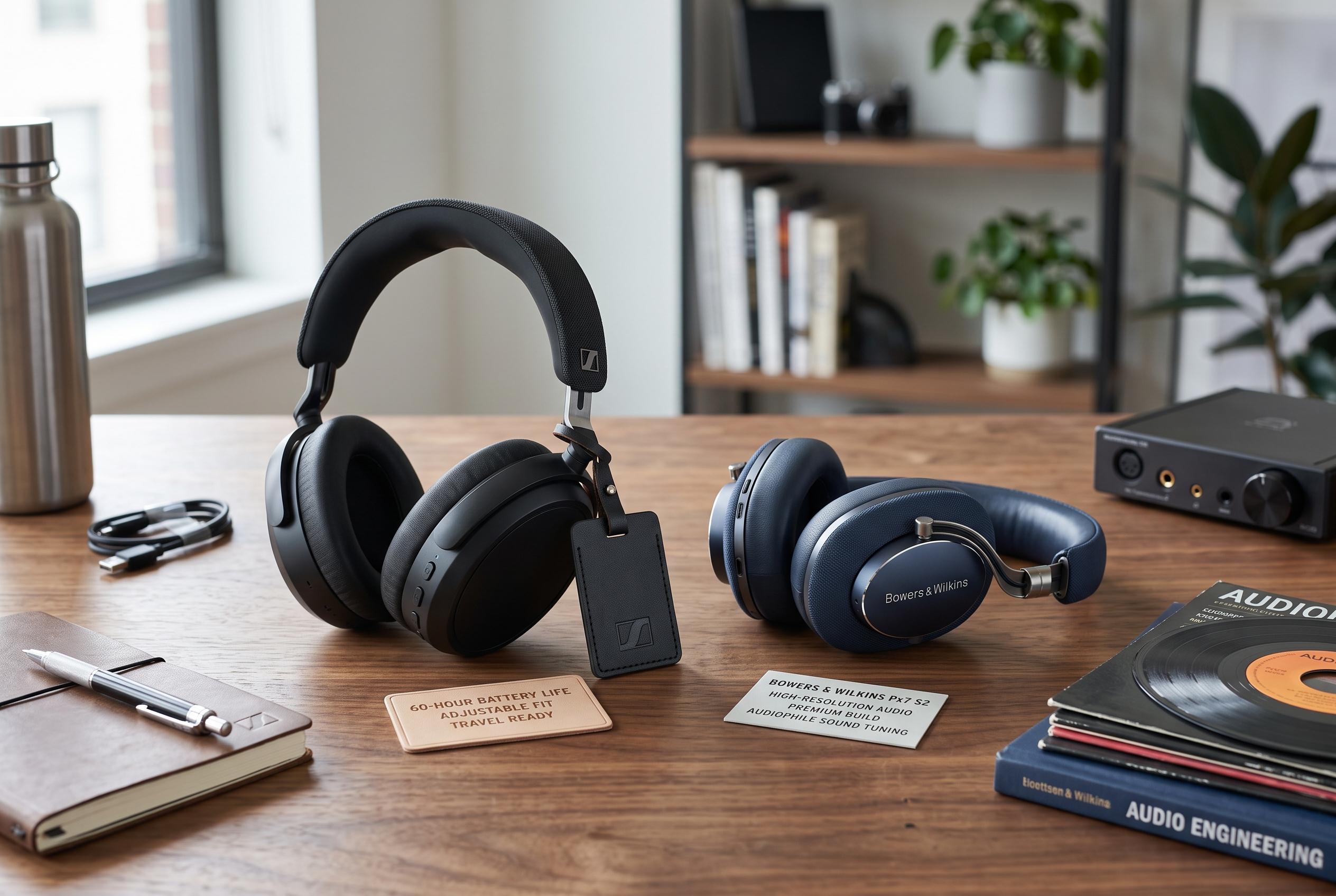

The Sennheiser Momentum 5 outperforms the Bowers & Wilkins PX7 S3 in battery endurance and adjustable features, catering to travellers and versatile listeners, while the PX7 S3 offers a more refined design and premium sound tuning for audiophiles.
The Sennheiser Momentum 5 and the Bowers & Wilkins PX7 S3 sit at the upper end of the wireless headphone market, but they are built around different priorities. The Momentum 5 is the more practical traveller’s choice, with longer battery life, stronger noise cancellation and broader customisation. The PX7 S3, by contrast, is aimed at listeners who value refinement, with a more compact design, a more polished finish and a sound tuned for clarity and control.
Bowers & Wilkins has given the PX7 S3 a slimmer frame, flattened ear cups and softer integration of fabric and metal, and its own product pages position it as a premium noise-cancelling model with eight microphones, aptX Lossless support and a 30-hour battery. Reviewers at Tom’s Guide have also praised its comfort and sound quality, while noting that its ANC is not class-leading. Sennheiser’s Momentum 5 takes a less luxurious visual approach, but it remains well put together and more overtly functional, with touch controls, quick wear detection and a companion app that allows deeper adjustment of cancellation, transparency and EQ.
The most obvious technical gap is endurance. Sennheiser claims up to 57 hours of playback with ANC enabled, a figure echoed by Android Central and What Hi-Fi?, while Bowers & Wilkins lists 30 hours for the PX7 S3. That makes the Momentum 5 notably better suited to long-haul travel and heavy daily use. Sennheiser also says the battery is user-replaceable, which gives the headphones a longer potential lifespan than most sealed rivals.
Wireless performance is strong on both sides. The Momentum 5 uses Bluetooth 5.4 and supports SBC, AAC, aptX, aptX HD, aptX Adaptive and aptX Lossless, while the PX7 S3 uses Bluetooth 5.3 with aptX Adaptive and aptX Lossless. In practice, either model should satisfy Android listeners with compatible devices; iPhone users will still be limited to AAC. Both also support USB-C listening, although Bowers & Wilkins leans more heavily into the idea of wired digital playback as part of the PX7 S3’s appeal.
Sonically, the split is just as clear. The Momentum 5 has the larger bass response, more top-end energy and a wider, more open presentation, making it the more versatile choice for mixed listening. The PX7 S3 is tighter and more precise, with cleaner imaging, warmer mids and a smoother treble that favours long sessions over outright sparkle. That makes the Sennheiser the stronger all-rounder, while the Bowers & Wilkins is the more disciplined and hi-fi-leaning headphone. For buyers comparing the two at roughly similar premium pricing, the decision largely comes down to whether they want convenience and flexibility, or finish and finesse.
Disclaimer: This content is intended for informational purposes only. Readers are advised to exercise their own judgement, conduct due diligence, or consult a qualified expert before acting on any information provided.