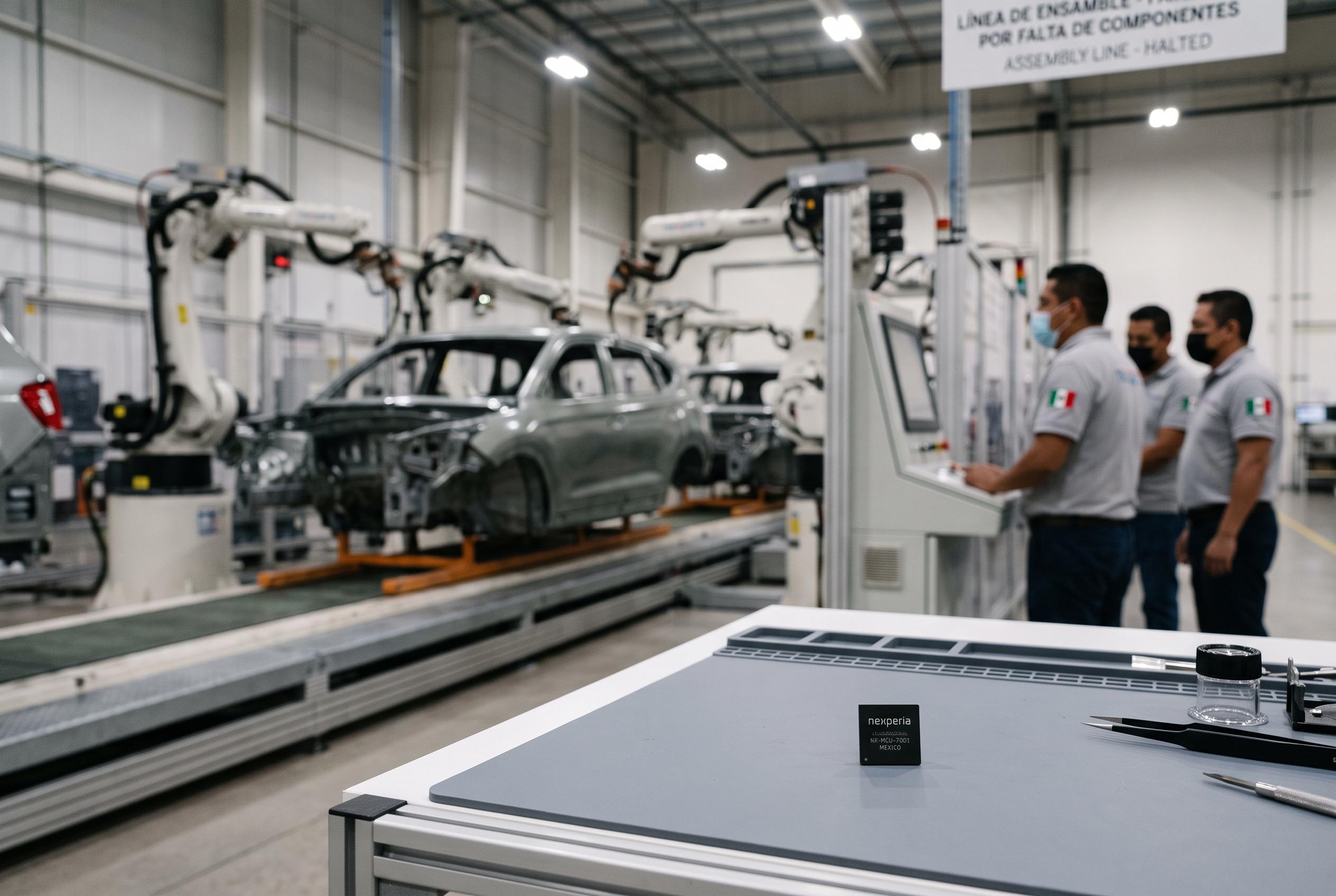

The recent halt in Honda’s Mexican plant underscores how a single, low-cost chip component can trigger widespread manufacturing disruption amid geopolitical tensions and supply chain fragility.
Honda’s production halt in Mexico in late October 2025 exposed how a single low-cost component can disrupt an entire industrial chain. According to reporting from Mexican outlets, the Celaya plant stopped assembling the HR-V after Nexperia chips became unavailable, with the interruption also affecting Honda’s North American operations. The episode showed that the weakest point in a modern manufacturing system is not always the most expensive part. Rather, it is often the least visible one.
Nexperia, a Dutch chipmaker based in Nijmegen and owned by China’s Wingtech, sits in a critical but largely overlooked part of the semiconductor market. Its output is not cutting-edge logic silicon but transistors and diodes, the kind of components used in ordinary switching functions inside vehicles and industrial equipment. The company’s importance lies in scale: it supplies a large share of these mature chips, including a substantial portion of what the European automotive sector relies on.
The chain reaction began outside the factory floor. In late September 2025, the United States expanded its export-control regime to capture foreign affiliates controlled by listed companies, bringing Nexperia into scope because Wingtech had already been designated. Dutch authorities then intervened on national-security grounds, while China responded by restricting exports from Nexperia’s Dongguan operation. What followed was a dispute that linked Washington, The Hague and Beijing to a production stoppage in Mexico within days. Reports in South China Morning Post and Tom’s Hardware also described a Dutch court move that sharply limited Chinese control over the business.
The episode matters because semiconductors are not made in one place. Design, wafer fabrication, assembly, testing and packaging are separate stages, and each has migrated to the location offering the best mix of cost, expertise and policy support. That split has made the industry efficient, but also brittle. The cheap and labour-intensive stages were pushed into a handful of countries, while the higher-value work stayed elsewhere.
Malaysia illustrates how that model took hold. According to UNCTAD, the country built a major semiconductor base through export zones and industrial policy, becoming a global centre for assembly, testing and packaging. It now accounts for around 13 per cent of the packaging, assembly and test market and employs roughly 590,000 people in the sector. Yet UNCTAD also says most local firms remain concentrated in lower-value segments of the chain, despite repeated government efforts over several industrial master plans to move them into research, design and engineering.
The UK’s own assessment of the sector points in a similar direction. Parliament concluded in 2022 that Britain has strength in design and compound semiconductors but no meaningful volume fabrication, and that domestic self-sufficiency is neither realistic nor desirable. That judgment fits the wider pattern: countries can capture high-value design work without gaining much control over the physical bottlenecks that keep global production moving.
Nexperia’s own crisis shows how leverage works in practice. Once shipping between the European and Chinese parts of the company was disrupted, the front end was left with wafers it could not finish, while the back end lacked fresh supply. Reuters and other reporting later indicated that the Chinese unit began qualifying domestic wafer suppliers, but that substitution takes time. In automotive-grade production, the delay is measured in quarters, not days. That gap is why a small part can stop a car plant long before anyone can reconfigure the chain.
The broader lesson is that global specialisation does not merely divide labour. It also divides power. The stage that earns the least may be the stage that can halt the most activity, and it can do so fastest. That is the structural weakness revealed by the Nexperia dispute: a system built for efficiency also created highly concentrated points of failure.
Disclaimer: This content is intended for informational purposes only. Readers are advised to exercise their own judgement, conduct due diligence, or consult a qualified expert before acting on any information provided.