
The Mobile World Congress 2026 in Barcelona showcased a shift from traditional handsets to integrated mobile systems, highlighting advancements in foldable design, embodied AI, and network infrastructure readiness for AI-driven services.
Mobile World Congress 2026 in Barcelona was less a straight handset exhibition than a broad showcase of where mobile computing is heading. According to the GSMA, the event ran from 2 to 5 March and drew nearly 105,000 attendees, marking two decades of MWC in the city. That scale mattered because the show’s most important themes stretched beyond phones to AI, wearables, robotics, network infrastructure and the commercial future of 5G.
The clearest consumer story was the push towards thinner foldables with bigger batteries and more credible everyday use. HONOR’s Magic V6 emerged as one of the most substantial launches, with a claimed 6,660mAh silicon-carbon battery, dual LTPO displays and a body that is markedly slimmer than earlier book-style foldables. Industry coverage from Gadgets 360 and Android Central said the device was unveiled at MWC 2026 and is now available in Europe, the Middle East and Asia, including a UK price of £1,999.99.
That makes the Magic V6 more than a specification exercise. The combination of a large battery, high-brightness screens and a Snapdragon 8 Elite Gen 5 chipset suggests the industry is trying to address two persistent foldable weaknesses at once: limited endurance and awkward portability. Android Central’s review coverage described the handset as a major step forward in design and durability, while also placing it firmly in the premium end of the market.
HONOR’s more futuristic Robot Phone drew attention for a different reason. It is best understood as a demonstration of embodied AI rather than a conventional product launch. The concept combines a smartphone with a mechanically moving camera system, allowing the device to track subjects and move in response to its surroundings. That makes it a useful illustration of how AI is moving from on-screen software into hardware that can physically react.
The trade-off is obvious. A device built around moving parts introduces new questions about durability, repairability and long-term reliability. The announcement does not, on its own, establish that the Robot Phone is a mass-market device with confirmed sales dates, regional pricing or warranty terms. It is better read as a technical preview of where camera design might go next.
Motorola also used Barcelona to push its foldable line further, showing the razr fold as part of Lenovo and Motorola’s broader MWC portfolio. The company positioned it as a larger-screen foldable aimed at productivity, creativity and entertainment, with support for the moto pen ultra. That places it in direct competition with other premium foldables that are now trying to look less like novelty devices and more like replacements for small tablets.
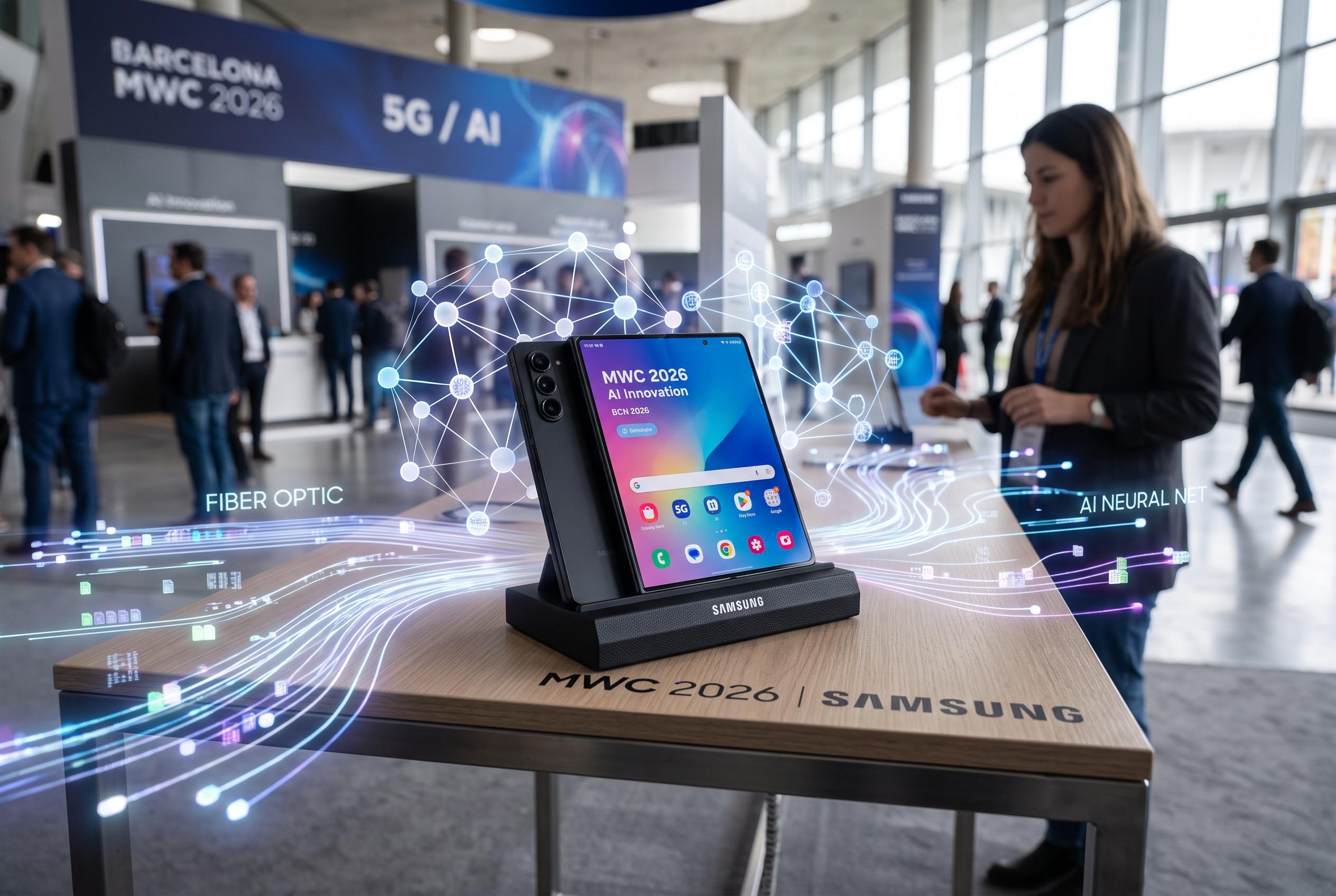
Samsung’s presence at MWC was broader still. Rather than presenting AI as a single feature, the company framed Galaxy AI as an ecosystem that can operate across phones, wearables and PCs. The point was strategic: AI was presented as a way for devices to share context and automate tasks, not merely as a camera filter or writing assistant built into one handset.
That same shift was visible in Qualcomm’s wearable announcement. The Snapdragon Wear Elite platform was introduced as a new base for future smartwatches and connected devices, with claims of up to five times faster single-core CPU performance, up to seven times faster GPU performance and up to 30% better battery life. Qualcomm also said the platform supports an integrated Hexagon NPU, 5G RedCap, Micro-Power Wi-Fi and Bluetooth 6.0, with Google, Motorola and Samsung named among its partners.
Those claims should still be treated as platform potential rather than finished-device performance. Real-world battery life will depend on screen size, software, radio usage and the final product design. But the direction is clear: more AI will run locally on smaller devices, reducing dependence on the cloud and making wearables more capable on their own.
Beyond the headline products, MWC 2026 showed how much of the mobile industry now revolves around infrastructure. Accenture and Telefónica both used the event to highlight AI-led transformation and open platforms, while the GSMA’s own priorities centred on standalone 5G, digital safety and networks that can support AI workloads. That matters because the next stage of mobile competition is increasingly about whether networks can support new services profitably, not simply about faster downloads.
For buyers, the practical message is to separate announcements from availability. A device shown in Barcelona may be a retail product, a regional launch, a limited edition or a concept with no clear shipping schedule. That distinction is especially important for foldables and AI-led devices, where the headline innovation can easily obscure the real questions: price, software support, repair costs, privacy, battery life and regional compatibility.
MWC 2026 therefore confirmed a broader industry shift rather than a single winning product. Phones are still central, but they are now being designed as part of a wider system that includes wearables, PCs, cameras, networks and AI services. The most important developments were not spectacles for their own sake, but the signs that mobile hardware is becoming more integrated, more adaptive and more dependent on software-defined infrastructure.
Disclaimer: This content is intended for informational purposes only. Readers are advised to exercise their own judgement, conduct due diligence, or consult a qualified expert before acting on any information provided.