
The latest foldables from Google and Samsung enter a competitive market with contrasting designs and features, redefining what premium foldable smartphones can offer in 2023.
Google’s latest foldable arrives in a market that has moved well beyond novelty. According to Android Central, the Pixel 11 Pro Fold and Samsung’s Galaxy Z Fold 8 are both positioned at the same $1,899 to $1,900 price point, yet they pursue very different ideas of what a premium foldable should be. One leans into Google’s software and imaging strengths; the other favours Samsung’s larger book-style format and stronger multitasking tools.
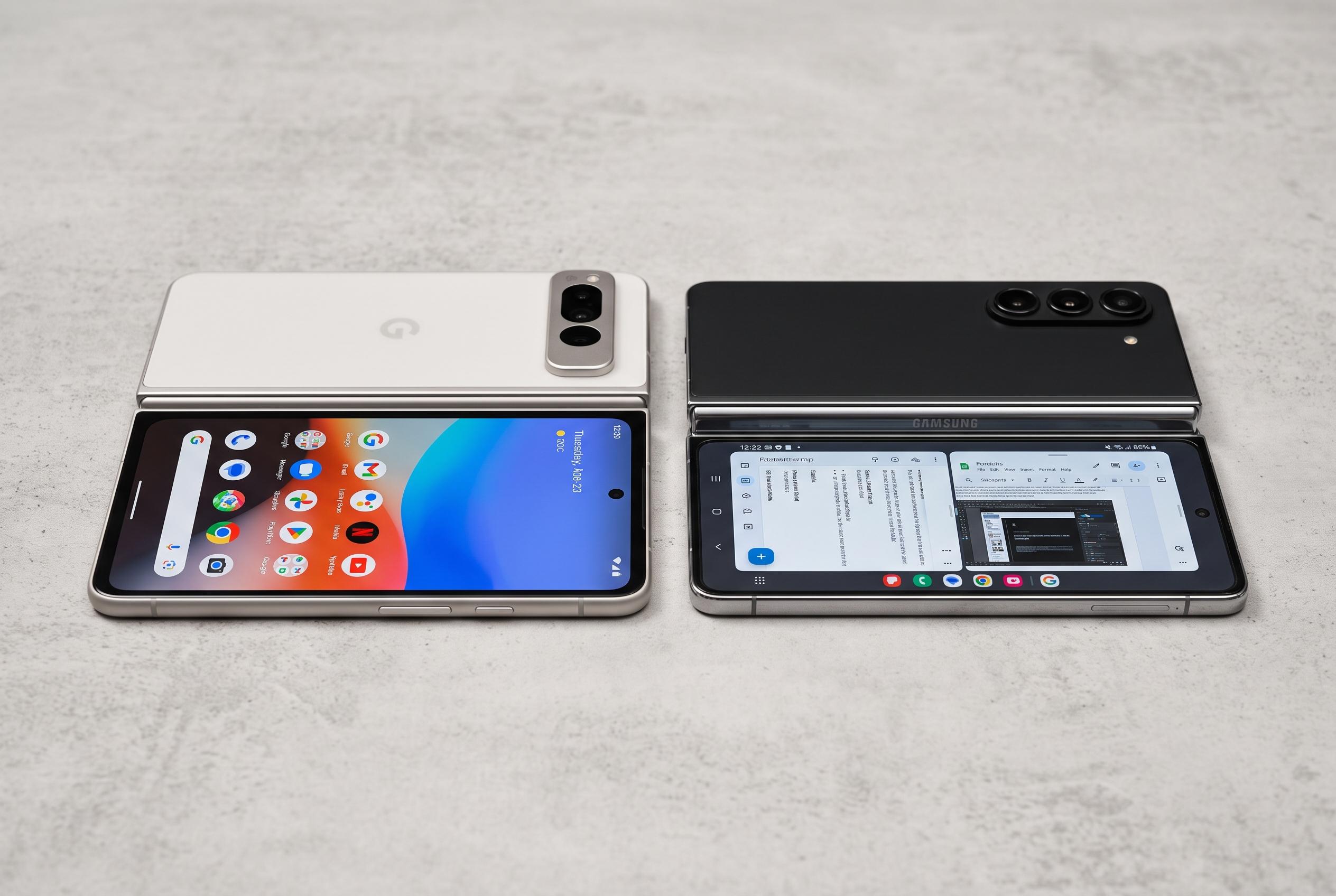
The most visible difference is in shape and screen behaviour. SamMobile says the Galaxy Z Fold 8 is Samsung’s first wide-screen foldable, with a shorter, broader body, a 5.5-inch cover display and a 7.6-inch inner panel. Android Central reports that the Pixel 11 Pro Fold takes the opposite route with a taller, narrower frame, a 6.5-inch external display and an 8.0-inch main screen. Both panels refresh at 120Hz, but the Pixel’s claimed 3,600-nit peak brightness gives it a clear advantage in strong daylight, while Samsung’s design is aimed more squarely at users who want a tablet-like workspace when unfolded.
Performance also splits along familiar lines. Samsung’s model uses the Snapdragon 8 Elite Gen 5 and up to 16GB of RAM, and Android Central says its interface is tuned for split-screen use and even three-app layouts, making it the stronger choice for heavy multitasking. The Pixel 11 Pro Fold uses Google’s Tensor G6 and 16GB of RAM, with Android Central describing a sharper focus on Gemini Intelligence, live translation, task automation and other AI-led functions. In practical terms, Samsung is built for doing more at once, while Google is pushing the phone towards smarter assistance.
Battery and charging follow the same pattern. Both phones use similar-capacity batteries, with Samsung at 4,800mAh and Google at 4,750mAh. Samsung offers 45W wired charging and 20W wireless charging, which should suit users who want faster top-ups. Google’s model is slower on cable at 30W, but Android Central says it adds 25W wireless charging via Qi 2.2 and magnetic attachment, which may be more convenient for desk and bedside use.
Camera hardware is another point of contrast. SamMobile reports that the Galaxy Z Fold 8 uses a dual rear setup with two 50-megapixel sensors and no telephoto lens, which leaves it dependent on software processing rather than optical reach. By comparison, Android Central says the Pixel 11 Pro Fold has a triple camera system with a 48-megapixel main sensor, a 10.5-megapixel ultrawide and a 10.8-megapixel telephoto lens, alongside Google features such as Magic Capture, Camera Looks and 30x zoom. Samsung offers more colour choices, while Google counters with IP68 protection, seven years of Android updates and a cleaner software pitch.
Disclaimer: This content is intended for informational purposes only. Readers are advised to exercise their own judgement, conduct due diligence, or consult a qualified expert before acting on any information provided.