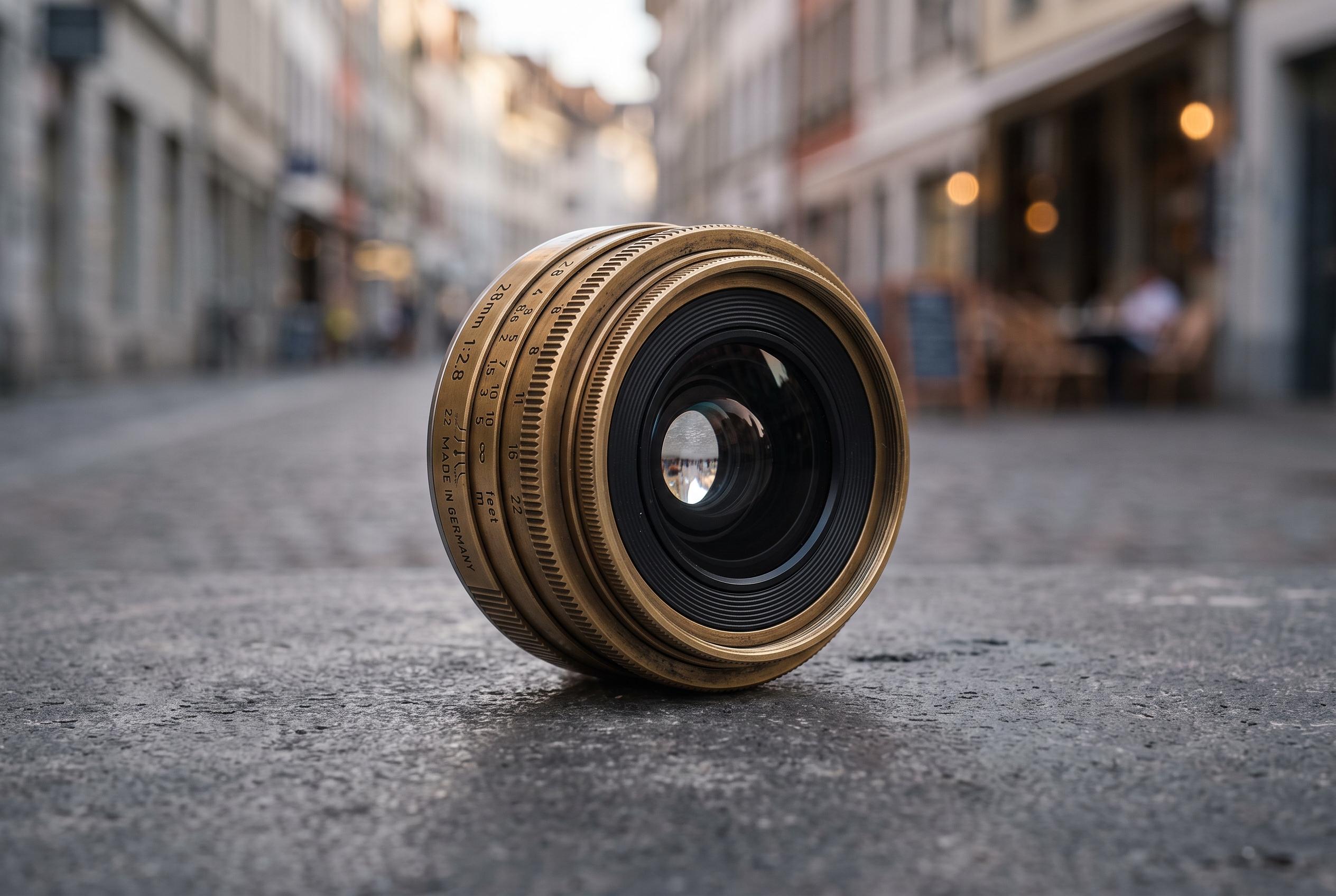

Brightin Star introduces a strikingly small, brass-bodied 28mm f/2.8 pancake lens that blends portability with premium style, attracting street and travel photographers seeking discretion and accessibility.
Brightin Star’s 28mm f/2.8 pancake lens is an unusually compact option for Leica M users, and it is now drawing attention not just for its size but for its finish. The version first shown in glossy black lacquer looked strikingly retro, but the chromed brass edition seen in testing gives the lens a more restrained, premium appearance. According to the review, the lens projects just 10mm from the camera body, enough to make an M10 look almost like a pocket compact rather than a rangefinder. That very small footprint is central to its appeal for street and travel work, where discretion and ease of carry matter as much as image quality.
Brightin Star’s lens is built around a solid brass body and, at 125g, it has a more substantial feel than its dimensions suggest. Retail listings from B&H describe it as a manual-focus wide-angle lens for Leica M rangefinders with an aperture range from f/2.8 to f/16, while independent reviews note that its 51.4mm diameter and 21.5mm overall length place it in a new “micro-pancake” category. The same reviews also confirm that it can be used on other cameras with adapters, including mirrorless systems from Sony, Nikon, Fujifilm and Canon, as well as L-Mount bodies from Panasonic, Sigma and Blackmagic.
That adaptability is part of its broader appeal. Mounted on a Nikon Z6III via an M-to-Z adapter, the lens still remained compact enough to preserve the spirit of an everyday carry setup. The review also noted practical details that matter in the field: the screw-on metal cap, the tiny UV filter, and the rangefinder-coupled focus tab that moves smoothly without an infinity lock. At the same time, the lens’ reduced scale brings compromises. The aperture ring is very small, the markings are hard to read, and operation can be fiddly, particularly in poor light or when moving quickly.
Image quality appears to follow the expectations set by the design. The centre is described as sharp even wide open, but the corners soften at f/2.8 and improve only gradually as the lens is stopped down. Reviewers also mention some field curvature and moderate vignetting, although chromatic aberration is said to be well controlled. Those traits make the lens less suited to flat, architectural subjects shot square-on, but more forgiving for general street scenes, travel snapshots and loosely composed urban work, where the edges matter less than the overall rendering.
For photographers who value portability above technical perfection, Brightin Star has delivered a compelling niche product. The combination of brass construction, pocketable dimensions and a relatively modest price of $339 makes it stand out in a market where compact rangefinder lenses are often far more expensive. The trade-off is clear: this is not a clinical optic, nor is it meant to be. It is a small, mechanical lens designed to disappear on the camera and encourage constant use, which is exactly why it suits the style of photography it targets.
Disclaimer: This content is intended for informational purposes only. Readers are advised to exercise their own judgement, conduct due diligence, or consult a qualified expert before acting on any information provided.