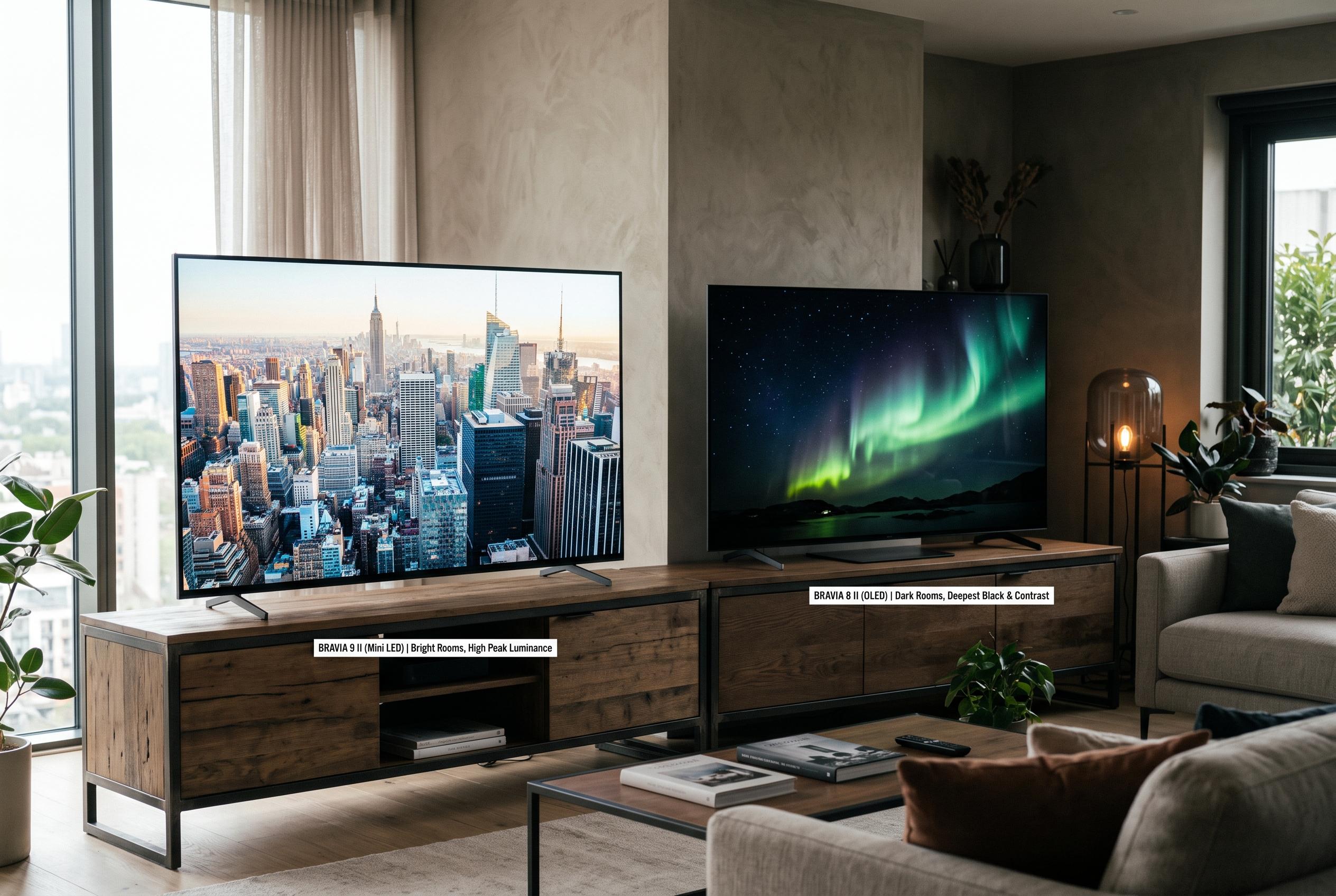

Sony’s latest premium televisions highlight a strategic split: the BRAVIA 9 II excels in bright environments thanks to its Mini LED backlighting, while the BRAVIA 8 II’s OLED panel offers better contrast in darker rooms, shaping buying decisions based on room lighting and viewing preferences.
Sony’s latest premium television comparison is unusually clear-cut once the room is taken into account. Counterpoint Research said OLED panel shipments rose 20% in the second quarter of 2026 even as the wider TV market contracted, yet Sony chose that same period to place an LCD model at the top of its range. The BRAVIA 9 II uses True RGB Mini LED backlighting, while the BRAVIA 8 II is a QD-OLED, and both are sold only in 65-inch form. For buyers weighing picture quality against room conditions, that choice matters more than the model names suggest.
In bright rooms, the BRAVIA 9 II has the stronger case. Its matte screen is designed to cut reflections, and its high output gives it a clear advantage when daylight is pouring in or curtains stay open for much of the day. What Hi-Fi? says the set’s RGB Mini LED system and large number of dimming zones are aimed squarely at premium living rooms where brightness and colour volume are more useful than absolute black level. Sony’s own pricing places the 65-inch model at $3,599.99 in the US, while the 8 II comes in $300 cheaper at $3,299.99.
The BRAVIA 8 II remains the more convincing television for dark-room viewing. Tom’s Guide and What Hi-Fi? both note that the QD-OLED panel delivers superior blacks, stronger shadow detail and better contrast balance, which are the qualities most visible in films and prestige drama after sunset. Because each pixel can switch off entirely, black bars and subtitles sit more naturally on screen than they do on a backlit set. That gives the 8 II a cleaner, more cinematic image in the environments where most home cinema owners actually watch.
Viewing angle is another point in the OLED’s favour. Sony’s RGB Mini LED approach improves brightness and colour, but it still depends on a backlight, which can make contrast fall away for people sitting far from the centre. The 8 II’s self-emissive panel holds its look more consistently across a sofa or sectional, which makes it easier to share with a larger household. Tom’s Guide scores the 9 II slightly ahead overall, but What Hi-Fi? says the 8 II is the better-balanced set for most buyers because it loses less ground in real living-room use.
Gaming shifts the calculation again. The BRAVIA 9 II’s brightness and colour punch can make HDR titles stand out, especially in well-lit rooms, but the OLED still has the faster pixel response. That matters for smearing, motion clarity and rapid camera pans, where self-emissive panels tend to look more precise. The wider market is also leaning towards OLED for gaming displays: Windows Central, citing TrendForce, reported a 98% year-on-year rise in OLED monitor shipments and a 26.1% gain in the second quarter of 2026, while PC Gamer reported a 78% jump in Q1 shipments.
Sound and design also separate the two sets. What Hi-Fi? says the 8 II’s acoustic surface-style system produces more natural dialogue placement than the 9 II’s speaker arrangement, while Sony has paired the flagship Mini LED model with a Mirage Stand and an upgraded remote to underline its premium positioning. That makes the 9 II the more obvious choice for larger spaces and brighter, more public rooms, but the 8 II is the one that seems better matched to critical viewing in a dedicated cinema setup. In practical terms, the decision comes down to whether the room demands more light output or more contrast refinement.
For most buyers, the BRAVIA 8 II is still the safer recommendation. It is the better television for night viewing, has the cleaner black level, and avoids the trade-offs that come with a very bright backlit panel. The BRAVIA 9 II is the specialist pick: more useful in daylight, more suitable for very large rooms, and more compelling if brightness is the priority. Sony has made the choice easy, but not simple.
Disclaimer: This content is intended for informational purposes only. Readers are advised to exercise their own judgement, conduct due diligence, or consult a qualified expert before acting on any information provided.