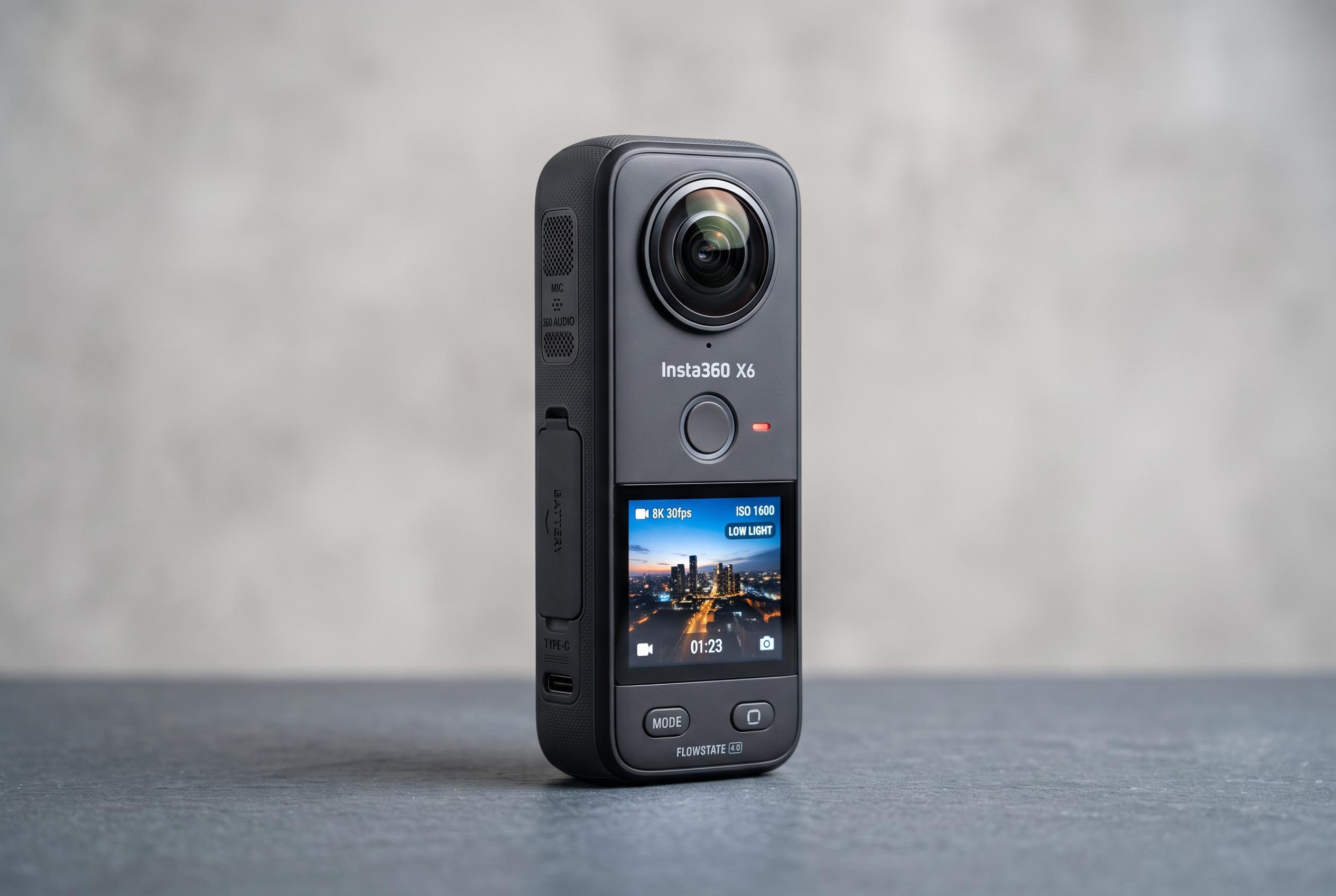

The Insta360 X6 introduces major improvements in image quality, low-light performance, and battery life, making it a compelling yet premium choice for creators seeking advanced 360-degree recording capabilities.
For budget-conscious videographers, new influencers, skaters, snowboarders and anyone filming a weekend trip for social media, the Insta360 X6 makes a strong case for itself. According to Gizmodo Japan’s review, it is the company’s most capable 360-degree camera yet, with better low-light performance, a longer-lasting battery and a broader set of shooting modes than the X5. That said, the same review also makes clear that 360-degree cameras remain powerful but awkward tools, not simple point-and-shoot devices.
The headline upgrade is image capture. Gizmodo Japan says the X6 uses larger 1/1.1-inch sensors, up from 1/1.28-inch on the X5, alongside 2.44μm pixels at 8K and a 14.5-stop dynamic range. Notebookcheck’s leaked-spec summary points in the same direction, saying the camera is expected to use dual 1/1.1-inch sensors and a larger 2,600mAh battery, while Gizmochina reports leaks suggesting 8K video, 120-megapixel 360-degree stills and improved tone handling in difficult light. The upshot is a camera clearly tuned for low-light capture and greater headroom in post-production.
That promise appears to carry through to the physical design. The review says Insta360 has kept the familiar tall, narrow format, although the body is slightly more compact than before and weighs about 195g. Gizmodo Japan also highlights a new OLED display, 360-degree microphones, improved lens durability, removable lenses and an internal Qualcomm processor supported by extra imaging chips. Leaks reported by Gadgets360 add that the screen may reach 1,200 nits, which would help outdoor visibility if that specification holds.
In use, the X6 seems strongest when left to do the hard work itself. The review found that the PureView low-light mode was capable of pulling usable detail out of very dark spaces, including gyms and exhibition halls with poor lighting. It also notes support for Dolby Vision and I-Log, although not at the same time, with 8K at 30fps the ceiling for those capture modes. For more controlled work, the camera still offers full manual adjustment over shutter speed, ISO, white balance and exposure compensation.
The most ambitious addition is Insta360’s attempt to make a 360 camera behave like a gimbal. Gizmodo Japan says the InstaFrame 2.0 mode can keep a face centred while the camera is swung around, and that the effect works well enough for everyday vlogging. But the same review argues that it is still not a true substitute for a dedicated gimbal camera, particularly for creators who want more control over framing. It also criticises the system’s AI editing tools for favouring faces over objects, which limits their usefulness for product filming.
Battery life, though, stands out as one of the X6’s best traits. Gizmodo Japan says a 2,600mAh battery allowed close to an hour of 8K filming to leave roughly 56% charge remaining, and that more than two hours of shooting was possible without a swap. The review also points to 47GB of internal storage, Wi-Fi 6, USB 3.0, NFC pairing and an improved tactile interface with haptic feedback. Even so, the price increase is severe: the X6 is said to cost ¥118,000, well above the X5’s launch price of ¥84,800 and far beyond the entry-level X4 Air.
The result is a camera that looks increasingly polished but still asks a lot from its owner. Gizmodo Japan concludes that the X6 may be the best 360-degree camera available, yet it is not an easy recommendation for most buyers. The image quality, battery life and automation are all persuasive, but the workflow remains more involved than conventional phone or action-camera shooting. For creators who genuinely need the flexibility of 360 capture, it appears to be a serious upgrade. For everyone else, the premium may be hard to justify.
Disclaimer: This content is intended for informational purposes only. Readers are advised to exercise their own judgement, conduct due diligence, or consult a qualified expert before acting on any information provided.