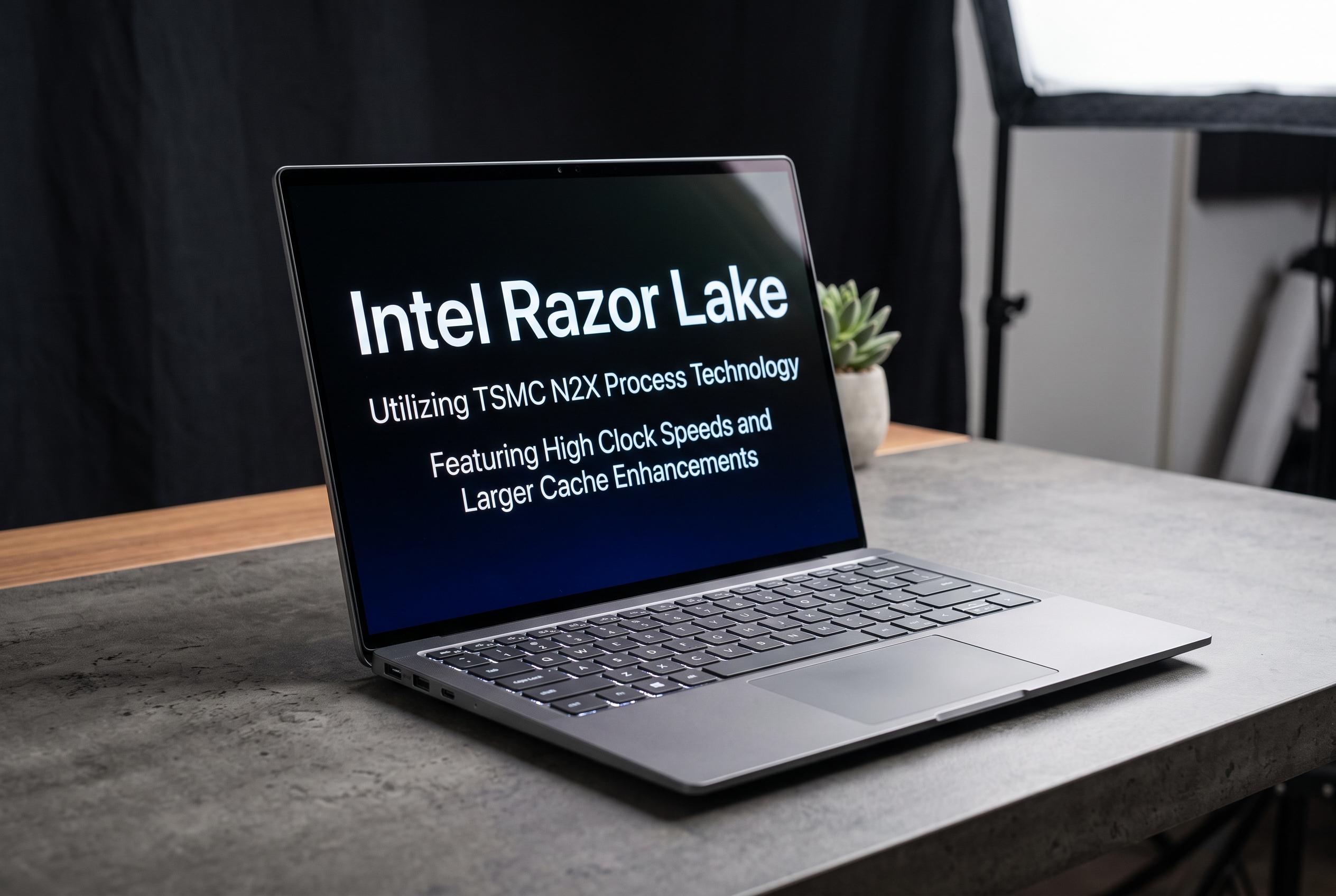

Intel’s upcoming Razor Lake processors are set to leverage TSMC’s advanced N2X technology and introduce significant cache enhancements, signaling a strategic shift towards higher performance for notebooks and desktops in a competitive landscape.
Intel’s next client processors are being lined up around a sharper performance strategy, with the follow-on to Nova Lake said to use TSMC’s N2X manufacturing process and to bring a larger shared cache design to notebooks. According to reporting from Wccftech, the Razor Lake family is still at an early stage, but the leak suggests Intel is aiming for higher clock speeds rather than lower power draw, which would fit a chip designed to push frequency above 6GHz.
That approach would sit alongside Intel’s wider split between process technologies. Tom’s Hardware has reported that Nova Lake is expected to combine TSMC’s N2 with Intel 18A, while Intel’s first 18A products are now being rolled out through the Panther Lake generation. TSMC’s N2X is generally understood to be a higher-frequency variant of N2P, trading some efficiency for more headroom, which helps explain why it is being linked to a later, more aggressive desktop and mobile design.
The cache story is equally notable. Wccftech says Razor Lake would be Intel’s first laptop family to adopt bLLC, or big last-level cache, bringing a design concept closer to AMD’s 3D V-Cache approach on mobile systems. Tom’s Hardware has previously reported that Nova Lake desktop parts are expected to reach 144MB of L3 cache on single-tile designs and up to 288MB on dual-tile versions, with the largest dies also carrying a meaningful increase in manufacturing cost because of TSMC’s advanced node and EUV multipatterning.
If the leak proves accurate, Intel’s roadmap would show a clear progression: Nova Lake for the first broad move to bigger cache and mixed manufacturing, Razor Lake for a higher-frequency N2X derivative, and then Titan Lake as the eventual unification of performance and efficiency cores under a more consolidated design. That would put Intel on a longer competitive path against AMD’s HX3D mobile chips, which already use large cache stacks to improve gaming and latency-sensitive workloads, while also underscoring how much Intel’s next few generations depend on both foundry strategy and cache scaling.
Disclaimer: This content is intended for informational purposes only. Readers are advised to exercise their own judgement, conduct due diligence, or consult a qualified expert before acting on any information provided.