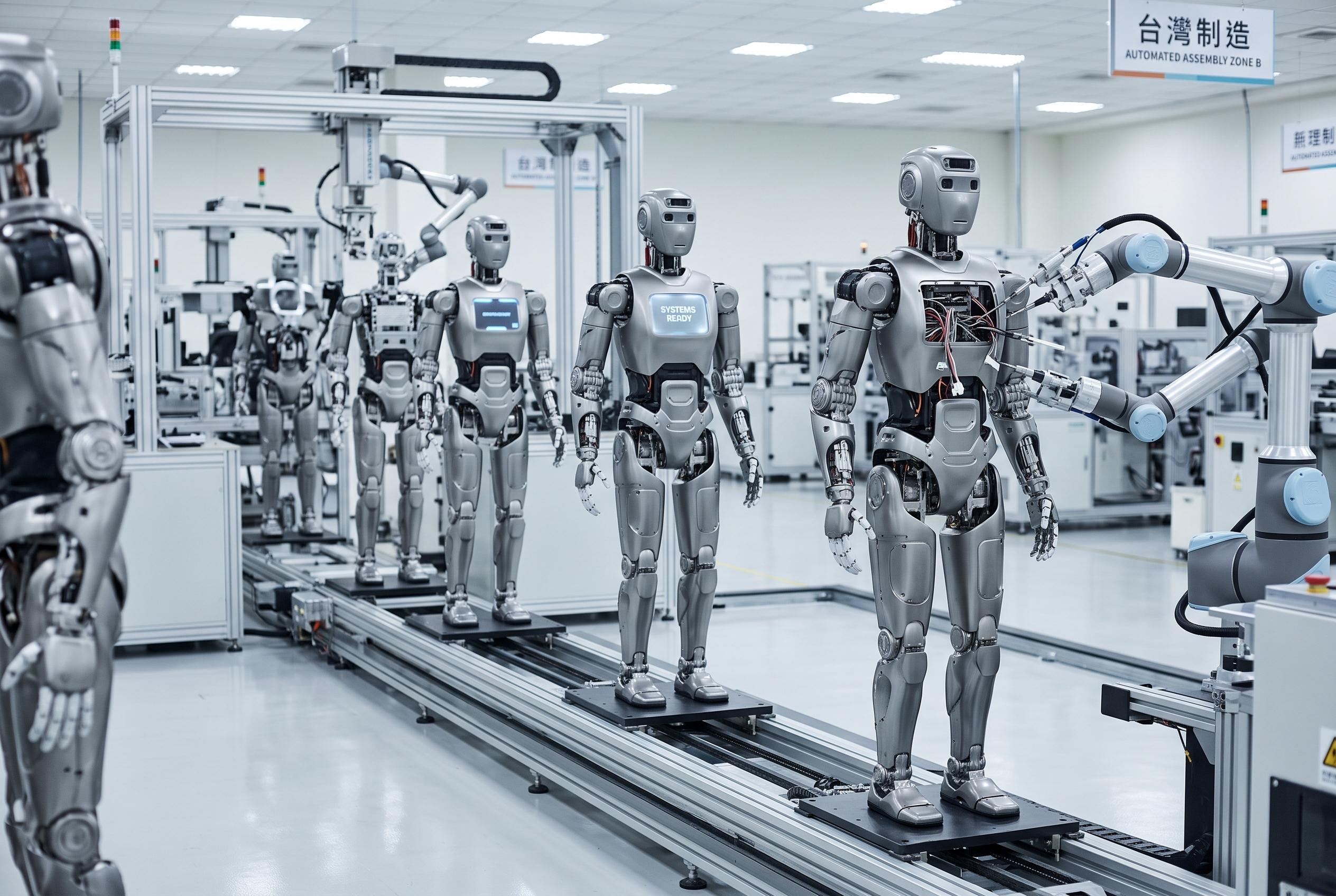

A new report highlights Taiwan’s potential to challenge China’s dominance in humanoid robot manufacturing within a narrow window of opportunity, as democracies race to build independent robotics supply chains amid escalating tech tensions.
Taiwan and other technology democracies have a narrow three-to-five-year period to build the foundations of an advanced robotics supply chain outside China, according to a researcher at the Research Institute for Democracy, Society and Emerging Technology.
The institute’s latest report examines competition between China and the West in physical artificial intelligence, and argues that Taiwan could become an important alternative manufacturing base for humanoid robots and related systems. Nathanael Cheng, a policy analyst at DSET’s Economic Security Programme, said China’s lead in shipment volumes still has limited immediate effect because humanoid robots remain largely unproven in day-to-day use. He described the next few years as a “golden but narrowing” opportunity for democracies to invest in non-China production and deployment.
That warning comes as Chinese companies have taken clear early advantage in the market. Market research cited by DSET suggests Chinese vendors made up 85 per cent of global shipments of humanoid and quadruped robots in 2025, while only about 10 per cent of humanoid robots were being used in real-world applications. Separate reporting earlier this year by Bloomberg and the South China Morning Post said Chinese firms led global humanoid robot shipments in 2025, with AgiBot alone accounting for several thousand units. Smart Analytics Global, which DSET also cites, projects rapid growth in the category through 2030.
DSET says China’s manufacturing depth and deployment scale could help it gather operational data, but it has not yet secured the entire physical AI technology stack. The report says Chinese producers still depend on frontier edge AI chips and simulation software from the United States, along with precision machinery and components from Japan and Europe. Cheng said companies in technology democracies still hold an edge in traditional industrial robotics, where reliability and precision matter most, and noted that the United States imports more than two-thirds of its industrial robots from Germany and Japan.
The report identifies about 180 Taiwanese organisations already involved in, or developing capabilities for, the robotics supply chain. It argues that Taiwan’s strength lies in electronics manufacturing services, a broad ecosystem of precision components and advanced semiconductor production led by Taiwan Semiconductor Manufacturing Co. Cheng said the main constraint is that many US robotics start-ups still do not understand what Taiwan can provide, while many American firms remain too early in the production cycle to trigger large-scale investment. Sunny Cheung, another DSET fellow, said the effort to reduce dependence on China should be phased, beginning with software, sensors, chips, controllers and firmware before moving to lower-risk parts. He added that Taiwanese suppliers need to shift towards other markets as domestic Chinese competition rises.
Disclaimer: This content is intended for informational purposes only. Readers are advised to exercise their own judgement, conduct due diligence, or consult a qualified expert before acting on any information provided.