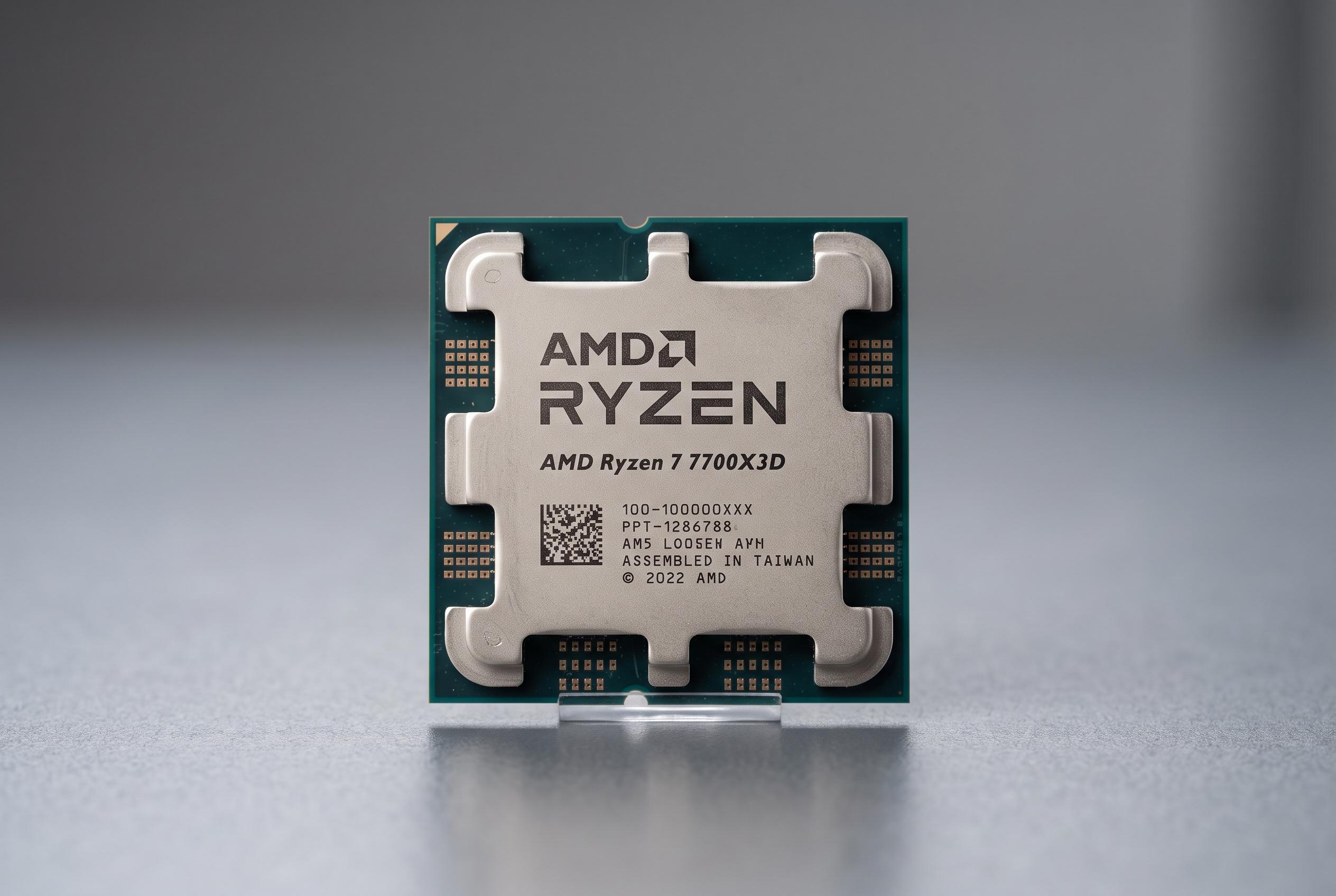

The Ryzen 7 7700X3D offers strong gaming performance but struggles to justify its higher price and lower clock speeds compared to the widely available Ryzen 7 7800X3D and more versatile Intel alternatives, highlighting the challenges for AMD in the competitive gaming CPU space.
AMD’s Ryzen 7 7700X3D is a capable gaming processor, but it arrives in a crowded and awkward part of the market. PC Gamer’s review describes it as almost indistinguishable from the well-regarded Ryzen 7 7800X3D, just with lower clock speeds and a lower official price. The problem is that the older chip is still widely available and is often discounted to roughly the same level, which weakens the case for buying the newer model on its own.
On paper, the two AMD chips are close. Both use the AM5 platform, both have eight cores and 16 threads, and both carry a 120W TDP. The key difference is frequency: the 7700X3D tops out at 4.5GHz, while the 7800X3D reaches 5.0GHz. Tom’s Hardware says that makes the 7800X3D the faster all-round option, although the 7700X3D can be more efficient in some workloads.
In gaming, the newer chip still performs strongly. PC Gamer’s tests put it very close to the 7800X3D and not far behind the newer Ryzen 7 9800X3D in several titles. The benefit of AMD’s 3D V-Cache remains clear in cache-sensitive games, where the 7700X3D easily outpaces the non-X3D Ryzen 7 7700X despite the latter’s higher clock speeds.
That said, this is not a particularly balanced processor for broader use. PC Gamer found that the 7700X3D trails the 7800X3D and Intel’s Core Ultra 5 250K Plus in general compute work, especially rendering, compression and video encoding. The Intel chip, which PC Gamer reviewed at $199, has 18 cores and is framed as a more rounded alternative for users who want strong gaming performance without sacrificing productivity. NanoReview’s comparison also points to Intel’s advantage in single-core performance and memory support, although AMD retains the larger cache.
Thermals and power draw are a stronger part of the 7700X3D’s story. PC Gamer reports relatively modest temperatures in sustained gaming tests and notably lower package power than the standard Ryzen 7 7700X. That efficiency may matter in compact builds or quieter systems, and it also helps explain why full pre-built systems using the chip could be priced attractively. Even so, for most do-it-yourself buyers, the older 7800X3D remains the cleaner purchase unless the 7700X3D appears in a heavily discounted bundle.
Disclaimer: This content is intended for informational purposes only. Readers are advised to exercise their own judgement, conduct due diligence, or consult a qualified expert before acting on any information provided.