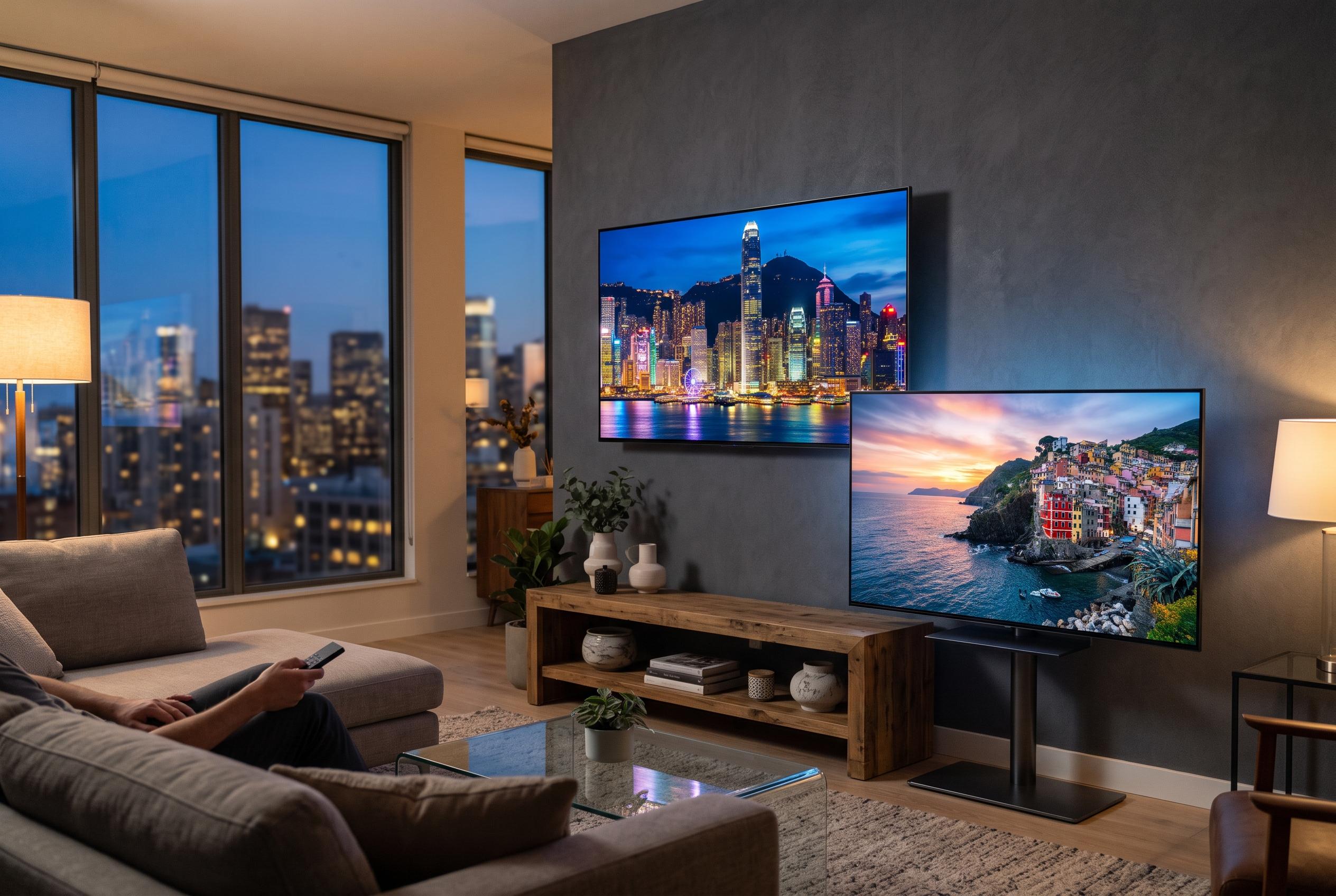

TCL’s latest Mini-LED pairing highlights rapid advances in its Super Quantum Dot technology, with the QM8L delivering premium brightness and picture quality, while the more affordable QM7L offers solid performance for budget-conscious buyers.
TCL’s latest Mini-LED pair shows how quickly the company is pushing its SQD, or Super Quantum Dot, platform up the market. The QM8L is the more ambitious set, with a brighter backlight system and a fuller HDMI 2.1 package, while the QM7L aims at buyers who want much of the same core technology for less money. Both run Google TV, both support Dolby Vision, HDR10+ and 144Hz gaming, and both are clearly positioned as high-brightness alternatives to OLED for living rooms with more ambient light.
On paper, the main separation is practical rather than dramatic. Tom’s Guide notes that the QM8L is sold in 65-, 75-, 85- and 98-inch sizes, whereas the QM7L adds a 55-inch model that broadens its appeal for smaller rooms. The QM8L also includes four HDMI 2.1 ports, giving it more flexibility for modern consoles and high-end gaming PCs. By contrast, the QM7L has only two HDMI 2.1 inputs, although its eARC connection does not overlap with those faster ports.
That port count matters less than the measured performance gap. In Tom’s Guide testing, the QM8L delivered higher peak HDR brightness and stronger backlight control, which translated into a more forceful image with better handling of small highlights and less visible haloing. The QM7L remained competitive on colour and low input lag, but it could not match the QM8L’s ability to make HDR material look more vivid and cinematic. RTINGS also places both sets in TCL’s 2026 line-up as SQD Mini-LED models with WHVA 2.0 panels, but it describes the QM8L as the more fully specified premium option.
Design is closer to a draw. Tom’s Guide found that both sets use a similar pedestal stand and a relatively chunky chassis, reflecting the demands of Mini-LED hardware rather than ultra-thin styling. Both also ship with backlit remotes and two-height stand configurations, which should help anyone using a soundbar. In smart-TV use, the pair is much the same: Google TV, broad app support and the usual TCL gaming tools, including variable refresh rate and AMD FreeSync Premium Pro.
The final choice comes down to value. Tom’s Guide says the 65-inch QM8L had fallen to $1,399 at the time of writing, down from $2,499, while the 65-inch QM7L was available for $1,199, down from $1,499. That £200-equivalent gap makes the mid-range model easier to recommend for most buyers, especially because the QM7L can also be bought in 55 inches. Yet the QM8L remains the better television overall: brighter, more controlled and better equipped for demanding use. For shoppers who want the strongest picture TCL offers short of its flagship tier, the QM8L is the clear step-up. For everyone else, the QM7L looks like the more sensible purchase.
Disclaimer: This content is intended for informational purposes only. Readers are advised to exercise their own judgement, conduct due diligence, or consult a qualified expert before acting on any information provided.