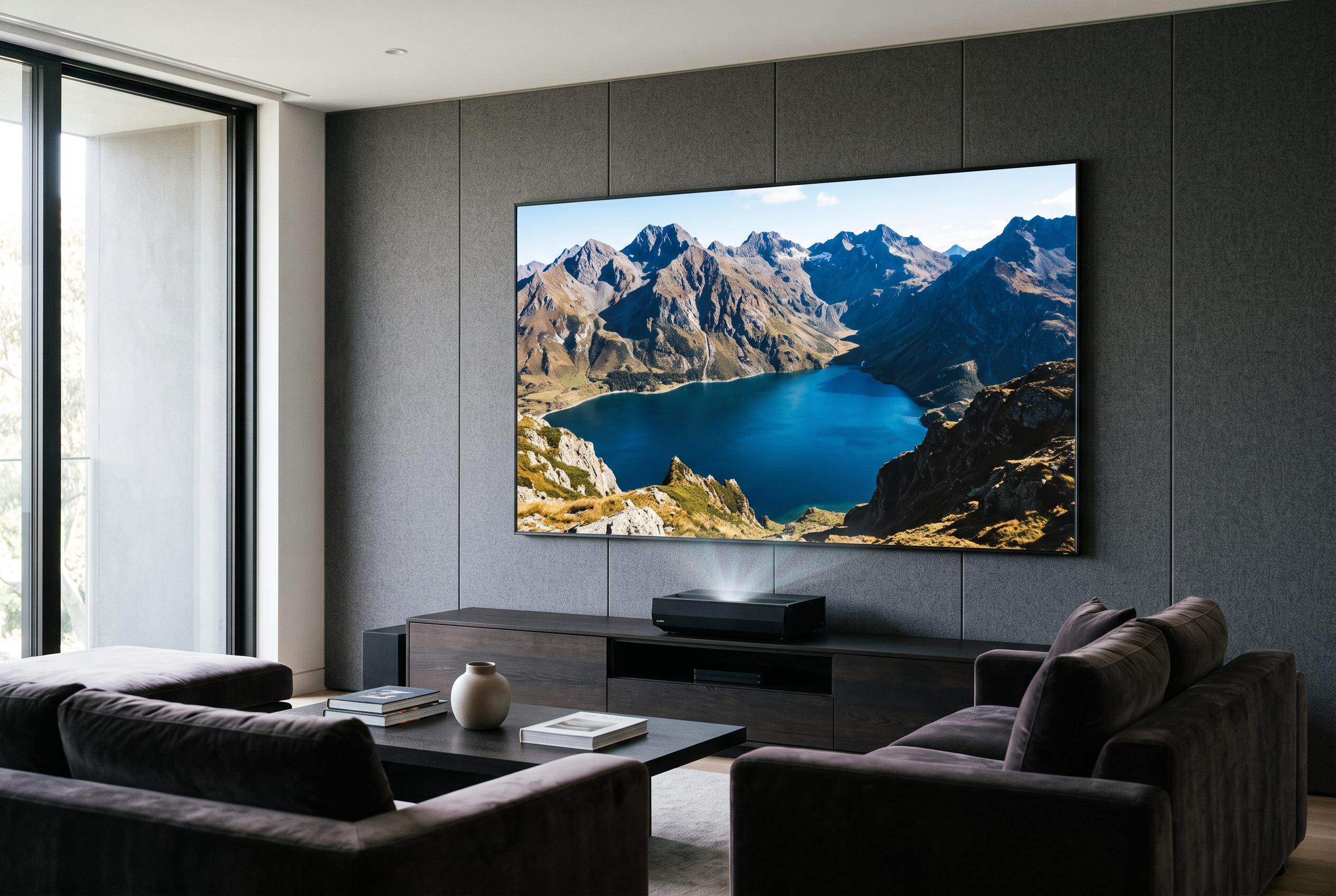

As ALR projector screens transition from niche accessories to essential home cinema gear, selecting the optimal surface requires understanding the projector type and room lighting conditions. Recent tests highlight the importance of tailored solutions for ultra-short throw and long-throw models to ensure optimal brightness, clarity, and flexibility.
ALR projector screens have moved from niche accessories to essential kit for anyone using a projector in a room that cannot be fully darkened. In tests across eight screens, the clearest divide was not price alone, but projector type: ultra-short throw models need screens built for steep upward light, while standard long-throw projectors work best with different optical structures. That distinction matters because the wrong pairing can leave the image dim, distorted or both.
The strongest long-throw option in the group was the Valerion 120-inch Fresnel screen. B&H Photo Video describes it as an eight-layer design with 85% light rejection, neutral colour temperature and 1.8 gain, while Best Buy says it is built specifically for long-throw projectors and supports up to 8K resolution. The appeal is straightforward: it preserves more brightness than most ALR surfaces, making it a serious choice for daylight viewing without forcing the projector to run at full power.
For ultra-short throw owners, the NothingProjector Black Series 120 inch stood out for value. NothingProjector says it offers 95% ambient light rejection, a 170-degree viewing angle and a fixed-frame surface designed to stay flat and tensioned. Frandroid also notes that the brand now sells a motorised floor-rising version, which broadens its appeal in multi-use living rooms where a permanent wall installation is not practical. In practice, that makes the Black Series one of the more versatile UST-focused options for buyers balancing performance and room design.
Elite Screens remains the most established name in the category, and its Aeon CLR line continues to target buyers who want a larger-screen living room setup with a cleaner finish. The company’s Aeon CLR models are known for slim bezels and wide viewing angles, while the broader CineGrey 3D line serves standard-throw projector owners who want colour accuracy and ambient-light control without moving to a UST-only screen. That split is useful, because it reflects the real market: there is no single ALR solution that fits every projector or seating layout.
For buyers on tighter budgets, the main compromise is usually not image quality but convenience and flexibility. Portable ALR screens can be useful for outdoor films or temporary setups, but they generally cannot match the contrast, stability or light rejection of fixed-frame models. The clearest buying rule is to match the screen to the projector first, then decide how much viewing angle, brightness and installation effort you are willing to trade for better performance in a lit room.
Disclaimer: This content is intended for informational purposes only. Readers are advised to exercise their own judgement, conduct due diligence, or consult a qualified expert before acting on any information provided.