
Owners in Malaysia are advised to select wallboxes that match their electrical supply and vehicle capacity, emphasising practical, cost-effective solutions over high-power chargers for their Tesla Model Y, with installation considerations crucial for apartments and condominiums.
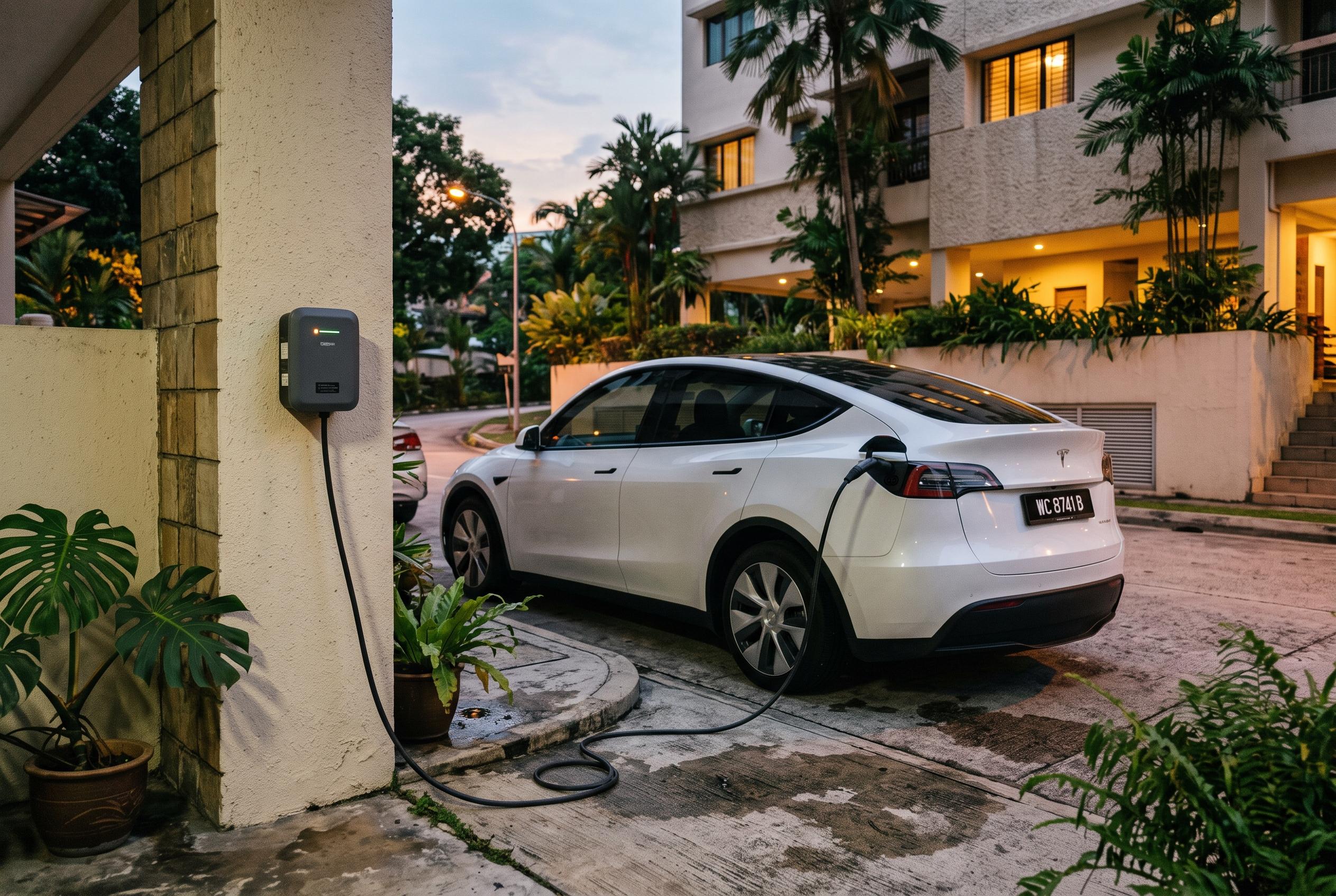
For Malaysian owners of the Tesla Model Y, the most practical home charging solution is usually a 7.4kW single-phase wallbox for terrace homes and other properties with single-phase supply, or an 11kW three-phase wallbox where three-phase power is already available. Tesla’s own support material in Malaysia confirms that home charging can be set up with a suitable wall connector or compatible equipment, and that the car can be charged through standard AC home infrastructure rather than a Tesla-only system.
The key technical point is that the Model Y’s AC charging limit is 11kW, so a wallbox rated above that does not make the car charge faster on AC power. Independent charging references for the Model Y list an 11kW onboard AC charger, which means a three-phase unit can only help up to that ceiling. For most owners, the extra cost of a higher-rated charger is therefore about flexibility and future-proofing, not immediate speed.
That makes installation choice more important than charger branding. Tesla says its home charging products are compatible with all electric vehicles, while Malaysian EV guides from EV Sifu, Malaysia4u and SuperHomes all point to the same principle: select the charger to match the property’s electrical supply and the car’s onboard AC capacity. In practical terms, a 7kW to 7.4kW single-phase wallbox is sufficient for an overnight refill for many drivers, while a three-phase installation is most useful for heavier daily mileage or for households planning to change vehicles later.
Cost is another reason the simpler setup often makes sense. The article’s estimates put a full home charge at roughly RM33 to RM36, depending on variant and consumption, with overnight charging restoring the battery before morning. Those figures are broadly consistent with Malaysian tariff-based home charging calculations, although actual bills will vary with household usage, tariff adjustments and driving efficiency. For routine use, the article also warns against relying on a standard three-pin socket except as an emergency measure, because it is far slower and less suitable for daily full charges.
For apartment and condominium owners, the hardware decision is only one part of the job. Tesla’s Malaysian support notes that apartment charging is possible, but installation may depend on building rules, approval processes and, in some cases, the need for proper three-phase wiring certification. Malaysian installation guides similarly stress JMB approval, compliant wiring and a licensed installer, especially where sub-metering or shared parking bays are involved. The overall message is straightforward: for a Tesla Model Y in Malaysia, a compliant Type 2 wallbox matched to the property supply is usually enough, and the strongest home-charging choice is not the most powerful charger, but the one that fits the site properly.
Disclaimer: This content is intended for informational purposes only. Readers are advised to exercise their own judgement, conduct due diligence, or consult a qualified expert before acting on any information provided.