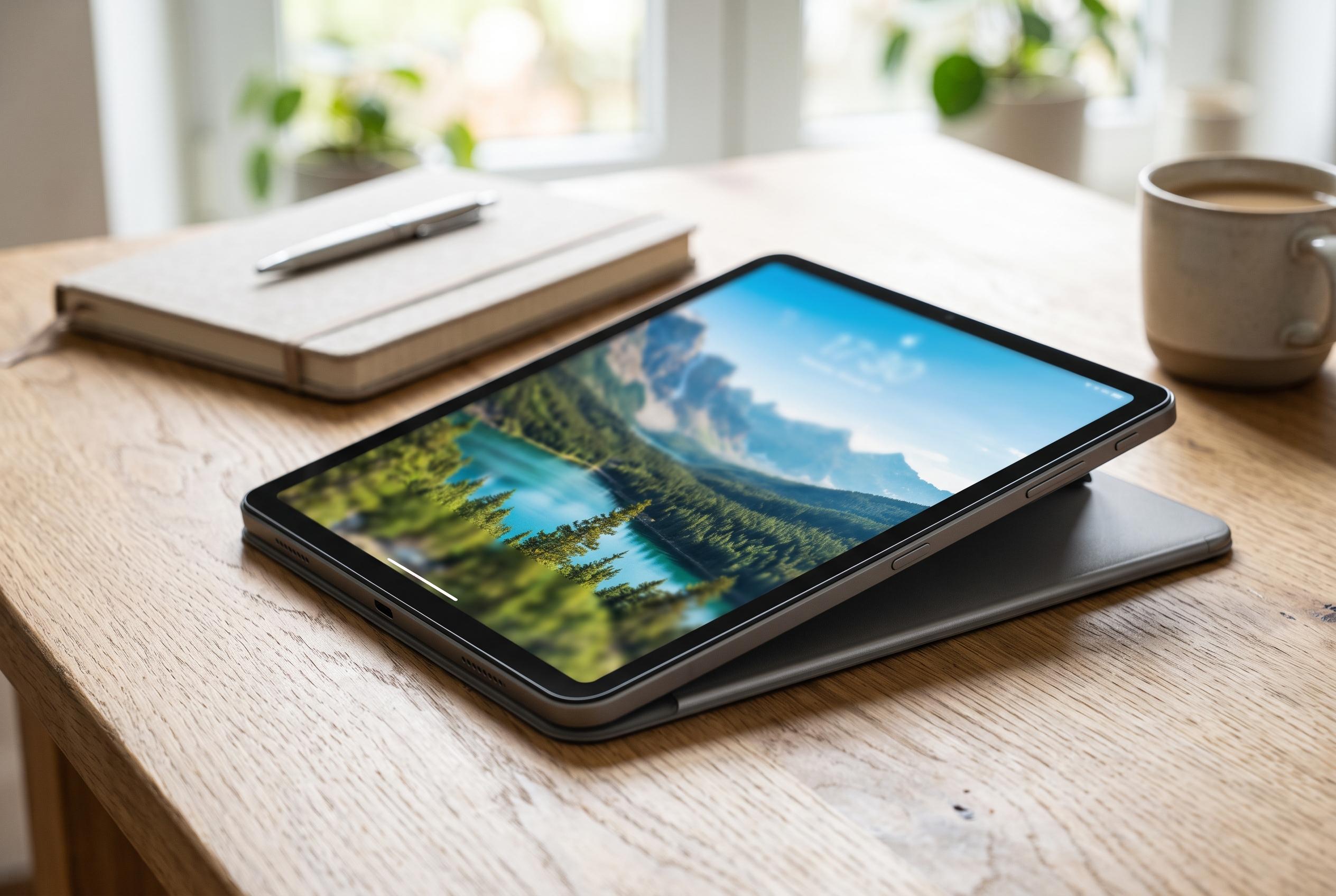

In 2026, the best budget tablets offer practical performance with models from Samsung, Xiaomi, Vaio, Lenovo and Positivo, focusing on battery life, screen quality, and basic connectivity rather than high-end specs.
For buyers looking for an inexpensive tablet in 2026, the best options are defined less by premium features than by practical balance. The Tecnoblog selection focuses on models that can handle reading, video streaming, note-taking, web browsing and light gaming without pushing the budget too far. It places Samsung, Xiaomi, Vaio, Lenovo and Positivo side by side, with the Galaxy Tab A11+ 5G positioned as the most rounded choice for general use. According to Tecnoblog, it combines 6 GB of RAM, a MediaTek Dimensity 7300 chip and a 90 Hz 11-inch display, while also offering 5G and IP52 protection.
That makes the Tab A11+ 5G the clearest all-rounder in the group, especially for students and commuters who want steadier performance and mobile data support. The device is described as capable of smooth streaming and everyday browsing, with a 7,040 mAh battery rated for up to 15 hours of video playback. Camera hardware is modest but functional, with 5 MP front and 8 MP rear sensors that record in Full HD at 30 frames per second. Independent comparison pages broadly confirm the tablet’s 11-inch 90 Hz panel and Dimensity 7300 platform, while also noting 128 GB of storage and 25 W charging.
Among the cheaper alternatives, the Xiaomi Redmi Pad 2 offers a different emphasis. It uses a MediaTek Helio G100-Ultra chip and is available with either 4 GB or 8 GB of RAM, plus up to 256 GB of storage. Tecnoblog says it is best suited to email, social media and streaming rather than heavier workloads, but its 9,000 mAh battery is a major advantage, with the site citing up to 19 hours of continuous video playback. Comparison material also shows a sharper 1600 x 2560 display and confirms the 90 Hz refresh rate, making it a strong value choice for media consumption.
Samsung’s smaller Galaxy Tab A11 is the more basic sibling in the line-up. With a Helio G99 processor, 4 GB of RAM and just 64 GB of storage, it is aimed squarely at light use. The 8.7-inch screen still runs at 90 Hz, which helps it feel smoother than many entry-level tablets, but the reduced capacity limits its appeal for heavier multitasking. Tecnoblog also points to 5,100 mAh battery capacity and stereo speakers with Dolby Atmos, making it a compact option for simple entertainment.
Xiaomi’s Redmi Pad SE sits in a similar budget bracket but is better positioned for study and streaming. Tecnoblog recommends the higher-memory versions, because the base 4 GB model is more likely to feel constrained when several apps are open. The tablet pairs a Snapdragon 680 with an 11-inch Full HD+ display at up to 90 Hz, plus an 8,000 mAh battery and four speakers with Dolby Atmos support. For readers who value battery life and a large screen over raw speed, it remains one of the more sensible low-cost options.
The Vaio TL 10, Lenovo Tab and Lenovo Tab K11 cover the middle ground. The Vaio model offers 8 GB of RAM, a Unisoc T616 chip, 4G support and a 10.4-inch 2K screen, but its 60 Hz refresh rate makes it less fluid than rivals with faster panels. The standard Lenovo Tab is even more basic, with a Helio G85 processor, 4 GB of RAM and a 60 Hz Full HD display, although it does include a 4G variant, stereo audio and 15 W charging. The Tab K11 improves the formula with a 90 Hz panel, a larger 7,040 mAh battery, 20 W charging and IP52 protection, which is why Tecnoblog identifies it as the most suitable option for children.
Positivo’s Vision Tab 11 is the most accessory-rich model in the list. Tecnoblog says it combines a Unisoc T606 processor with 4 GB or 8 GB of RAM, a 6,000 mAh battery, stereo speakers and 4G support. The package also includes a keyboard cover and stylus, which may make it attractive for basic schoolwork or note-taking. Its 11-inch Full HD screen is limited to 60 Hz, so it is not the smoothest option, but the bundled extras help offset its modest performance.
When choosing a cheap tablet in 2026, the key trade-off is clear: better processors, more RAM and higher refresh-rate screens usually cost more, but they also reduce lag and make the device more pleasant to use. Tecnoblog’s guidance is straightforward: look at build quality, battery life, screen quality, storage and mobile connectivity before deciding. For most buyers, 6 GB of RAM is a reasonable minimum, while 8 GB or more is preferable if multitasking matters. If the tablet will travel often, 4G or 5G support may be worth the premium; if it will stay at home, a larger battery and faster charging may matter more.
Disclaimer: This content is intended for informational purposes only. Readers are advised to exercise their own judgement, conduct due diligence, or consult a qualified expert before acting on any information provided.