
The market for smart window air conditioners is expanding with models offering app control, voice support, and inverter technology, focusing on energy efficiency and user convenience for small rooms.
Smart window air conditioners are moving beyond basic cooling, with app control, voice-assistant support and inverter-driven efficiency now common in higher-end models. BGR’s roundup points to a market aimed largely at small rooms, typically around 6,000 BTU, which is usually enough for a home office or compact bedroom. It also notes that many units can now be controlled remotely through dedicated apps and integrated with Amazon Alexa or Google Home, while some are promoted as energy-saving options.
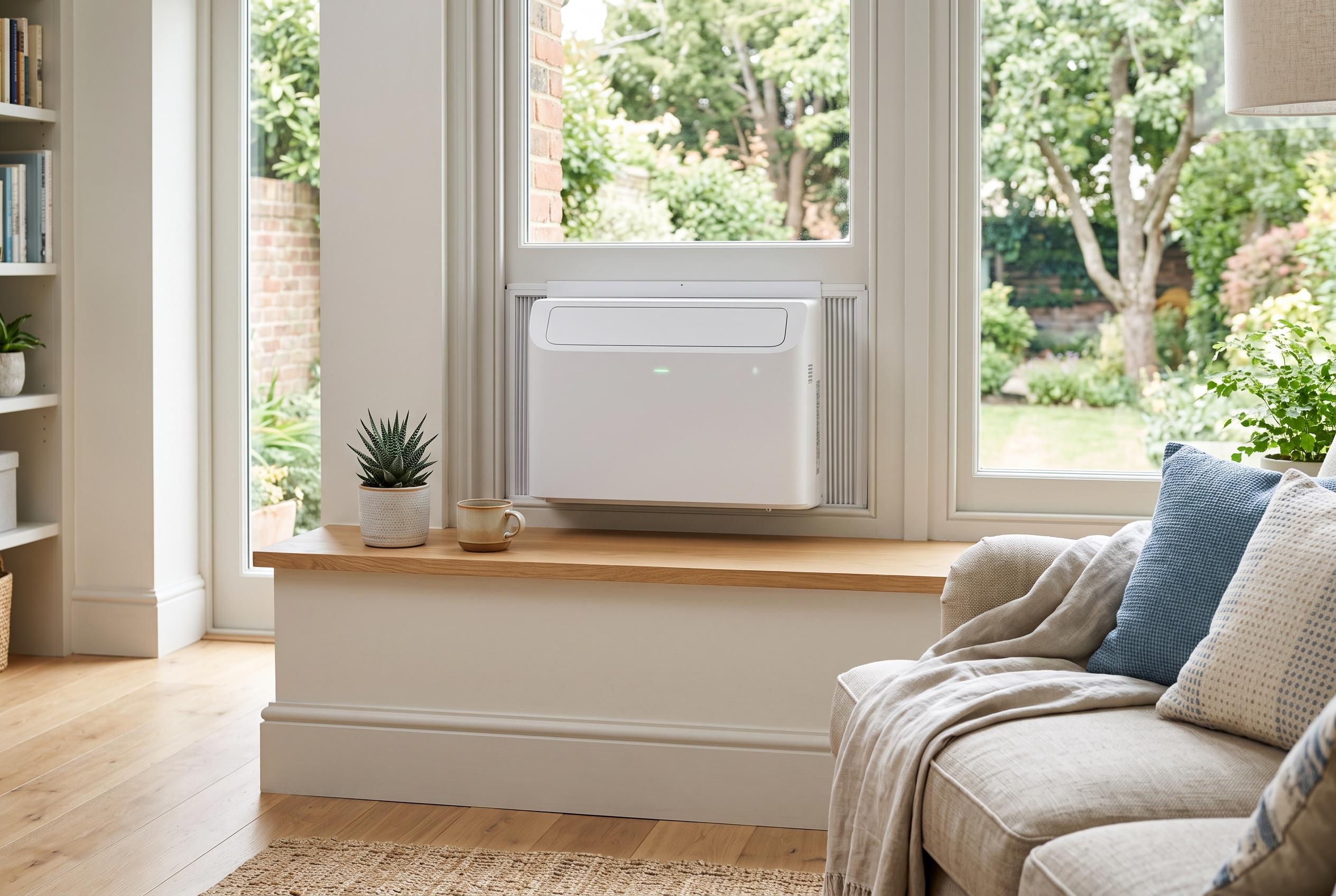
Among the most distinctive designs is the Zafro Auro Window Air Conditioner, which Tom’s Guide says uses a U-shaped format that sits on the windowsill rather than blocking the whole opening. That layout improves visibility and insulation, and the publication reported that the model cooled a 315 sq ft room in 25 minutes during testing. It also recorded a CEER rating of 15.1 and power use as low as 250.8 watts in Eco mode, although the unit was noisier at higher settings and required manual drainage of condensation.
Tom’s Guide also singled out the Hisense AW0822TW1W for quiet operation, crediting its inverter technology with making it one of the more discreet smart window units on test. The review said it remained efficient, again drawing as little as 250.8 watts in Eco mode, and was straightforward to install in roughly 20 minutes. The trade-off was a more conventional baffle design and an app interface described as plain rather than polished.
A broader 2026 guide from Talk of the House places the Midea U Inverter Window Air Conditioner at the top of the category, citing strong energy efficiency, reduced noise and the same U-shaped approach that helps with installation and insulation. It also highlights the LG Dual Inverter for larger rooms, the Windmill unit for style and compact spaces, and the TCL Smart Inverter for its wider smart-home compatibility, including Matter support. The guide says smart controllers such as Sensibo and Cielo can also add app-based control to conventional air conditioners, broadening the market beyond purpose-built smart models.
For buyers, the practical question is still room size. PickHVAC recommends matching BTU output to the space, with 6,000 BTU units for small rooms and 12,000 BTU models for larger areas. It also points to Midea’s 12,000 BTU U-shaped model for bigger rooms, while other buying guides stress that inverter technology tends to be quieter and more efficient than older compressor designs. In that sense, the category is becoming less about novelty and more about whether the unit can deliver comfort, low noise and remote control without wasting power.
Disclaimer: This content is intended for informational purposes only. Readers are advised to exercise their own judgement, conduct due diligence, or consult a qualified expert before acting on any information provided.