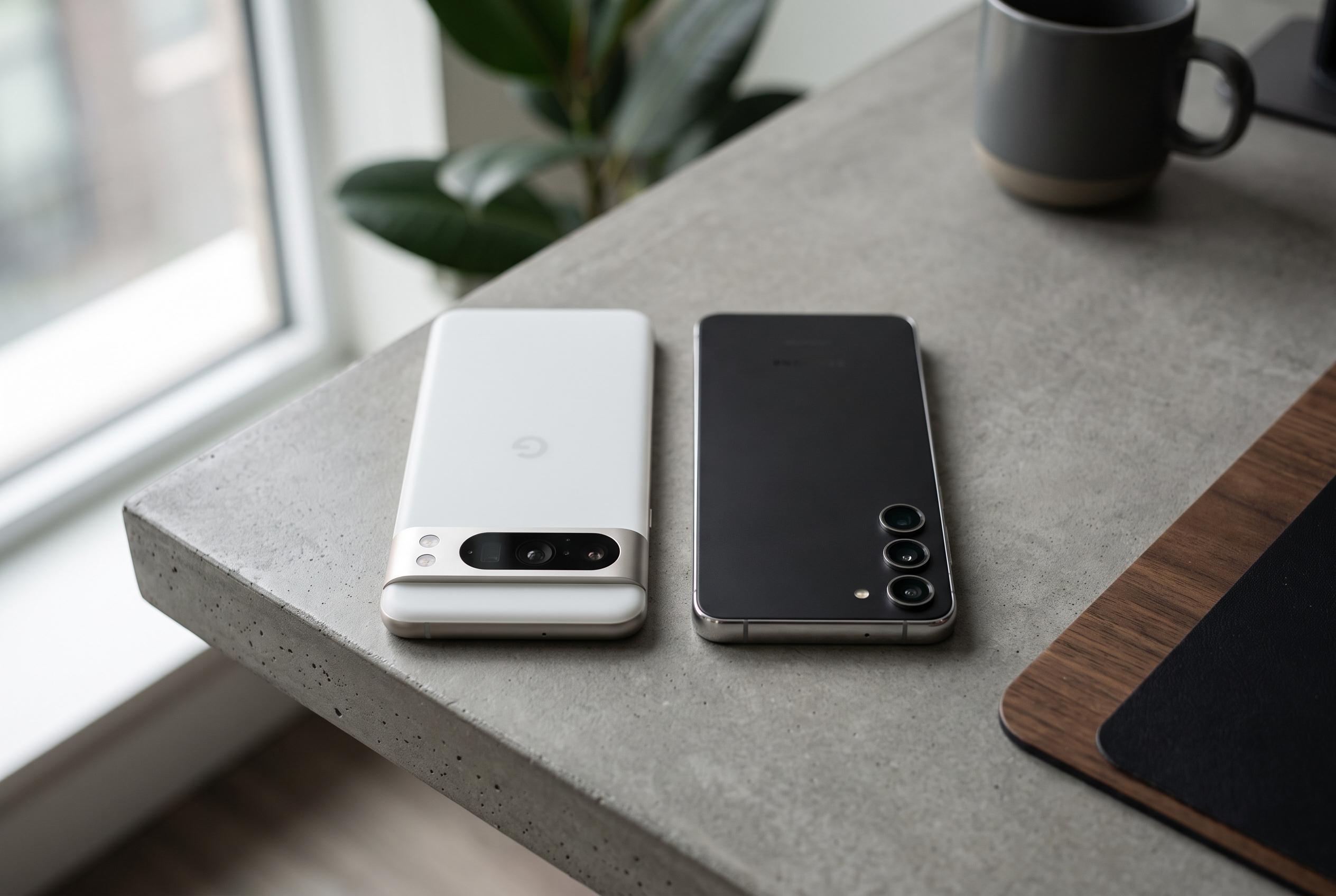

The newly launched Google Pixel 11 and Samsung Galaxy S26 are going head-to-head in India, highlighting distinct strengths in hardware, software, and AI capabilities, with consumers facing a nuanced choice between performance and imaging excellence.
The Google Pixel 11 and Samsung Galaxy S26 arrive as unusually close rivals on price, yet they are built around different priorities. In India, the two sit within a narrow band of each other at launch, both offer 12GB of RAM, 256GB of base storage and seven years of support, and both use 6.3-inch displays. But the comparison stops being neat once the details are examined: Samsung has focused on speed and size, while Google has leaned into imaging, battery capacity and a deeper AI layer branded Gemini Intelligence. According to the comparison coverage, that makes the choice less about raw specifications than about which strengths matter most in everyday use.
Samsung’s strongest case is performance and ergonomics. The Galaxy S26 is thinner and lighter than the Pixel 11, which makes it easier to use one-handed and less noticeable in a pocket. Benchmarks cited by comparison sites also put Samsung’s chip ahead of Google’s Tensor platform, especially in sustained graphics work and gaming, although the precise result depends on which regional variant is being tested. The Indian model uses Exynos silicon rather than Qualcomm’s chip, so performance claims based on the Snapdragon version should be read cautiously. Even so, the broad picture is consistent: the S26 is the faster phone.
Display behaviour also favours Samsung. Both phones use 6.3-inch 120Hz panels, but the Galaxy’s LTPO screen can scale refresh rates down more efficiently, which should help reduce idle power use. Samsung also keeps a tighter hardware package around the panel, adding features such as a privacy display option on higher-end models and pairing the screen with Wi-Fi 7 support in markets where that matters. The Pixel 11’s display is still high-end, but Samsung’s implementation is the more flexible one.
Google counters with battery life and charging. The Pixel 11 carries a larger 4,985mAh battery, and the reported charging figures are stronger both over cable and wirelessly. By contrast, the Galaxy S26 uses a smaller 4,300mAh cell and slower charging on paper, although Samsung’s efficiency appears to offset some of that disadvantage in testing. The practical conclusion is straightforward: Google gives the Pixel more endurance headroom, while Samsung delivers respectable real-world stamina from a smaller battery.
The camera split is clearer still. Google fits a 5x telephoto lens, which gives it a real advantage in long-range shooting and makes the Pixel more useful for stage, travel and candid photography from distance. Samsung’s 3x telephoto is more modest, though arguably more useful for standard portraits. Google also has the larger main sensor and a stronger ultrawide setup, while Samsung’s camera hardware is more conservative and its ultrawide still lacks autofocus. In ordinary daylight snaps, the two are close; at the edges of zoom and in lower light, the Pixel has the better hardware basis.
Software is where the philosophies diverge most sharply. Samsung’s One UI continues to offer desktop-style DeX, deeper multitasking, Secure Folder and the Good Lock customisation suite, which makes the Galaxy feel more configurable and more suited to power users. Google’s approach is cleaner and more integrated, with Pixel features tied directly into Android 17 and Gemini Intelligence. That includes system-level translation, call handling and camera-adjacent AI tools that are meant to feel less like separate apps and more like part of the operating system.
AI is also where the two companies reveal different ideas of value. Samsung’s Galaxy AI tools are presented as clear, optional features, and the company has said core functions will remain free. Google’s Gemini Intelligence is more ambient and more aggressive, aiming to surface suggestions, improve transcription and automate parts of camera and search behaviour without much user effort. In practice, Samsung’s system is more predictable, while Google’s is more ambitious. For most buyers, the useful parts remain the mundane ones: translation, transcription and call assistance.
For buyers in India, the wider ownership experience may matter as much as the hardware. Samsung still has the stronger retail, accessory and after-sales footprint, and that reduces friction if a device needs servicing or replacing. Google offers newer software on day one and built-in magnetic accessory support, but its service reach is narrower. That means the Pixel 11 may be the more interesting device, yet the Galaxy S26 is often the safer purchase for buyers who want convenience and local support.
Taken together, the decision is not about which phone is better in the abstract. The Galaxy S26 is the stronger all-round engineered object: quicker, lighter and more adaptable. The Pixel 11 is the more specialised tool: better for photography, stronger on battery, and more deeply tied into Google’s AI plans. For most people, Samsung offers the lower-risk buy. For those who care most about imaging and software intelligence, Google has the sharper proposition.
Disclaimer: This content is intended for informational purposes only. Readers are advised to exercise their own judgement, conduct due diligence, or consult a qualified expert before acting on any information provided.