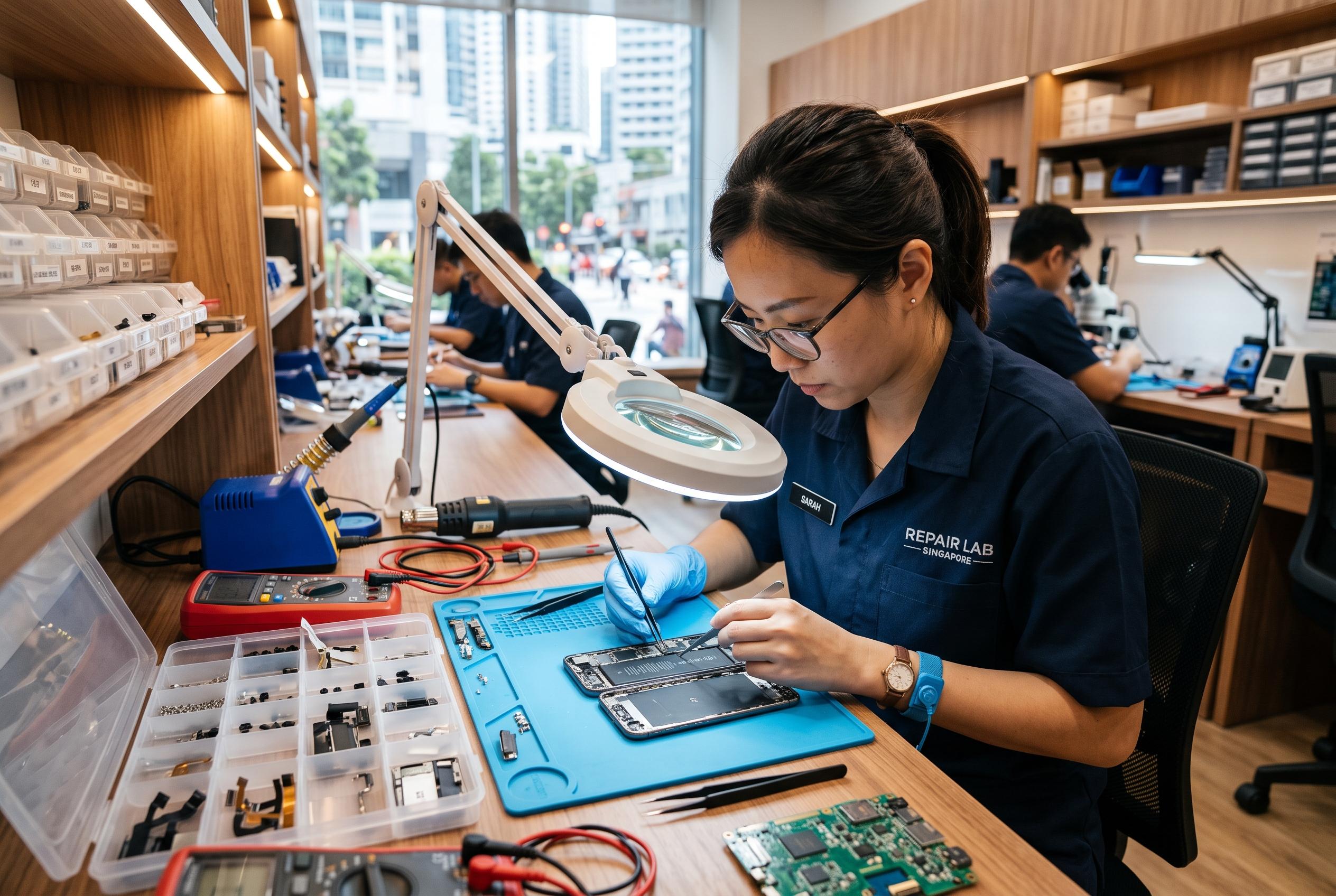

Choosing the right repair shop in Singapore involves assessing diagnosis accuracy, parts quality, transparent pricing, data security, warranty clarity, and customer reviews, with a focus on trustworthiness over speed or cost.
A cracked screen, a fading battery or a charging fault can quickly turn a phone into a costly interruption. In Singapore, where a handset may also hold payment apps, authentication tools, navigation and work access, the choice of repair shop matters as much as the repair itself. The strongest providers are not simply the fastest or the cheapest; they are the ones that can explain the fault, state the part being used, give a firm price, protect personal data and back the work with a clear warranty.
The first test is diagnosis. A credible technician should identify the problem before suggesting a replacement. That matters because the same symptom can have several causes: a charging issue may be the port, battery, cable connection or logic board; a dark screen may be the panel, connector or power system. Shops with real technical depth can separate those possibilities, rather than treating every fault as a parts swap. MacInfinity’s Singapore guidance on Apple repairs makes the same point, stressing that technical competence is more valuable than a quick sales pitch.
Parts quality is the next issue. In Singapore’s repair market, terms such as original, OEM and aftermarket are often used loosely, so customers should ask exactly what grade of part is being fitted and what that means for brightness, touch response, battery life and reliability. Apple-certified service providers and Independent Repair Providers are the most straightforward option for Apple devices because Apple says they have access to genuine parts, tools and diagnostics under defined conditions. Non-certified shops can still do good work, but the customer should ask more questions.
Price should be fixed before work begins. A proper quote should cover labour, parts, tax and any diagnostic charge, with no surprise additions once the device is opened. That is especially important for liquid damage or motherboard faults, where a shop may need to inspect the phone before knowing the full scope of work. Clear pricing is one of the most repeated signals in Singapore repair guides, including advice from MacInfinity, Soup.io and Ur Phone Store.
Data handling is another practical test. Many hardware repairs do not require a full passcode handover or a factory reset, so the shop should be able to explain why access is needed and what testing will be done. Customers should back up their data first, sign out of sensitive accounts where possible and avoid giving broader access than necessary. Trusted repair businesses will describe their process plainly rather than dismissing the issue with vague assurances.
A written warranty matters just as much as the repair. It should say how long coverage lasts, what it includes, what would void it and whether labour is covered as well as the part. The best shops make the process simple if a fault reappears. That is one reason recent Singapore reviews place value on after-sales support rather than only on turnaround time or low prices.
Turnaround claims also deserve scrutiny. Same-day work is realistic for many screen, battery and charging-port jobs when stock is available. It is far less plausible for liquid damage, intermittent faults or board-level repair, where diagnosis is part of the task. LYK Repair’s Singapore profile, for example, highlights doorstep and same-day services, but convenience should still be weighed against the complexity of the fault and the quality of the part being used.
Reviews are useful only when they are specific. Look for comments that mention the device model, the defect, whether the quote was honoured, how long the job took and whether the phone worked properly afterwards. A strong rating with thin detail is less persuasive than a smaller number of detailed, recent repair experiences. The best signs are consistency and practical evidence, not generic praise.
For Apple users in particular, certification and verification are worth checking directly. Apple says customers can confirm authorised or independent providers through its own verification tools, which is more reliable than a shop logo or a verbal claim. For Singapore consumers, that should be combined with local accountability signals such as registered business details, a physical location and visible warranty terms. Citri Mobile’s Singapore comparison guide also shows how much weight local buyers place on published pricing, location and review patterns, although any such ranking should be treated as one reference point rather than a final verdict.
Repair is often the better environmental choice when the device is otherwise sound. Singapore’s National Environment Agency advises repairing electronics where feasible, reusing working items and recycling only when a device has reached the end of its useful life. That logic is strongest when the phone has one clear fault, such as a cracked display or weak battery, and weaker when several expensive problems are present. In those cases, a sensible repair shop should be honest enough to say replacement may be the better option.
Disclaimer: This content is intended for informational purposes only. Readers are advised to exercise their own judgement, conduct due diligence, or consult a qualified expert before acting on any information provided.