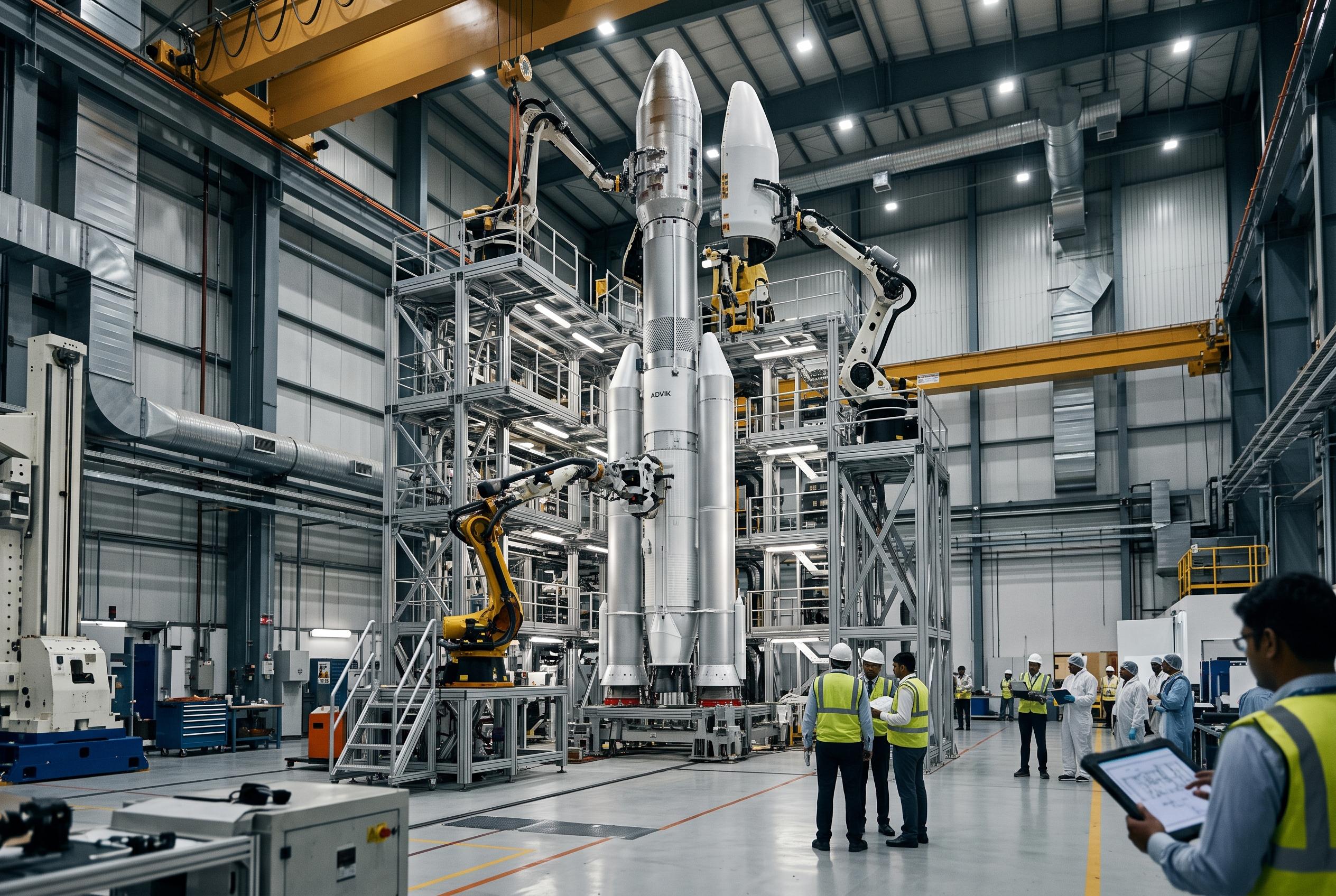

India is transitioning its space launch vehicle production from ISRO to private industry, signalling a profound shift toward a decentralised and commercialised space economy, with plans for industry-led manufacturing and expanded private participation by 2027.
India’s space programme is moving towards a quieter but more structural change: the routine building of rockets is set to shift away from ISRO and into the hands of industry. According to remarks attributed to IN-SPACe chairman Pawan Goenka, the agency’s long-term role is likely to narrow to research, advanced systems and mission-critical infrastructure, while private firms and some public-sector units take on production of mature launch vehicles. The direction of travel is already clear in the transfer of the Small Satellite Launch Vehicle to Hindustan Aeronautics Limited.
That handover is more than symbolic. Reports say the SSLV is now the first Indian launcher to enter an industry-led manufacturing model, with HAL expected to carry the work forward after winning the rights through a competitive process. Beats in Brief also reported that HAL’s first SSLV launch is expected in September 2027, suggesting the transition is not merely policy language but an operational change with a timetable.
The next tests are larger and more sensitive. The Polar Satellite Launch Vehicle, long one of India’s most dependable workhorses, is widely expected to be the next candidate for private-sector production. Launch Vehicle Mark-3, India’s heaviest operational launcher, is also being positioned for greater industry involvement. Moving those systems out of routine ISRO manufacture would mark a far more substantial shift than the SSLV transfer, because both rockets sit at the centre of India’s launch capability.
The logic behind the change is straightforward. ISRO has a broad remit, from planetary science and human spaceflight to Earth observation, navigation and next-generation propulsion. If the organisation is no longer tied up in repeating mature manufacturing cycles, it can devote more time to research and to technologies that remain too experimental, expensive or strategically important for commercial firms to develop alone. Industry can then absorb established designs and produce them at scale.
The policy also fits India’s wider effort to build a larger space economy. OneIndia reported that the government sees the sector growing sharply, with an ambition to reach $44 billion by 2033. That would require a much deeper private supply chain, covering engines, avionics, composite structures, testing systems and other specialist components, not just final rocket assembly. A broader industrial base would also give Indian launch services more room to compete on cost and turnaround time.
For now, the biggest practical question is execution. Technology transfer will need to be more than a licence on paper; companies will need access to engineering know-how, test facilities, quality systems and skilled labour. The same challenge applies to the new Small Satellite Launch Complex at Kulasekarapattinam, where IN-SPACe is seeking private partners to manage operations. If the transition works, India will move from an agency that builds almost everything itself to a model in which ISRO designs, industry manufactures and commercial operators deliver launch services.
Disclaimer: This content is intended for informational purposes only. Readers are advised to exercise their own judgement, conduct due diligence, or consult a qualified expert before acting on any information provided.