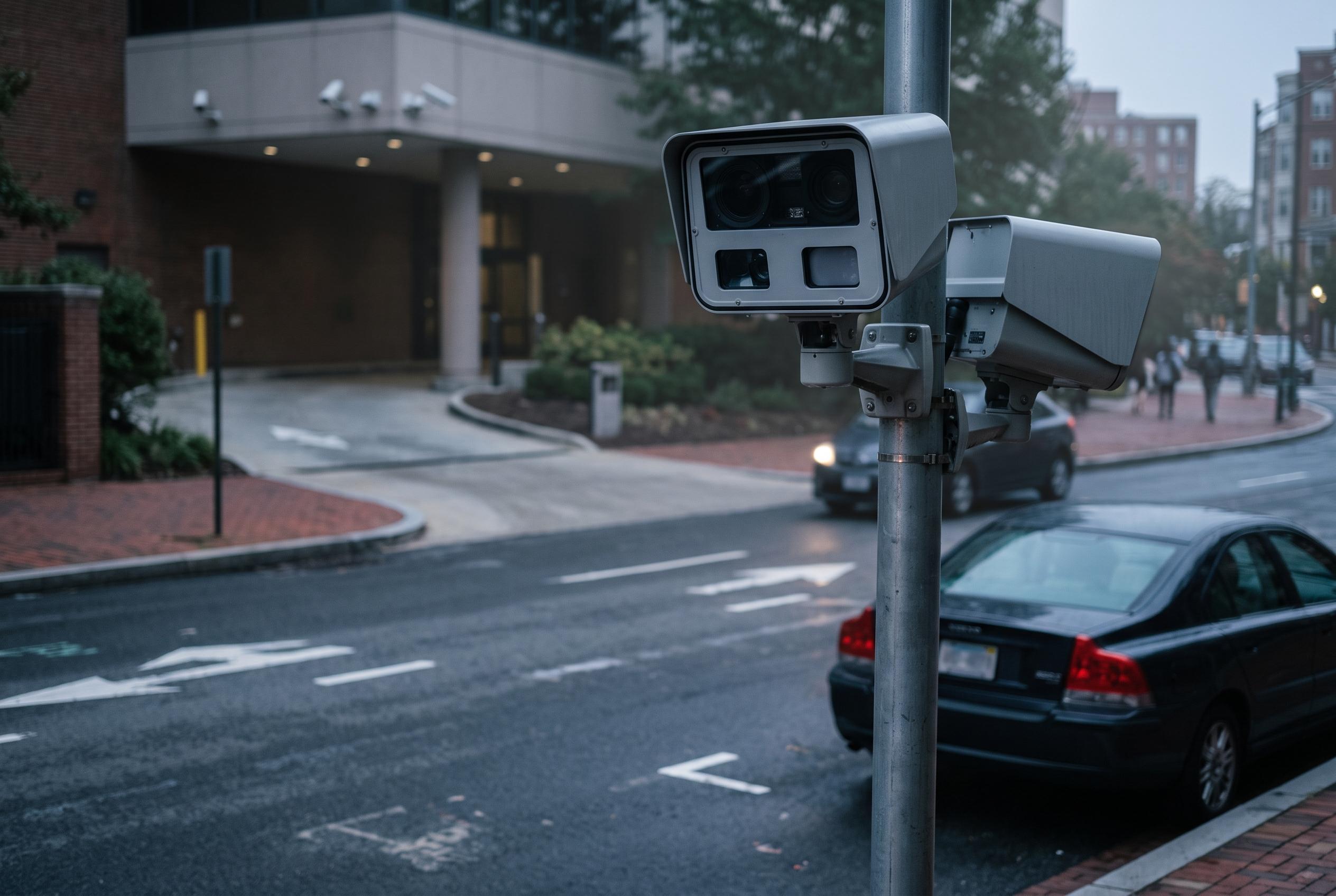

As Flock Safety’s licence-plate-reading cameras become increasingly common across public and private spaces, experts reveal how to distinguish these devices and uncover the broader implications for surveillance and privacy.
Flock Safety’s licence-plate-reading cameras have become common enough to confuse many people who pass them on the street. The problem is not only that the devices are spreading into cities, suburbs and private sites, but that other roadside cameras can look similar at a glance. Flock itself says its systems are designed to record vehicle information in public view rather than to identify people, while critics say the same network can still amount to a powerful surveillance tool if controls on access, retention and sharing are weak.
The first clue is usually the hardware. Flock’s standard units are typically mounted on poles or signposts and often use a compact white or light-grey housing, sometimes with a dark or black variant depending on the model. They usually face oncoming traffic at a slight downward angle and may have one or two forward-facing lenses, an infrared ring for night capture, and a small Flock logo or sticker on the casing. Competitor systems can look different, so a camera that does not match that general form is not necessarily a Flock device.
A second sign is the power setup. Many Flock installations rely on a visible solar panel placed above or beside the camera body, with LTE upload hardware or a small antenna attached to the unit. That makes the system easier to deploy in places without convenient mains power, but it also means the panels and mounting hardware are often easy to spot once you know what to look for. However, not every camera with a panel is a Flock system, and not every licence plate camera belongs to a police department.
The wider issue is that Flock cameras are bought by far more than just law enforcement. According to Flock-related material and industry explainers, they are used by cities, neighbourhoods, homeowners’ associations, schools, businesses and private property owners, which is why people may see one in a car park even when their local council says it no longer uses the technology. That can create confusion over ownership and purpose, particularly where private sites share data with police or where multiple vendors operate similar equipment.
For that reason, visual identification is only the starting point. The better checks are administrative: look up local purchases in surveillance-tracking tools such as the Atlas of Surveillance or similar mapping projects, ask who owns the property, press city councillors directly and, where necessary, file a public records request for contracts and installation documents. Senior researcher Beryl Lipton of the Electronic Frontier Foundation has urged people to search by town and county, noting that many communities would be surprised by how widely the technology has spread beyond major cities. In practice, that paper trail is often the clearest way to confirm whether a camera is genuinely part of a Flock network.
Disclaimer: This content is intended for informational purposes only. Readers are advised to exercise their own judgement, conduct due diligence, or consult a qualified expert before acting on any information provided.