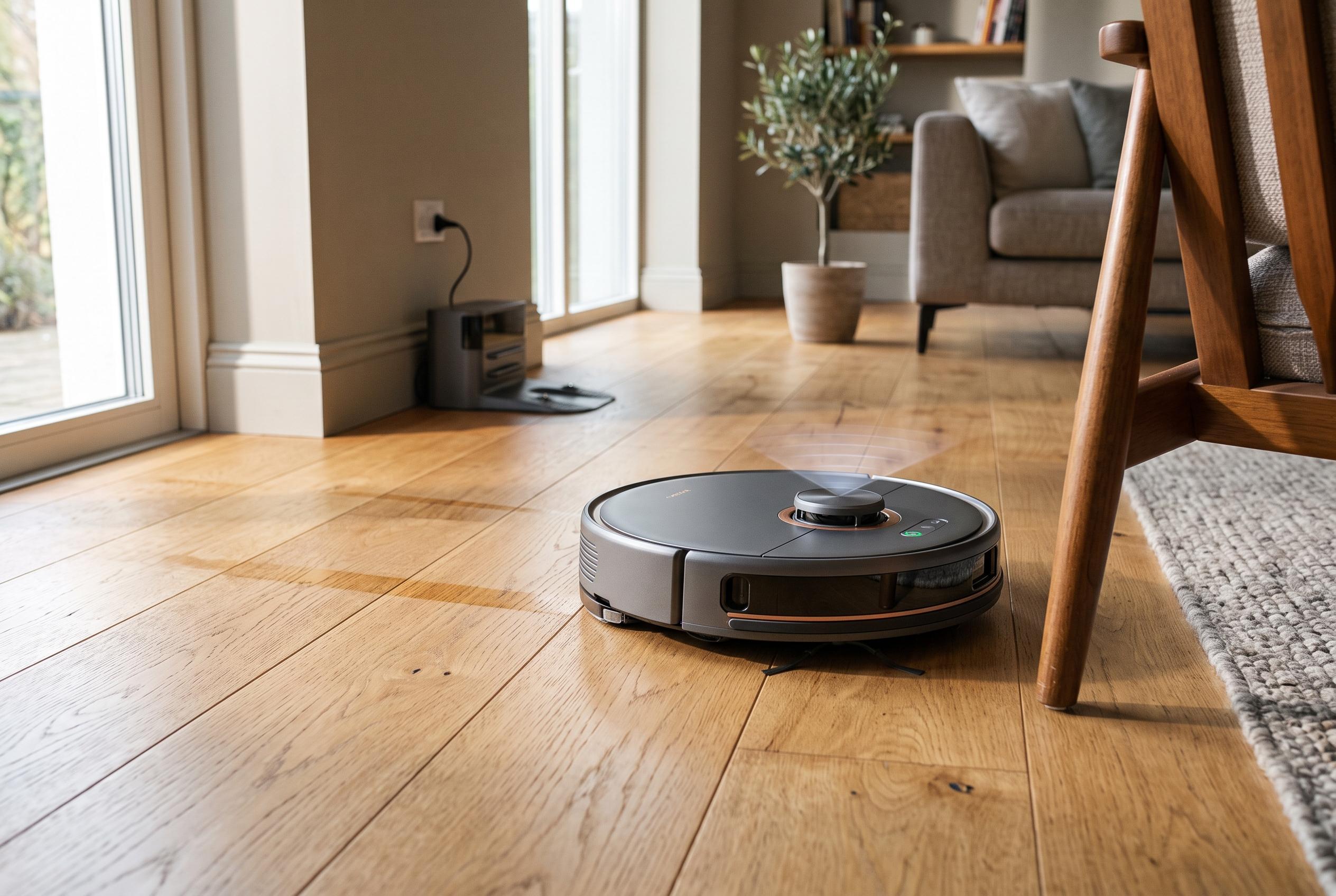

As Eufy and Roborock expand their offerings across price points, mid-range models now feature the advanced capabilities once exclusive to premium models, making choice more about household needs than brand superiority.
Eufy and Roborock occupy different points on the robot vacuum spectrum, but the gap between them has narrowed. Eufy has built its name on offering broad feature sets at comparatively restrained prices, while Roborock has tended to arrive first with higher-end functions and more refined software. As a result, the better choice is less about which brand is universally superior and more about which one matches the floor plan, budget and level of control a household actually needs.
Price shows that split clearly. According to comparison sites that track the two ranges, Eufy still leans towards value and simpler ownership, with entry-level models that can be far cheaper than Roborock’s premium machines. But both brands now span a wide spread of budgets, and the real contest increasingly sits in the middle of the market, where mid-range robots now include features such as self-emptying docks, mop washing and object detection that were once reserved for flagships.
On raw cleaning power, Roborock usually has the edge at the top end, with models such as the Saros line pushing suction well beyond what was common only a few years ago. Eufy is not far behind, however, and its newer flagships now post seriously high suction figures of their own. The more important point is that suction alone does not decide performance. Brush design, anti-tangle systems, carpet behaviour and how a robot manages debris all matter just as much, which is why individual model reviews remain more useful than headline specifications.
Mopping is one of the areas where the brands diverge most. Eufy has pushed roller-mop technology with its newer Omni models, which wash the roller as they clean and can be better suited to hard floors with dried-on marks. Roborock has stayed closer to pad-based systems across much of its range, but its newer machines have become highly capable at stain removal and can adapt cleaning around tougher patches. Where Roborock tends to pull ahead is in mixed-floor homes, especially in premium models that can lift or even leave behind their mopping hardware when carpet-only cleaning is needed.
Navigation and software also separate the two. Roborock has long been strong at mapping, route planning and app control, and it remains the more polished ecosystem for users who want fine-grained adjustments. Eufy is catching up, and independent testing has shown some of its newer models to be particularly effective at avoiding obstacles such as cables and shoes. That makes Eufy a credible choice in less tidy homes, even if Roborock still has the stronger overall reputation for navigation and map management.
In practice, the decision comes down to priorities. Roborock is the safer recommendation for buyers who want the most complete, technically capable package, especially in homes with mixed flooring or more complicated layouts. Eufy is easier to justify when value matters most, and it can be the smarter pick if obstacle avoidance and straightforward ownership matter more than software polish. Both brands now make competent robots across several price points, but Roborock remains the more rounded system, while Eufy remains the sharper value proposition.
Disclaimer: This content is intended for informational purposes only. Readers are advised to exercise their own judgement, conduct due diligence, or consult a qualified expert before acting on any information provided.