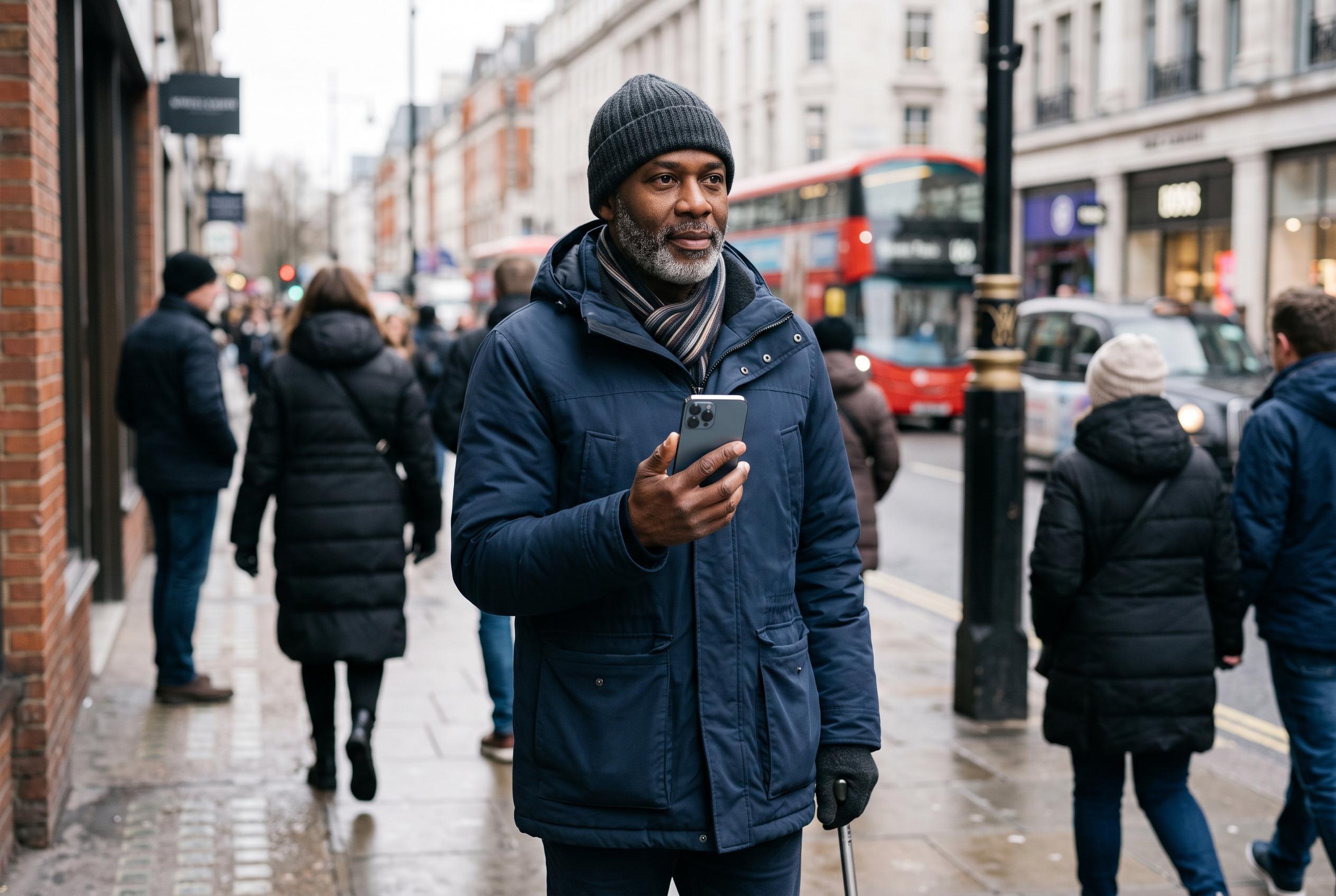

Harvard researchers have developed Mobilio, a smartphone app that uses AI and built-in sensors to provide continuous, personalised guidance for blind and visually impaired users, outperforming traditional aids in real-world trials.
Researchers at Harvard University have developed a smartphone app called Mobilio that aims to help blind and visually impaired people navigate more safely and independently. The system combines artificial intelligence, built-in phone sensors and tailored audio cues to give continuous guidance, rather than relying only on one-off instructions. Harvard’s School of Engineering and Applied Sciences said the work was published in Nature Biomedical Engineering.
The app was designed after the team surveyed more than 100 blind and low-vision users about the tools they needed most while travelling. The clearest requirements were reliable turn-by-turn guidance, ongoing support while walking along pavements and paths, and better detection of obstacles. Existing aids such as white canes, guide dogs and some electronic devices can address parts of that problem, but the researchers said they rarely combine all three functions in one system.
Mobilio runs entirely on a phone and draws on the camera, GPS, inertial sensors and, on supported devices, LiDAR. It uses a vision model trained on footage from a pedestrian’s point of view, rather than street imagery collected mainly from cars. That distinction matters because road datasets often reflect the driving environment more than the details most important to someone walking, such as kerbs, crossings, pavements and nearby hazards.
Instead of depending only on spoken prompts, the app sends a stream of directional sounds, including clicks and beeps that can come from the left or right. It also adapts those signals in real time to match how each user responds, which the researchers say makes the guidance more personal and easier to follow. In effect, the system tries to combine route planning, position tracking and obstacle avoidance in a way that resembles the logic of navigation software used in autonomous vehicles.
In early trials at the Carroll Centre for the Blind in Newton, Massachusetts, 14 volunteers completed both outdoor and indoor routes. They used Google Maps with a white cane in one test and Mobilio with the same cane in another. According to Harvard, participants moved about 13% faster on the outdoor route with Mobilio, while contact with obstacles indoors fell by roughly 41%. The app also performed comparably to a human guide in keeping users on course without major errors.
The next stage will be broader testing in real-world settings around Boston, where the team plans to see how well Mobilio copes with different environments and everyday use. Harvard said the project was led by researchers including Raymond Liu, whose personal experience of a family member’s sight loss helped shape his interest in accessibility research. The wider aim is to show that mainstream consumer hardware can deliver navigation support that is cheaper and more widely available than specialised mobility systems.
Disclaimer: This content is intended for informational purposes only. Readers are advised to exercise their own judgement, conduct due diligence, or consult a qualified expert before acting on any information provided.