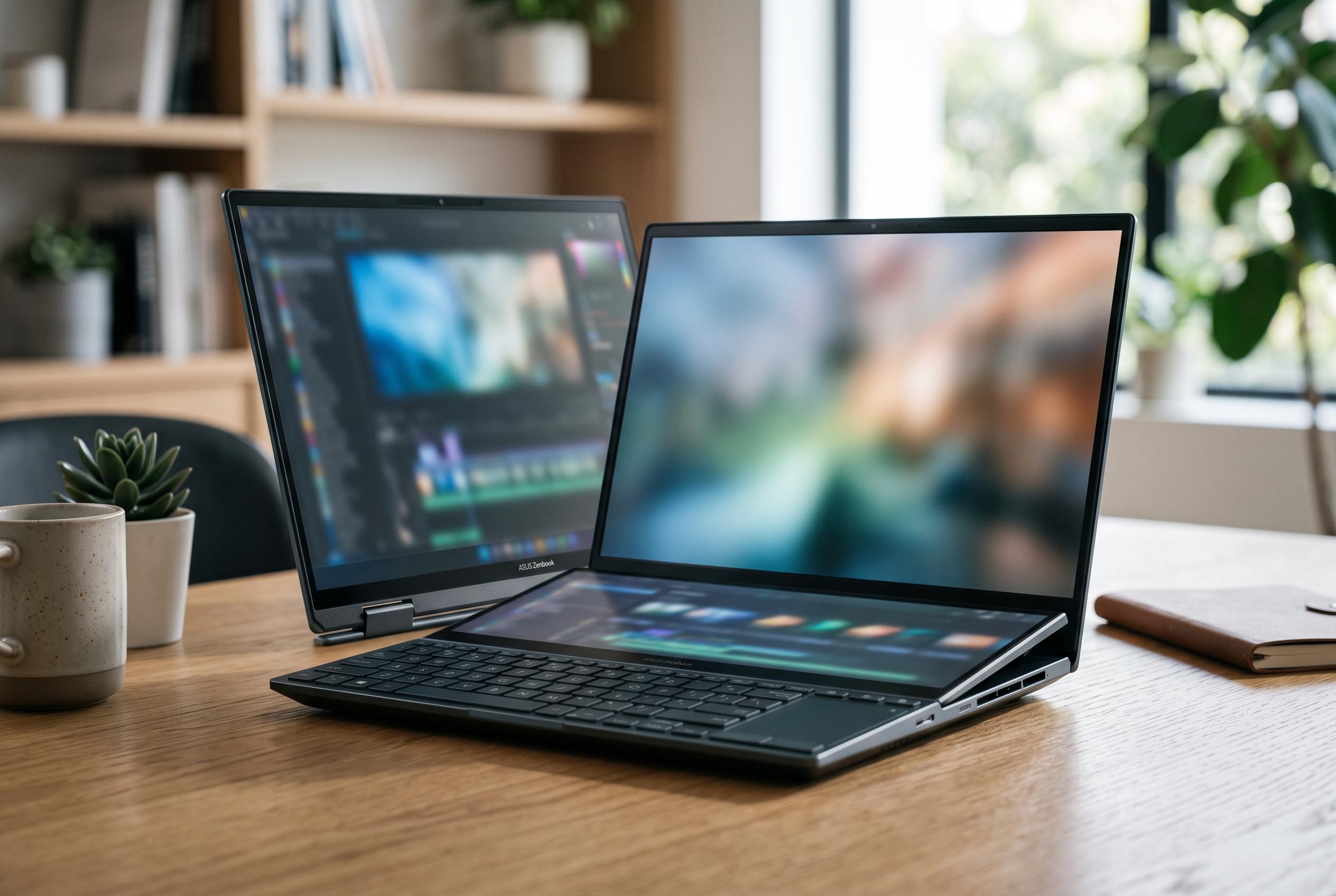

The 2026 Asus Zenbook Duo enhances its dual-screen concept with a more integrated chassis, improved performance, and better usability, though it remains a niche choice for specialised workflows.
The Asus Zenbook Duo remains one of the clearest examples of a laptop built around a specific way of working. For users who regularly keep research, reference material and active documents open at the same time, the two-screen layout still makes immediate practical sense. Asus has refined the concept further in the 2026 model, moving it on from earlier versions that relied on a more awkward hinge arrangement and a keyboard that had to sit between the displays.
The most important change is that Asus has finally reduced one of the design compromises that defined earlier generations. The new model keeps both OLED panels in a more integrated chassis, making the machine feel less like a novelty and more like a coherent productivity tool. The overall approach is still unusual compared with standard clamshell laptops, but reviewers say it is now much easier to use and better aligned with the dual-screen idea that made the line distinctive in the first place.
Performance is also a strong point. According to Tom’s Hardware, TechSpot and PCWorld, the 2026 Zenbook Duo pairs its twin 14-inch OLED displays with a powerful Intel processor, while also delivering solid integrated graphics performance and notably improved battery life. That combination makes it suitable not only for office work and multitasking, but also for more demanding use cases, including content creation and light gaming.
The trade-offs are familiar, however. Reviewers across Tom’s Hardware, Tom’s Guide, Gadgets 360 and Business Standard all point to the same core concerns: a high price, a weight that makes the machine less convenient to carry than a typical ultraportable, and a limited port selection. Tom’s Hardware also noted that the laptop arrives with too much pre-installed software, adding friction to an otherwise polished package.
Taken together, the Asus Zenbook Duo (2026) looks like a more mature version of a long-running experiment. Its dual-screen layout is now better executed, its thermals and battery life appear improved, and its performance should satisfy users whose work genuinely benefits from a second display. But it remains a specialist device, best judged by whether its design fits a buyer’s workflow rather than by conventional laptop standards.
Disclaimer: This content is intended for informational purposes only. Readers are advised to exercise their own judgement, conduct due diligence, or consult a qualified expert before acting on any information provided.