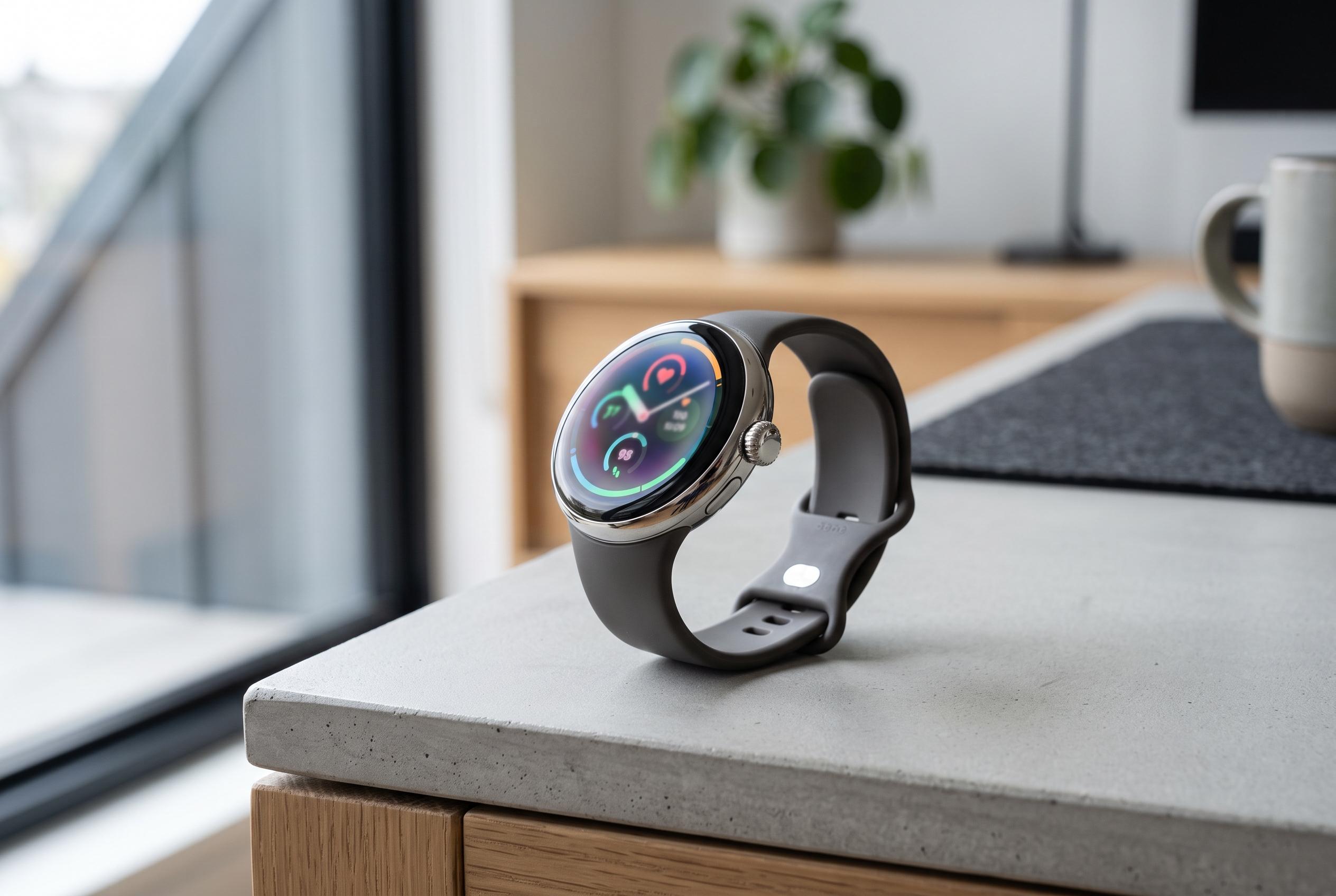

Google’s latest Pixel Watch 5 marks its most convincing iteration yet, addressing endurance issues, enhancing health monitoring, and refining familiar design, promising a more practical and responsive Android wearable experience.
Google’s Pixel Watch 5 is, by most accounts, the company’s most convincing smartwatch yet. After years of awkward compromises, the new model appears to have addressed the biggest complaint that dogged the range from the start: endurance. Reviewers say the 45mm version now lasts roughly two and a half to three days in normal use, while charging from low battery to full takes well under an hour. That alone changes the watch’s appeal, particularly for Android users who want a premium wearable without the daily charging routine that undermined the first Pixel Watch. Android Headlines said the new model finally made the case for staying with Google rather than switching to Samsung.
The hardware remains familiar, and that is both a strength and a weakness. Android Central reported that the Pixel Watch 5 launched on 12 August 2026 with the same domed circular design, 41mm and 45mm sizes, and the same custom 3D Corning Gorilla Glass 5 used on the previous generation. The case is still made from recycled aluminium, and the look is deliberately understated. Google has also kept the band mechanism, so existing straps remain compatible. That continuity will please current owners, although some reviewers argue it also exposes the lack of bold industrial changes.
Performance is improved, if not transformed. The Pixel Watch 5 uses Qualcomm’s Snapdragon W5 Gen 2 Accelerated chip, which Google says delivers a sizeable jump in speed over the previous model. Reviewers largely agree that Wear OS feels smoother and more responsive, with quicker app launches and fewer stutters. Google has paired that with Wear OS 7 and more aggressive use of Gemini Intelligence, including on-device help for basic tasks. The result is a watch that feels more immediate in day-to-day use, even if the silicon upgrade is evolutionary rather than radical.
The software story is where the Pixel Watch 5 stands apart. Android Headlines praised the new At a Glance integration, which surfaces contextual information such as briefings, ride details and flight information directly on the wrist. Gemini can also work offline for simple actions such as setting alarms and timers, which gives the watch a practical advantage when connectivity is poor. At the same time, some of Google’s more ambitious AI additions are described as less essential, including generative watch faces and proactive suggestions that sound useful in theory but may not become daily habits.
Health and fitness features are a more substantial part of Google’s pitch this year. Tom’s Guide said the new Health Guardian package is aimed at users who want more than standard activity tracking, with features such as Breathing Emergency Detection, Blood Pressure Trends and Insulin Resistance Trends. Android Headlines also noted better GPS accuracy, more reliable sleep tracking and improved route mapping during walks. Google’s own push is clearly towards earlier warnings and more proactive monitoring, although some of the most important features, including Health Guardian itself, are not yet available in full.
Taken together, the Pixel Watch 5 looks less like a dramatic reinvention than a carefully corrected one. It keeps the design that many users already liked, improves battery life enough to remove a major practical objection, and adds software features that make the watch more useful rather than merely more complex. There are still trade-offs: reviewers continue to question the lack of sapphire crystal, and some AI additions sound more fashionable than essential. Even so, the consensus is clear that this is the strongest Pixel Watch Google has made, and one of the most complete Android smartwatches on sale.
Disclaimer: This content is intended for informational purposes only. Readers are advised to exercise their own judgement, conduct due diligence, or consult a qualified expert before acting on any information provided.