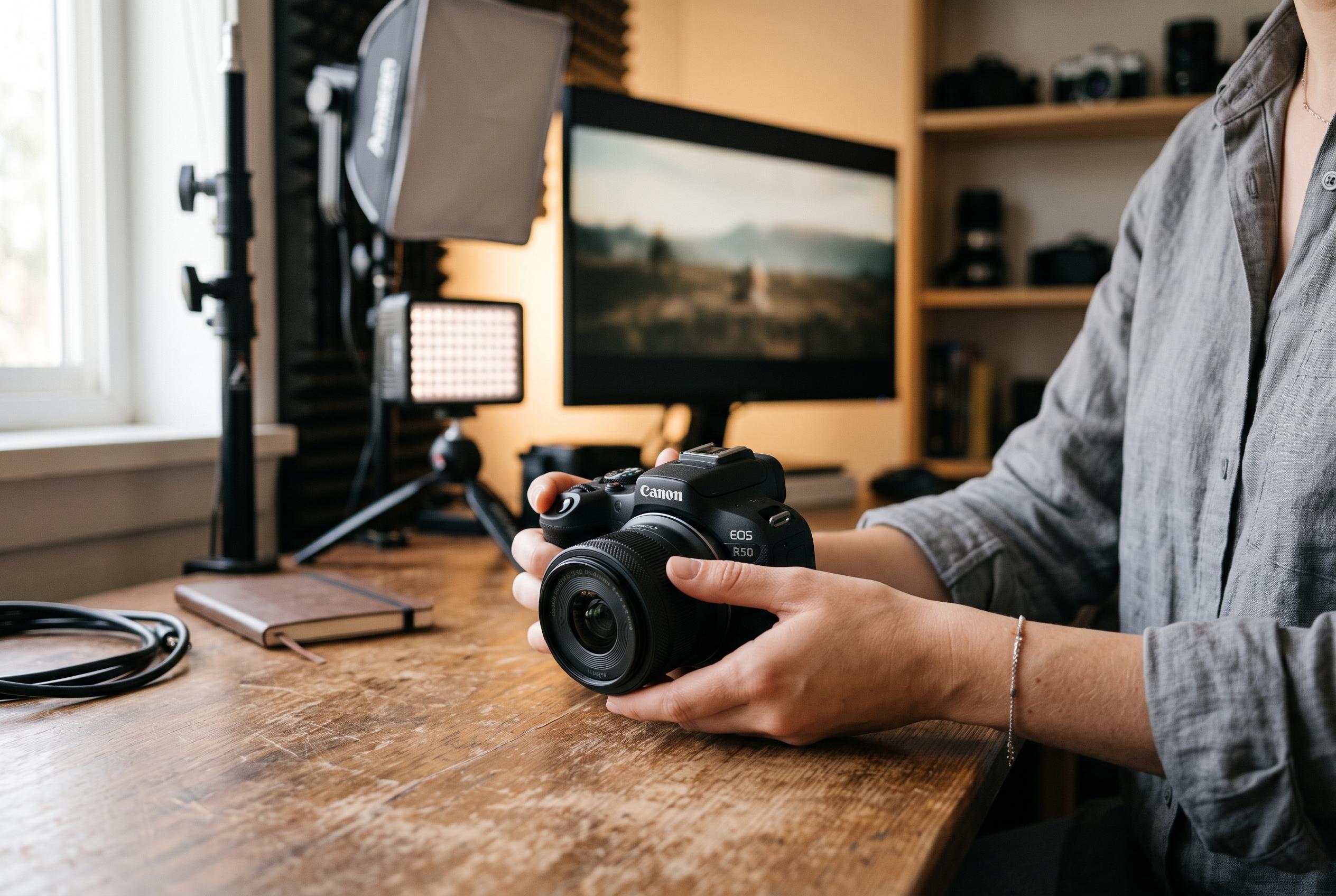

For beginner filmmakers on a budget, the Canon EOS R50 offers a balanced combination of image quality, autofocus, and lens support, making it the top choice for those looking to expand their system without overspending.
For beginner filmmakers on a budget, the strongest case is still for a camera that balances image quality, autofocus and lens growth rather than chasing the highest body-spec on paper. In testing across short films, interviews and creator work, the Canon EOS R50 emerged as the most rounded choice because it combines APS-C image quality, oversampled 4K and dependable subject tracking in a compact body. That matters because, as several recent buying guides note, buyers in this price range are usually better served by a system they can expand than by a slightly more expensive body paired with a weak lens kit.
The R50’s appeal is practical rather than glamorous. Canon’s Dual Pixel autofocus remains one of the easiest systems for new shooters to trust, and the camera’s vari-angle screen, light weight and solid colour output make it friendly for handheld work, gimbal use and self-shooting. The main limitation is still battery life and heat during longer 4K sessions, so it suits short-form filmmaking far better than long event coverage. For readers who want a more video-led Canon body, the newer EOS R50 V pushes further with 10-bit CLog3 and creator-focused controls, though it gives up some all-round flexibility.
Sony remains the closest rival in this segment, and that is why the ZV-E10 still makes sense for solo creators who film themselves. Its microphone is unusually useful at this level, and Sony’s Real-Time Eye AF continues to be a reference point for face tracking in run-and-gun use. That said, more recent round-ups now lean towards the ZV-E10 II as the stronger current-value creator body at around the $1,000 mark, reflecting how quickly this class is moving. The older a6100 also remains an inexpensive route into Sony’s autofocus system, but it is harder to justify once a lens has been added.
Several alternatives are compelling if the buyer’s priorities are different. Nikon’s Z 30 is repeatedly recommended for beginners because it records uncropped 4K, has a useful flip screen and sits in a growing Z-mount system, while Panasonic’s entry-level kits stand out for value when multiple lenses are included. For creators who want stabilised footage without building a larger rig, the DJI Osmo Pocket 3 remains an unusually strong compact option, although it is less suitable as a main interchangeable-lens filmmaking platform. The broader market consensus is clear: choose based on autofocus, lens ecosystem and how you actually shoot, not just the headline resolution figure.
For most first-time filmmakers, the real lesson is that a sub-$1,000 camera should be judged as part of a system. A cheaper body with room for a fast lens, an external microphone and a spare battery will usually outperform a pricier body left running on its kit lens alone. That is why the safest recommendation remains an APS-C mirrorless camera with reliable autofocus and broad lens support. In that context, the Canon EOS R50 is the cleanest all-round pick, the Sony ZV-E10 is the best creator-first alternative, and newer models such as the ZV-E10 II and EOS R50 V show where the market is heading.
Disclaimer: This content is intended for informational purposes only. Readers are advised to exercise their own judgement, conduct due diligence, or consult a qualified expert before acting on any information provided.