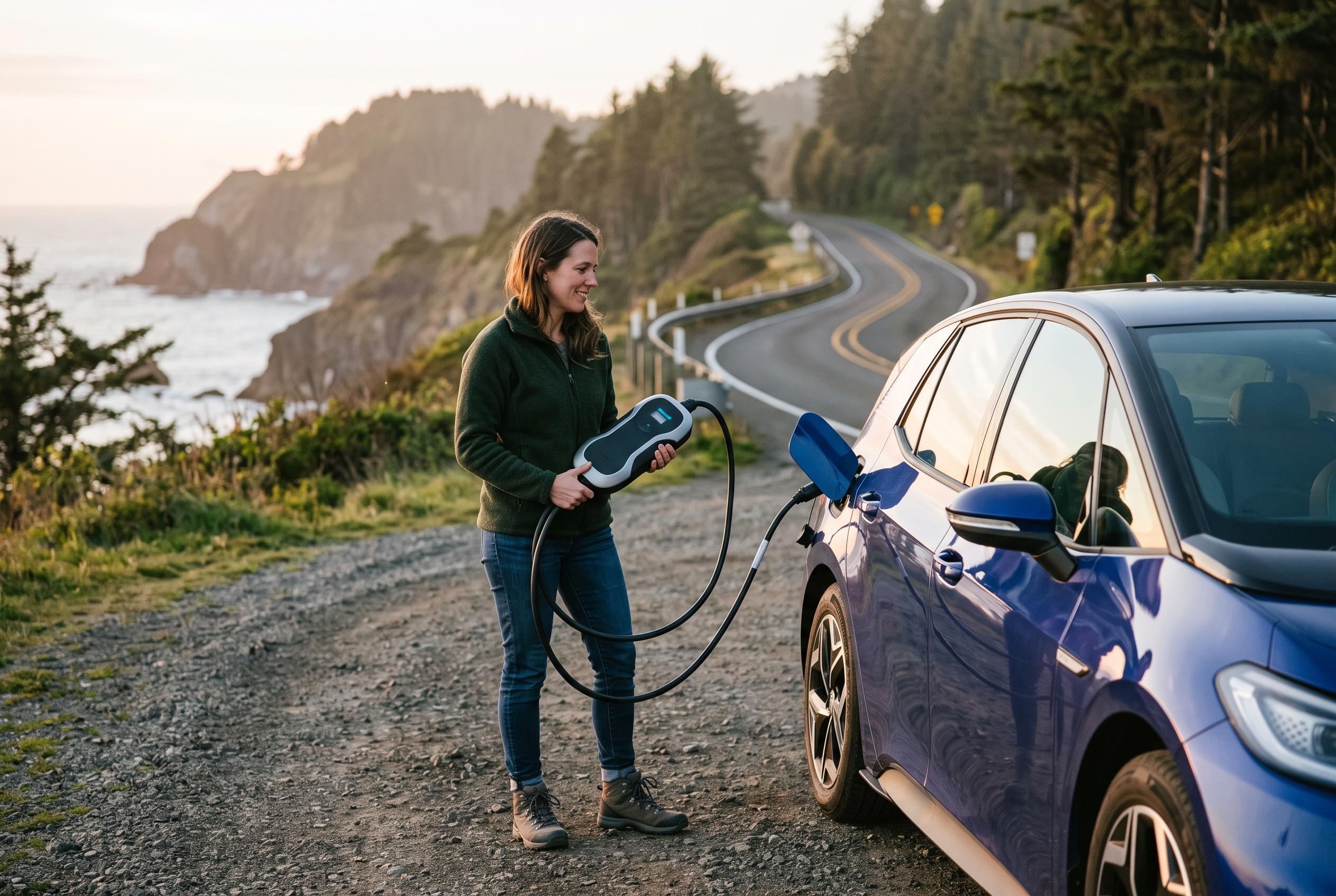

Portable EV chargers are increasingly popular among drivers seeking flexible, independent charging options for road trips and properties without fixed infrastructure, offering a practical alternative to traditional home chargers, though speed and safety considerations remain key.
Portable EV chargers are becoming a useful part of everyday electric-vehicle ownership, particularly for drivers who cannot rely on one fixed charging point. As TechBullion explains, the main advantage is flexibility: a charger that travels with the car can be used at home, at a second property, or at an overnight stop where a suitable socket is available.
Industry guides from EV Charging Experts and EV Digest describe these units as portable alternatives to permanently installed home chargers, often suited to renters, occasional travellers and drivers who want a back-up option in the vehicle. They are usually less expensive than a wall-mounted Level 2 unit, but they are also slower and, in many cases, bulkier to carry.
That trade-off matters most on road trips. Amp and Adapter notes that public DC fast charging remains the quickest way to add range on the move, but portable AC charging can be valuable once the journey ends, especially at hotels, holiday lets, campsites or friends’ homes. In those situations, an overnight top-up can turn an awkward stop into a practical charging opportunity.
The limits are equally important. The charger must match the vehicle’s connector, the local power supply and the circuit’s capacity. As Propel RC and TechBullion both emphasise, an outlet that physically fits is not automatically safe for continuous EV charging. Current settings, grounding, cable length and the quality of the installation all need to be checked before use.
That is why portable chargers are best seen as part of a broader charging strategy rather than a replacement for home infrastructure or the public network. For some drivers, they provide convenience and peace of mind; for others, they offer a workable solution in properties where a permanent charger is not possible. Their value lies less in speed than in independence.
Disclaimer: This content is intended for informational purposes only. Readers are advised to exercise their own judgement, conduct due diligence, or consult a qualified expert before acting on any information provided.