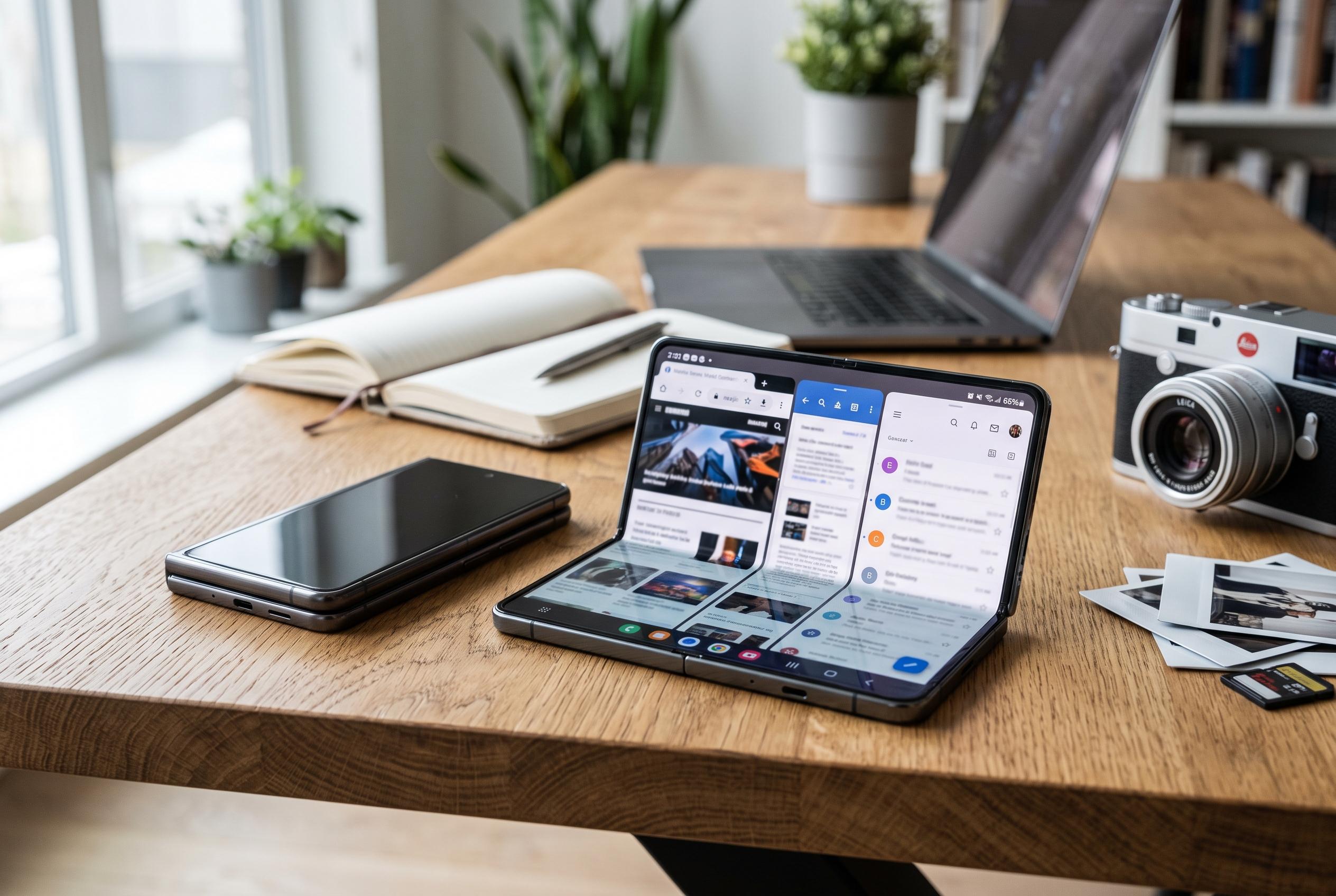

Despite matching at a similar price point, Samsung’s Galaxy Z Fold 8 offers greater refinement and multitasking capabilities, making it the more practical choice for most users, while Google’s Pixel 11 Pro Fold stands out with superior photography and robust build quality.
Google’s Pixel 11 Pro Fold and Samsung’s Galaxy Z Fold 8 arrive at the same price point, yet they are built around different priorities. Both aim to justify a premium close to $1,900 by combining large foldable displays, flagship silicon, advanced AI, capable cameras and long software support. But the comparison is not simply about specifications. It is about which company has made the more convincing case for living with a foldable every day, not just admiring one on a sheet of paper.
Samsung has clearly focused on usability and refinement. According to reports from Android Central and other reviewers, the Galaxy Z Fold 8 is lighter than the Pixel at about 201g, with a wider cover screen and a more polished hinge design that makes the device feel closer to a conventional phone when shut. Samsung has also strengthened the chassis with upgraded materials and kept the foldable IP48-rated for protection against dust and water. Google’s Pixel 11 Pro Fold, by contrast, is bulkier but now uses a reworked gearless hinge, a tougher body and IP68 protection, which is unusually strong for a foldable.
The display story follows the same pattern. Google offers the larger and brighter panels, with a 6.5-inch cover screen and an 8-inch inner display rated at up to 3,600 nits. TechRadar and Android Central both note that the Pixel’s screens are flatter and less visibly creased than before, which helps the tablet-like experience when unfolded. Samsung’s displays are smaller, but the wider outer screen and the 4:3 inner layout make the Z Fold 8 easier to use for multitasking, reading and app switching. In practice, Google wins on sheer size, while Samsung still looks better tuned for everyday folding use.
Inside, the gap narrows on paper but widens in real-world intent. Google’s Tensor G6 is designed around efficiency and AI-heavy features, paired with 16GB of RAM and Android 17 with Gemini integration. Samsung’s Snapdragon 8 Elite Gen 5 gives the Z Fold 8 more headroom for demanding games, heavy multitasking and creative work. Review coverage suggests the Pixel is fast enough for mainstream use, but Samsung has the stronger performance ceiling, which matters more in a device this expensive and this ambitious.
Cameras are where the Pixel makes its strongest argument. Google’s foldable pairs a 48MP main sensor with an ultrawide lens and a dedicated telephoto camera, giving it the more complete hardware setup for still photography and zoom. TechRadar says the Pixel’s AI-driven image processing and 5x optical zoom make it particularly appealing for travel and low-light scenes. Samsung counters with a more versatile video package, including higher-resolution recording and additional capture tools aimed at content creators. That leaves Google ahead for stills, while Samsung looks better for people who film and edit more often on the phone itself.
Software remains one of the clearest dividing lines. The Pixel 11 Pro Fold leans into Google’s cleaner Android approach, with foldable-specific tools such as split screen, drag-and-drop, tabletop mode and tighter Gemini integration. Samsung’s One UI 9 is more expansive, built for power users who want multi-window workflows, taskbar support and DeX for a desktop-like experience. Both companies now promise seven years of software support, so long-term ownership is no longer a major differentiator. The real question is whether the buyer prefers Google’s simpler, assistant-led interface or Samsung’s more feature-dense system.
Battery life and charging do not settle the debate, but they matter. The two devices are nearly matched on capacity, yet Samsung supports faster 45W wired charging, while Google tops out at 30W wired and 25W wireless charging. Google’s foldable is also being sold with trade-in offers and Pixel-specific bundles in some markets, which soften the premium, while Samsung’s launch promotions and store credits may do the same for its model. Even so, reviewers broadly suggest that Samsung’s faster charging and lighter build make it easier to live with over time.
On balance, the Galaxy Z Fold 8 is the more complete foldable, even if the Pixel 11 Pro Fold is the more distinctive one. Google’s device is the better choice for buyers who care most about Pixel photography, Gemini features, IP68 protection and a larger internal display. Samsung’s phone is the stronger recommendation for most people because it is lighter, faster, more mature as a foldable and better suited to multitasking and video work. In a market where both phones cost roughly the same, the sharper answer is that the Pixel is the more interesting machine, but the Samsung is the one most likely to feel worth the money.
Disclaimer: This content is intended for informational purposes only. Readers are advised to exercise their own judgement, conduct due diligence, or consult a qualified expert before acting on any information provided.