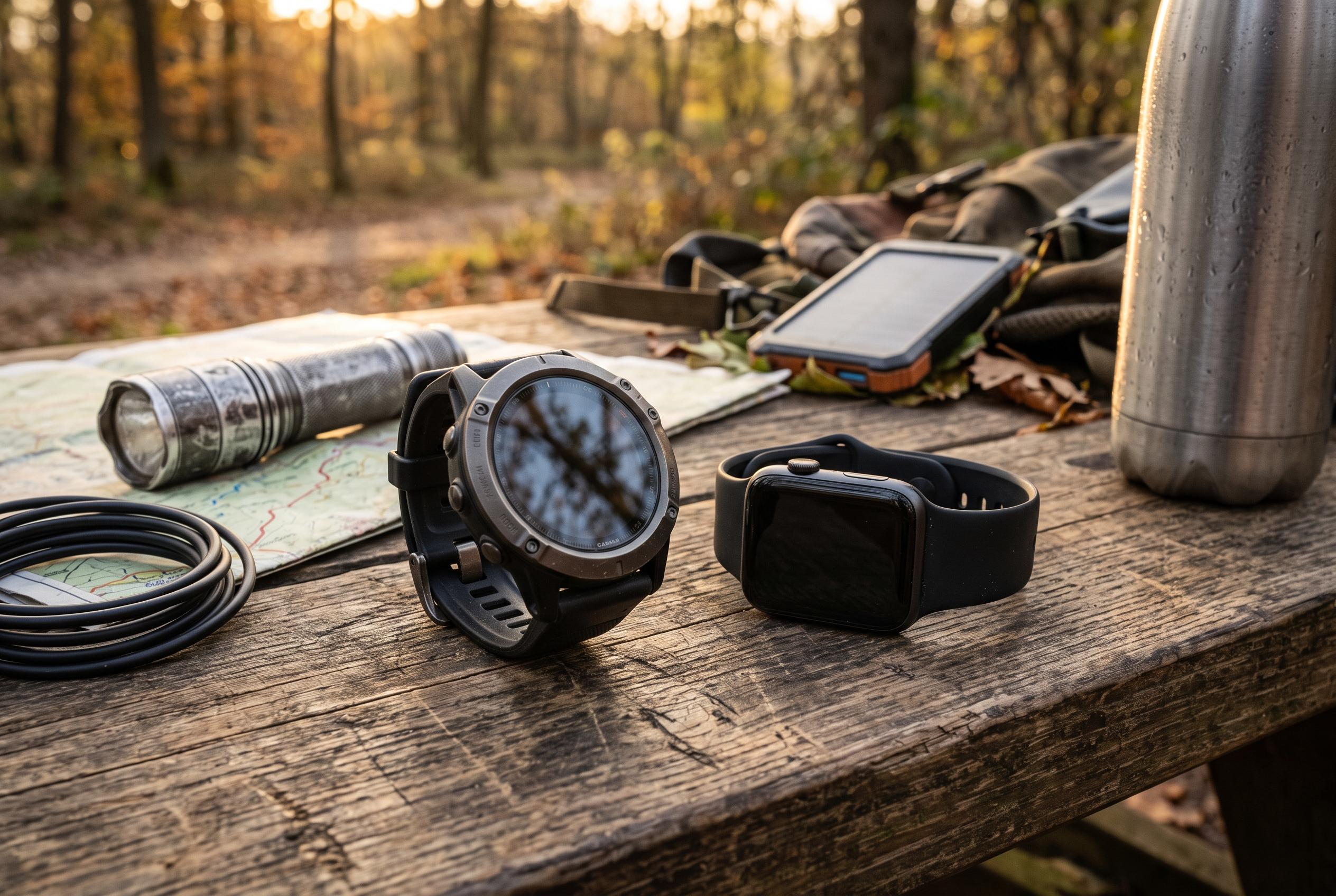

With flagship models ranging from rugged outdoor explorers to budget-friendly fitness trackers, the latest smartwatches are redefining endurance, offering longer battery life to meet diverse user needs while highlighting advancements from Garmin, OnePlus, Amazfit, and Apple.
Battery life remains the clearest divide between smartwatches. Most mainstream models still need daily charging, and even many premium devices struggle to last beyond a couple of days. For buyers who care more about endurance than constant app use, the market is narrower but better than it was. The strongest options now come from Garmin, OnePlus, Amazfit and Apple, each aimed at a different kind of user.
Garmin’s Instinct 3 is built for outdoor use first and smart features second. According to Garmin’s own documentation, the AMOLED versions can last up to 18 days on the 45mm model and up to 24 days on the 50mm model in smartwatch mode, with GPS-only endurance ranging from 32 to 40 hours depending on size. Android Central describes it as a rugged watch with 10ATM water resistance and MIL-STD-810 certification, while also noting that its physical-button navigation and lack of some premium extras may put off buyers who want a more conventional touchscreen experience.
For even longer endurance, Garmin’s Enduro 3 sits at the top of the field. Garmin says the watch can reach up to 36 days in smartwatch mode and up to 320 hours in GPS mode with solar charging, depending on which features are enabled. The company positions it for ultra-endurance athletes, and the hardware reflects that brief: a titanium bezel, sapphire lens, built-in LED torch and a design intended for harsh conditions. Tom’s Guide also points out that the line’s solar support and memory-in-pixel display remain major reasons serious adventure users still favour the Enduro family.
Among Wear OS watches, the OnePlus Watch 3 is the most practical choice for battery life. Phandroid says it is rated for up to five days, though real-world use is likely to bring that closer to three days for many owners. Android Central similarly places it in the three- to five-day range, with a much longer power-saver mode available. There are limits in the US, however: features such as ECG, LTE and female health tracking are not available there, which makes it a strong battery pick but not a complete flagship.
For shoppers watching cost as well as charging frequency, the Amazfit Bip 6 is the budget stand-out. Phandroid says it can last up to 14 days in normal use, up to six days with heavier use and up to 26 days in battery-saver mode. Android Central broadly agrees, and also highlights its GPS support, more than 140 sport modes and broad fitness tracking. It is not the most polished smartwatch here, but it offers an unusually large feature set for its price.
Apple’s strongest battery option is still the Apple Watch Ultra 3, although it remains well behind the best runners in this category. Phandroid says it delivers around two days of use, which is modest next to Garmin and OnePlus, but still the best Apple Watch battery life available. It also brings 5G cellular and satellite connectivity, plus a display rated at 3,000 nits, which helps explain the premium pricing. For people already committed to Apple’s platform, it is the most capable long-life model; for everyone else, the gap in endurance remains hard to ignore.
Disclaimer: This content is intended for informational purposes only. Readers are advised to exercise their own judgement, conduct due diligence, or consult a qualified expert before acting on any information provided.