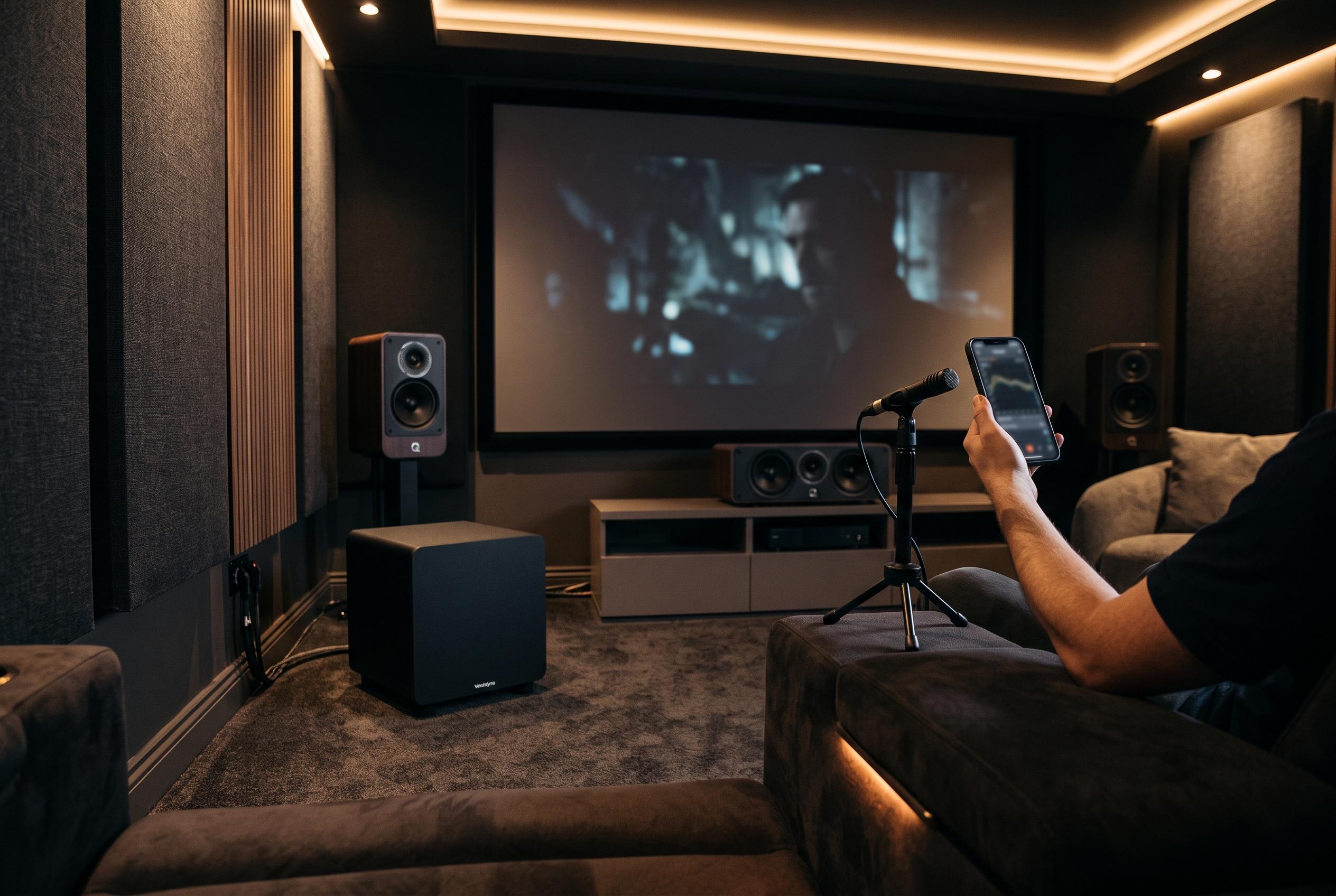

Effective subwoofer placement and tuning are crucial for achieving deep, even bass that enhances a home cinema without overpowering dialogue or mid-range sounds, highlighting the importance of proper setup techniques and calibration tools.
A well-set-up subwoofer should deepen a home cinema without drawing attention to itself. Pocket-lint argues that the best bass is not simply louder bass, but bass that blends into the rest of the system and adds weight to films and music without smothering dialogue or mid-range detail. That principle is echoed by Crutchfield and DALI, both of which stress that placement, wiring and calibration matter as much as the subwoofer itself if the low end is to sound controlled rather than exaggerated.
One of the most useful set-up methods is the subwoofer crawl. The idea is simple: place the subwoofer at the listening position, play familiar content with strong low-frequency energy, then move around the room to find where the bass sounds most even and powerful. Pocket-lint recommends using music or films that reveal bass texture clearly, while Tonal.fm likewise advises testing from the main seat and checking for room-related peaks and nulls before settling on a final position. For many rooms, that process is more reliable than guessing at a corner or wall placement.
Good placement is only part of the job. Crutchfield notes that a subwoofer should be connected with the proper subwoofer cable and then fine-tuned with controls such as crossover, phase and level, while DALI says timing is critical and that distance settings may need careful adjustment so the subwoofer keeps pace with the main speakers. Pocket-lint also warns against blocking the cabinet with furniture or other solid objects, because bass needs space to move through the room. In practical terms, the goal is not to isolate the subwoofer, but to let it energise the room evenly.
Calibration software can help complete the process, especially in soundbar-based systems where wireless latency or timing drift may be more noticeable. Pocket-lint suggests rerunning room correction after moving the subwoofer or adding it to an existing setup, so the system can rebalance itself around the new low-frequency source. Tonal.fm adds that phase checks and sweep tests are useful for spotting problems that may not be obvious with casual listening, particularly in rooms where reflections or standing waves create uneven bass.
Even simple maintenance has an effect. Pocket-lint recommends keeping the driver clean and checking the manufacturer’s instructions before using any cloth or cleaner, a small step that can help preserve performance over time. More broadly, several specialist guides agree that a well-calibrated subwoofer should be hard to locate by ear. When it is working properly, the main speakers sound fuller, bass feels integrated rather than separate, and the room gains impact without losing clarity. TechRadar adds that for larger spaces, a second subwoofer can further reduce dead spots and smooth out response across more seating positions, though for most homes one carefully adjusted unit is still enough.
Disclaimer: This content is intended for informational purposes only. Readers are advised to exercise their own judgement, conduct due diligence, or consult a qualified expert before acting on any information provided.