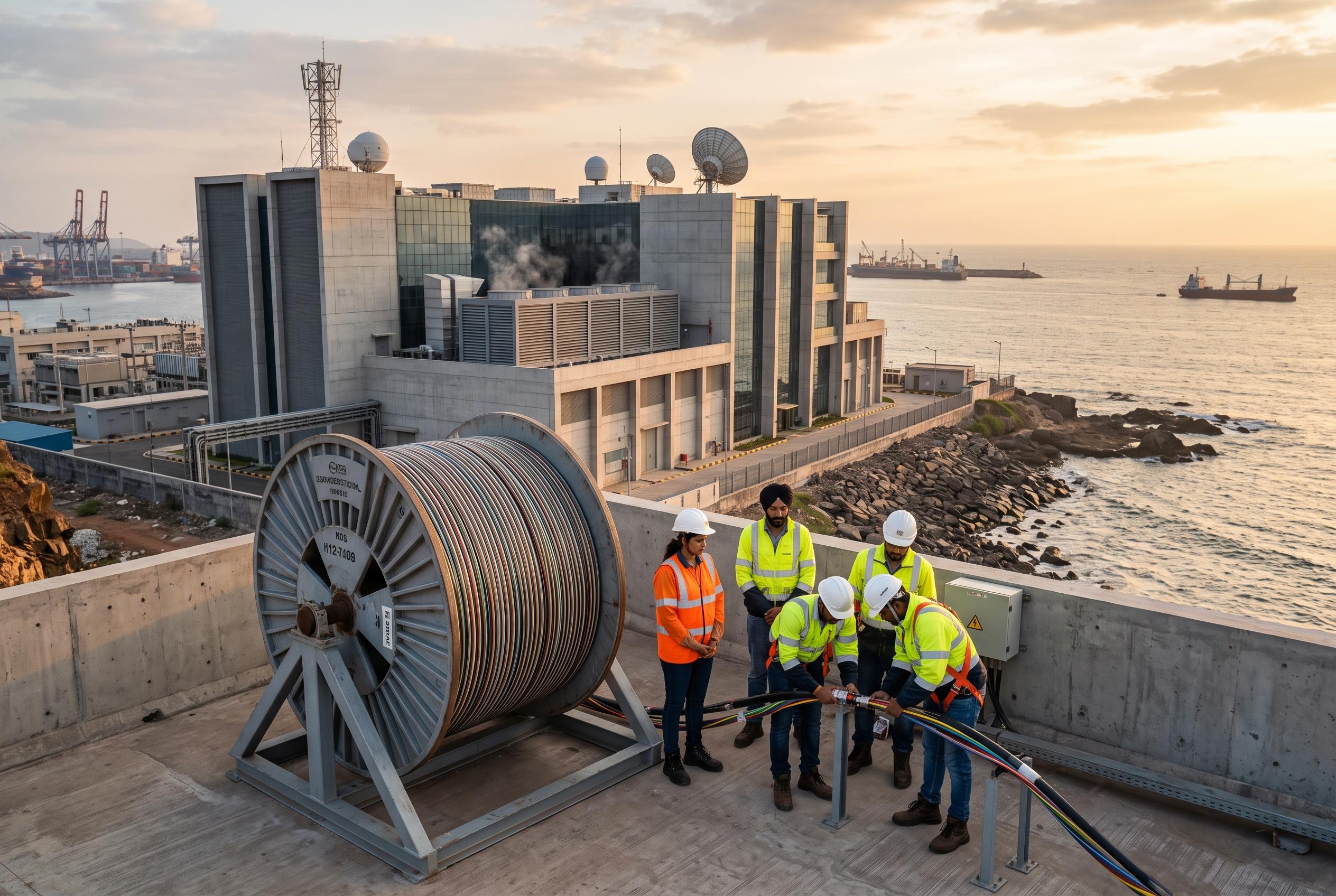

With major investments from Google and Adani, Visakhapatnam is emerging as a key hub for subsea infrastructure and AI-driven data growth, enhancing India’s digital resilience and global connectivity.
Andhra Pradesh is moving towards becoming India’s third major international subsea cable hub as global cloud and AI operators expand along its coast, with Visakhapatnam emerging as the centre of gravity for new landing stations, inland fibre routes and large-scale data-centre investment. Google’s Alexander Smith told The Hindu that the company’s AI hub in the city will bring multiple new subsea cables ashore near Visakhapatnam, creating what he described as a third digital international gateway for India after Mumbai and Chennai.
The shift is being driven by the need for both extra capacity and greater resilience. Lightstorm chief executive Amajit Gupta told The Hindu in June that the India-Southeast Asia submarine system would link Singapore and Malaysia to India’s east coast, including Chennai, and open a new corridor for traffic entering South Asia. He said the cable is due to be ready for service in the fourth quarter of 2029, and argued that new landing points are increasingly necessary because several of the cables already serving India’s eastern coast are ageing and close to the limits of their capacity.
Gupta also pointed to geopolitical risk as a reason for diversification, saying companies are looking for alternatives to routes that may be more exposed to disruption. That broader logic has been reflected in reporting by The Week, Data Center Dynamics and the Financial Express, which have described Google’s America-India Connect programme as including multiple subsea paths from Visakhapatnam, together with new fibre routes designed to strengthen redundancy and decentralised connectivity. Reuters has also reported that Google and Adani are partnering on a major AI data-centre campus in Visakhapatnam, underlining the scale of the buildout.
The inland network may prove just as important as the landing stations themselves. Smith said Google’s project is not only about cable capacity but also about laying and operating thousands of kilometres of fibre to connect major metros. Gupta said Lightstorm was likely to build a terrestrial corridor linking Machilipatnam, Hyderabad and Mumbai, as well as Chennai to Hyderabad and Mumbai, using the same bandwidth. Both executives also highlighted supply constraints in fibre production, with Gupta saying manufacturers are facing long backlogs because of the global AI boom. Smith added that Google’s Visakhapatnam facility will prioritise inference rather than heavy training workloads, and that the company is seeking renewable power and lower water use through air-cooling systems.
Disclaimer: This content is intended for informational purposes only. Readers are advised to exercise their own judgement, conduct due diligence, or consult a qualified expert before acting on any information provided.