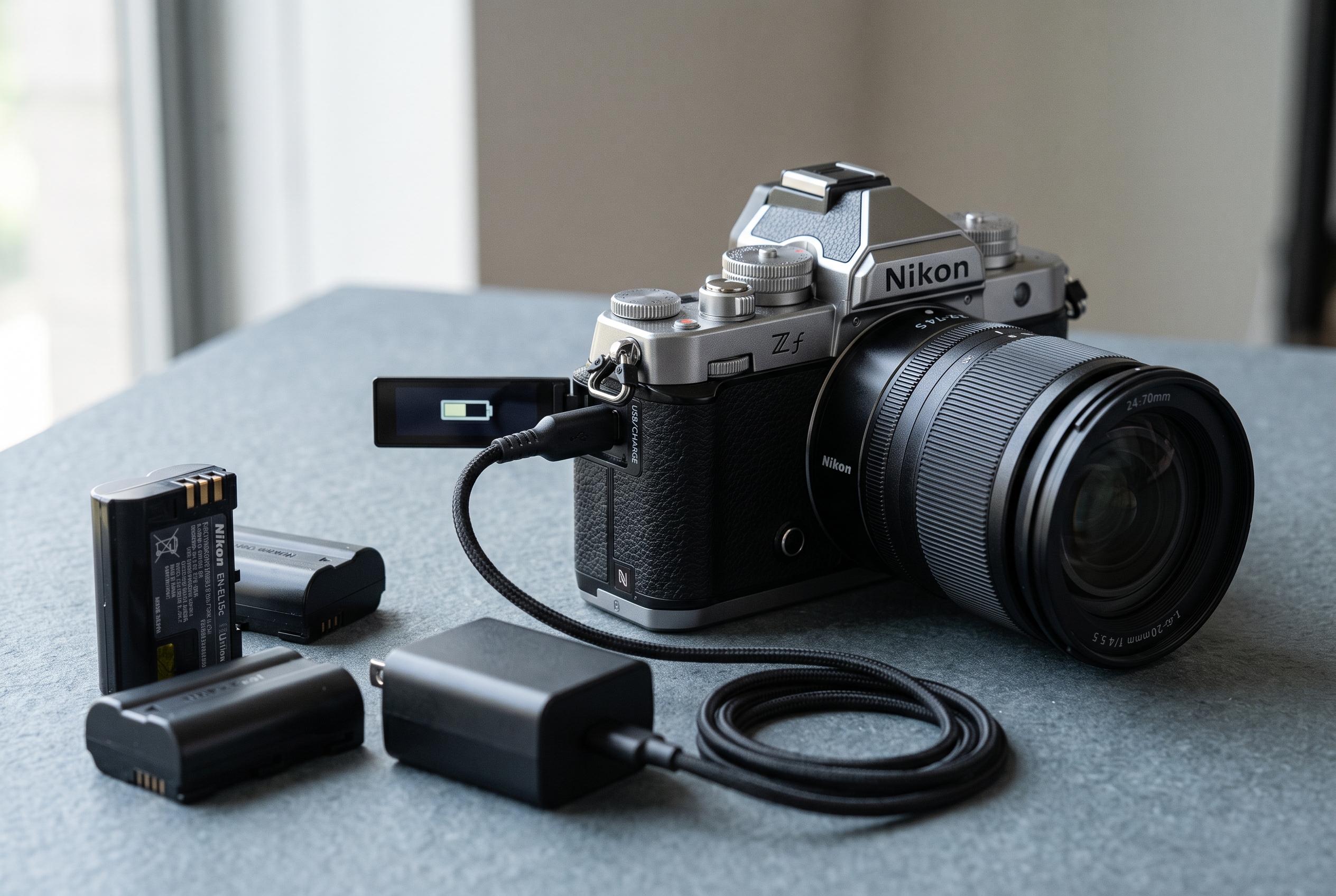

Nikon’s Zf mirrorless camera arrives with a new EN-EL15c battery and a USB-C charging protocol that requires specific power sources, prompting users to consider battery management and official spare purchases amid evolving charging options.
Nikon’s Zf arrives with the EN-EL15c battery, but not with a separate charger. Instead, owners are expected to charge the cell inside the camera over USB-C, using the supplied UC-E25 cable and a suitable power source. According to Nikon’s own support material, that source must be properly specified for USB Power Delivery; in practice, the company recommends a PD-compatible adapter rated at 27W or higher, or a compatible battery pack. If the power supply is too weak, the camera may simply fail to charge without issuing a clear warning.
The EN-EL15c is the key battery to buy if you want a spare. Nikon lists it as the supplied cell for the Zf, and it is the highest-capacity version in the long-running EN-EL15 family. It is also physically interchangeable with earlier EN-EL15 variants, although those older batteries provide less runtime. Nikon’s published figures put the Zf at roughly 380 shots using the rear monitor or 360 through the viewfinder, rising modestly with energy-saving settings enabled. For video, the company quotes about 90 minutes of recording.
For photographers who prefer to charge outside the camera, Nikon offers two separate routes. The MH-25a can charge the battery on its own and is the better choice if you still use older EN-EL15a cells, while the newer MH-34 is limited to the B and C versions and needs a USB Power Delivery source rather than mains power on its own. Nikon also sells the EH-7P and EH-8P AC adapters for in-camera charging. The EH-8P uses the same UC-E25 cable that comes with the Zf, and Nikon says the system is designed around the EN-EL15b and EN-EL15c.
That makes battery planning straightforward but important. If you already use other Nikon Z bodies such as the Z8, Z7 II, Z6 III, Z6 II, Z5 II or Z5, there is a good chance you already own compatible EN-EL15c spares. There is no battery grip for the Zf, so extended shooting comes down to carrying more cells or using a USB-C power bank. Nikon’s guidance also makes clear that third-party batteries can be a risk, both for quality and for future firmware compatibility, which leaves the official battery the safest choice for most users.
Disclaimer: This content is intended for informational purposes only. Readers are advised to exercise their own judgement, conduct due diligence, or consult a qualified expert before acting on any information provided.