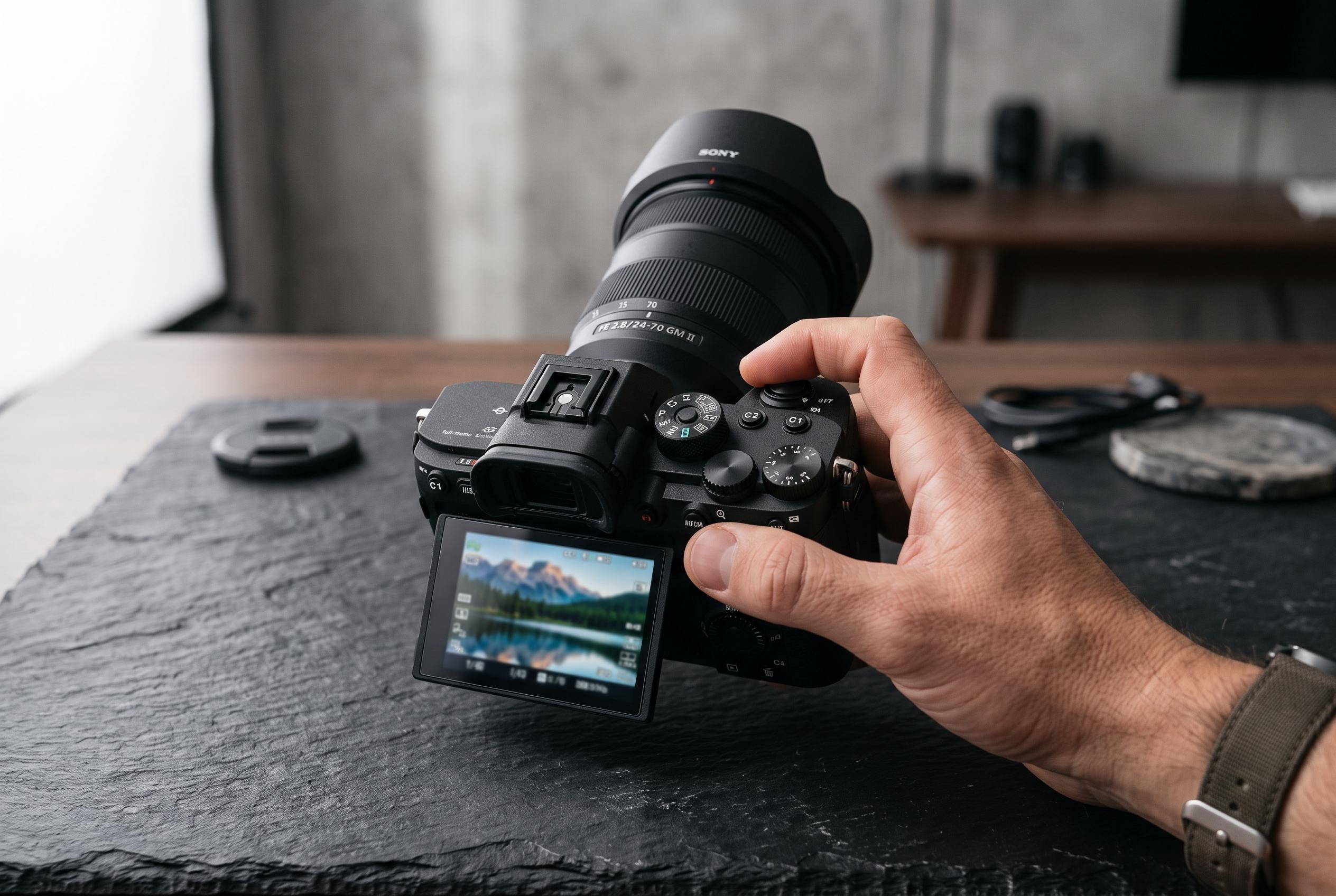

A detailed comparison of Sony’s latest full-frame mirrorless models reveals how the a7R VI’s upgraded sensor, battery, and video capabilities introduce new considerations for photographers and videographers choosing between high-resolution and hybrid performance.
Choosing between Sony’s a7R V, a7 V and a7R VI is less about outward design than about how each body behaves in use. They are close in size and handling, yet the differences in sensor architecture, storage, battery system and video readout make them suit quite different kinds of work. For photographers weighing a spend in the $3,000 to $5,000 range, the practical question is not which camera looks strongest on paper, but which one matches the way they actually shoot.
In Luca Petralia’s hands-on comparison, one of the clearest distinctions is in the small hardware details that affect daily use. He points to the a7R VI’s dedicated control for button illumination and its revised mode dial, which adds an asterisk position for storing extra custom setups tied to shooting situations. Storage also separates the cameras: the a7R V and a7R VI both offer two hybrid card slots that accept CFexpress Type A or SD media, while the a7 V combines one hybrid slot with one SD slot. Petralia sees that as a disappointing compromise at this price point, even if it is not enough on its own to disqualify the body.
Battery strategy marks an even bigger shift. According to Petralia, the a7R V and a7 V use the older NP-FZ100 pack, while the a7R VI moves to Sony’s newer NP-FW100 battery. He says the change delivered unexpectedly strong endurance in a week of shooting, with nearly 1,800 frames in one session and roughly 40 per cent charge still remaining. The trade-off is familiar: the new pack costs more, third-party options will take time to arrive, and the body is a little larger, which meant his existing cage no longer fitted. TechRadar similarly notes that the newer model’s larger battery brings around 17 per cent more capacity, but is not compatible with the older system.
The sensor and shutter behaviour are where the newer bodies pull away. Petralia says the a7R V relies on a conventional CMOS design, the a7 V on a partially stacked sensor, and the a7R VI on a fully stacked sensor. That matters because the electronic shutter becomes genuinely usable on the two newer cameras, supporting 30 frames per second with a blackout-free viewfinder. It is also the reason the a7R VI handles fast action and video with less compromise, while the a7R V remains more conventional in its readout. Tom’s Guide and DPReview both emphasise that the a7R V is still a strong high-resolution hybrid body, but its performance is shaped by an older sensor design and a slower readout path.
Low-light work adds another layer. Petralia highlights the dual base ISO behaviour on the a7 V and a7R VI, where the second base sits at ISO 8,000 and ISO 5,000 respectively, alongside a base of 800. The point is not to chase lower ISO numbers at all costs, but to choose the cleaner signal point when exposure demands it. In practice, that can mean raising ISO and controlling brightness with shutter speed, aperture or neutral density rather than forcing a file into a noisier range. He argues that this is a useful habit across modern Sony bodies and increasingly across competing systems from Panasonic and Nikon.
Video is where the gap is most obvious. Petralia says he used the a7R V for 18 months without major problems, but the newer bodies change the balance. The a7R V tops out at 4K 60p with a heavy crop, while the a7 V records 4K 60p without cropping when angle-of-view priority is used, and 4K 120p in Super 35. The a7R VI adds only a very small crop at 4K 120p. Fstoppers’ earlier comparison also notes that the a7 V uses 7K oversampling, the a7R VI 5K oversampling, and the a7R V line skipping in some video modes, although Petralia says the latter is unlikely to matter unless footage is examined very closely.
His conclusion is not that one body is universally best, but that value depends on budget and purpose. The a7R V remains the most obvious bargain if a used copy can be found around $2,000 to $2,500, especially for stills-focused users who want high resolution without paying for the latest sensor design. The a7 V is the more balanced mid-point for photographers and hybrid shooters who care about speed and lower-light flexibility. The a7R VI is the most capable, but also the hardest to justify unless its battery life, stacked sensor and improved video handling directly match the work being done.
Disclaimer: This content is intended for informational purposes only. Readers are advised to exercise their own judgement, conduct due diligence, or consult a qualified expert before acting on any information provided.