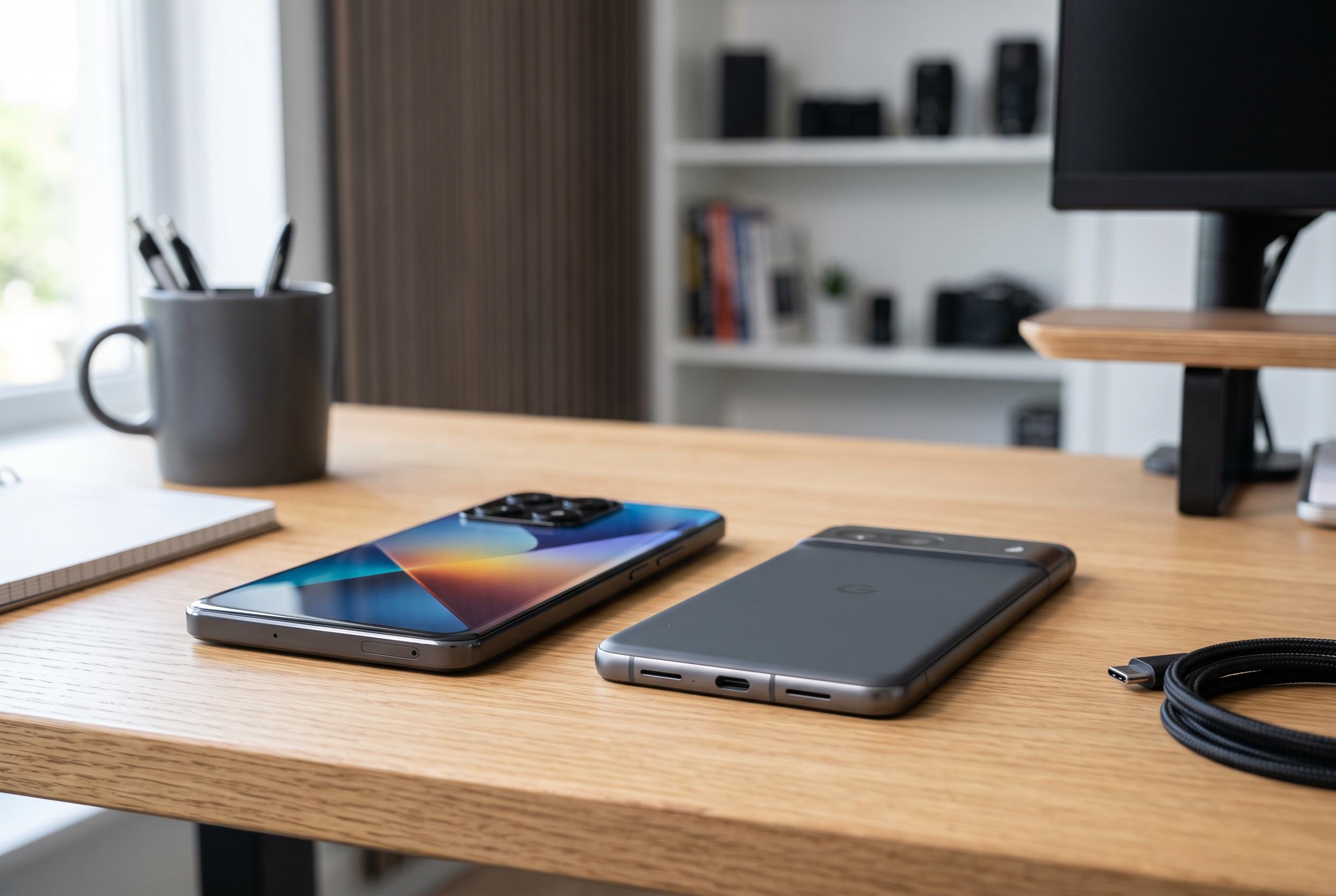

The Xiaomi POCO X8 Pro Max offers superior hardware and price advantage, but Google’s Pixel 10a impresses with software support and photography, shifting the mid-range smartphone battle.
Google has built a strong position in the mid-range smartphone market, but the latest comparison with Xiaomi’s POCO X8 Pro Max suggests the balance of power has shifted. Frandroid notes that the Xiaomi model is the cheaper handset, starting at €430, while the Pixel 10a launched at €549. That price gap is reinforced by Frandroid’s own test scores: 9/10 for the POCO and 8/10 for the Pixel. On paper, at least, Xiaomi appears to offer more hardware for less money.
The two phones follow very different design philosophies. The POCO X8 Pro Max is the larger, heavier device, measuring 162.9mm tall and weighing 218g, with a more assertive look that includes RGB lighting and a reinforced metal frame. Frandroid says the handset is certified to SGS 5-star shock and drop resistance, while both devices carry IP68 water and dust resistance. The Pixel 10a, by contrast, is the more restrained option, with a flat back and no raised camera island, making it easier to hold and better suited to pocket use.
Display quality is another area where Xiaomi pushes harder. Frandroid says the POCO uses a 6.83-inch AMOLED panel with a 2772 x 1280 resolution and peak HDR brightness of 3,417 nits in its own testing. The Pixel 10a is smaller at 6.3 inches, using an OLED screen, but still reaches a strong 2,900 nits in HDR. Independent comparison sites such as NanoReview and Mobolist broadly confirm the same size and panel split, with the Xiaomi favouring scale and brightness, and the Google phone prioritising compactness.
Software is where Google keeps its clearest advantage. Both phones run Android 16, but the POCO’s HyperOS 3 is described by Frandroid as feature-rich and geared towards gaming and productivity, while also carrying unwanted pre-installed apps. The Pixel 10a offers a cleaner version of Android, plus Google-specific features such as advanced photography tools and satellite SOS. More importantly, Frandroid says Google promises seven years of updates, compared with four years for Xiaomi, which remains a major selling point for buyers planning to keep a phone for longer.
Performance and battery life further separate the two. Frandroid says the POCO X8 Pro Max uses MediaTek’s Dimensity 9500s chip, giving it gaming-class headroom and enough power to handle titles such as Call of Duty or PUBG at 120fps. The Pixel 10a’s Tensor G4 is competent for everyday use, but less ambitious and more prone to heat under heavy load. The biggest gap is endurance: the POCO’s 8,500mAh battery is described as a record in this class, with GSMArena data cited by Frandroid showing more than 25 hours in a standard endurance test. The Pixel 10a’s 5,100mAh battery is far smaller and much less enduring, although it does support wireless charging, which the POCO does not.
Photography remains the one area where Google can still justify its premium. Frandroid says the POCO relies on stronger hardware, with a 50MP main camera and 8MP ultra-wide lens, while the Pixel 10a uses a 48MP main sensor and a higher-resolution 13MP ultra-wide. In daylight, the Xiaomi appears more detailed and brighter, but Google’s processing delivers richer colour, stronger contrast and better results at night. That makes the Pixel the more consistent choice for photos, even if its zoom performance is still limited by software rather than optics.
For buyers, the decision is straightforward. The POCO X8 Pro Max is the better pick for gaming, battery life and raw value. The Pixel 10a is the more balanced phone, with a cleaner interface, better update support, stronger camera processing and a more manageable form factor. Frandroid’s verdict is clear: Xiaomi wins on price and hardware, but Google still makes the more rounded long-term purchase for users who value software, photography and practicality over brute force.
Disclaimer: This content is intended for informational purposes only. Readers are advised to exercise their own judgement, conduct due diligence, or consult a qualified expert before acting on any information provided.