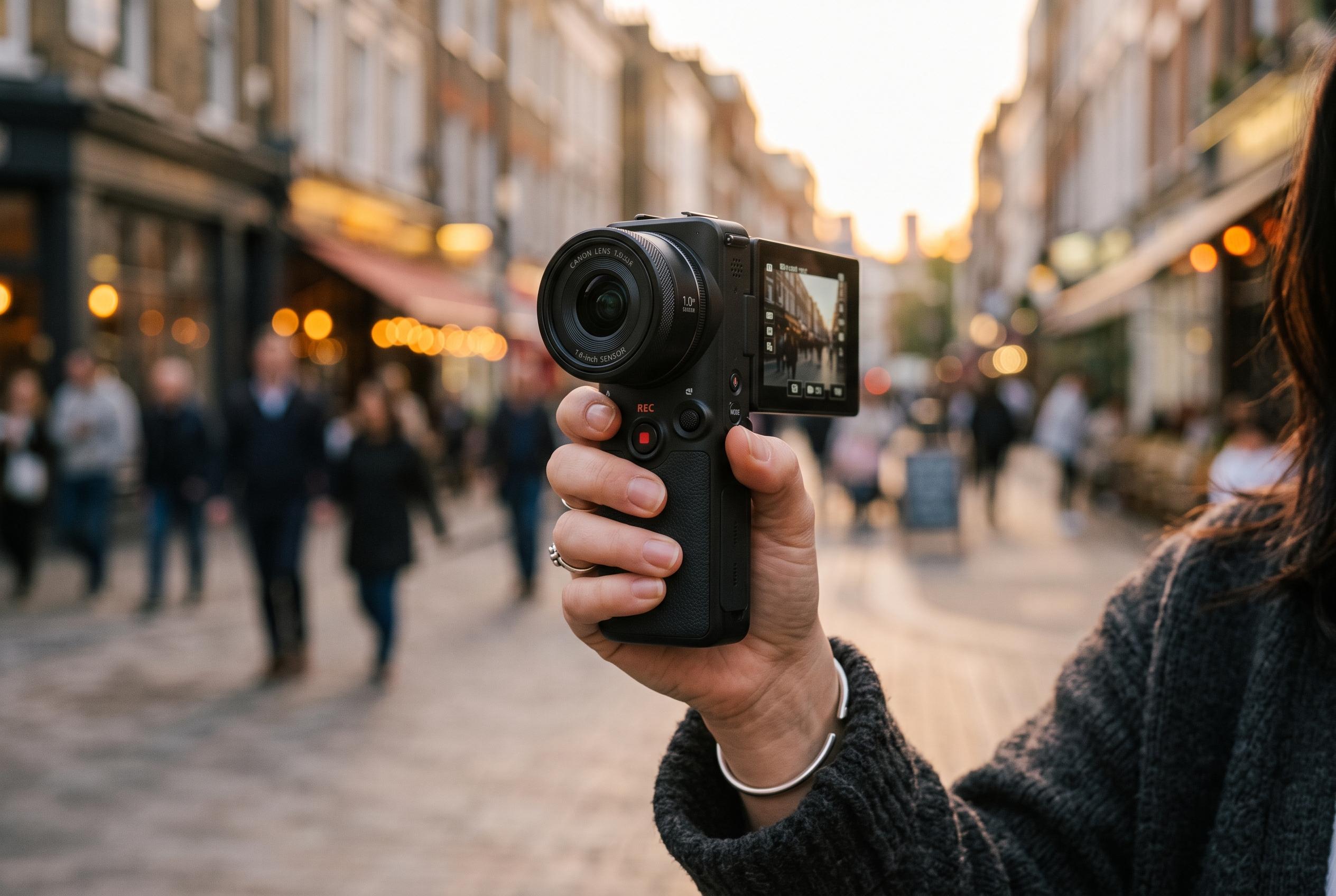

Canon’s new PowerShot V1 signals a shift in the camera market, prioritising creator-oriented features such as enhanced video capabilities, user-friendly design, and reliable autofocus, catering to vloggers and hybrid content creators.
Canon’s PowerShot V1 is a clear sign that Canon is treating compact cameras as creator tools rather than pocket stills machines. According to Pokde’s review, that shift is central to the camera’s identity: instead of chasing the old G7 X-style formula, Canon has built a model with vloggers, streamers and hybrid video users in mind. The result is a camera that prioritises practical shooting features over traditional enthusiast-camera expectations.
The design follows that brief closely. The body is compact, the screen fully articulates for front-facing use, and the control layout is built for quick operation in video mode. Pokde notes a mode switch on the body, a responsive touchscreen and a control ring around the lens, while the connectivity is unusually complete for a small camera, with USB-C, micro HDMI, microphone and headphone jacks, plus Canon’s multi-function shoe. DPReview and Cameralabs both also underline how strongly the V1 is oriented towards creators rather than photo-only users.
The most distinctive hardware choice is the active cooling system. Digital Camera World describes Canon’s fan-and-vent design as an uncommon answer to a familiar compact-camera problem: overheating during high-resolution recording. That matters because the V1 can record 4K 30p continuously, and Pokde says the fan makes overheating largely a non-issue in normal use. DPReview similarly highlights the camera’s 5.7K-derived full-width 4K 30p and cropped 4K 60p modes, with the latter carrying a clear quality trade-off.
Image quality appears to be one of the V1’s strongest points. Pokde says the 22.3MP 1.4-inch sensor is noticeably larger than the 1-inch chips used by many rival compacts, which helps with dynamic range, noise control and background separation. TechRadar also points to the wider-than-usual 16mm equivalent starting point of the lens as a major advantage for handheld vlogging, while Pokde praises autofocus and subject tracking for feeling reliable enough to disappear into the background. Cameralabs likewise notes the addition of C-Log 3, which gives more advanced users room for post-production grading.
There are, however, clear compromises. Pokde flags audible zoom noise on the internal microphone, limited stabilisation at the frame edges during more active movement, a warm colour bias in RAW files and the lack of a viewfinder. TechRadar and T3 likewise note the absence of in-body stabilisation, while both emphasise that the V1 is not trying to compete with interchangeable-lens cameras. That is also the context in which the price should be judged. At RM3,999, or somewhat less in street pricing, the V1 is not cheap, but it packages enough creator-focused hardware to make a strong case for itself. For users who want a compact camera that is ready for video work straight out of the box, Canon’s approach looks carefully judged rather than merely novel.
Disclaimer: This content is intended for informational purposes only. Readers are advised to exercise their own judgement, conduct due diligence, or consult a qualified expert before acting on any information provided.