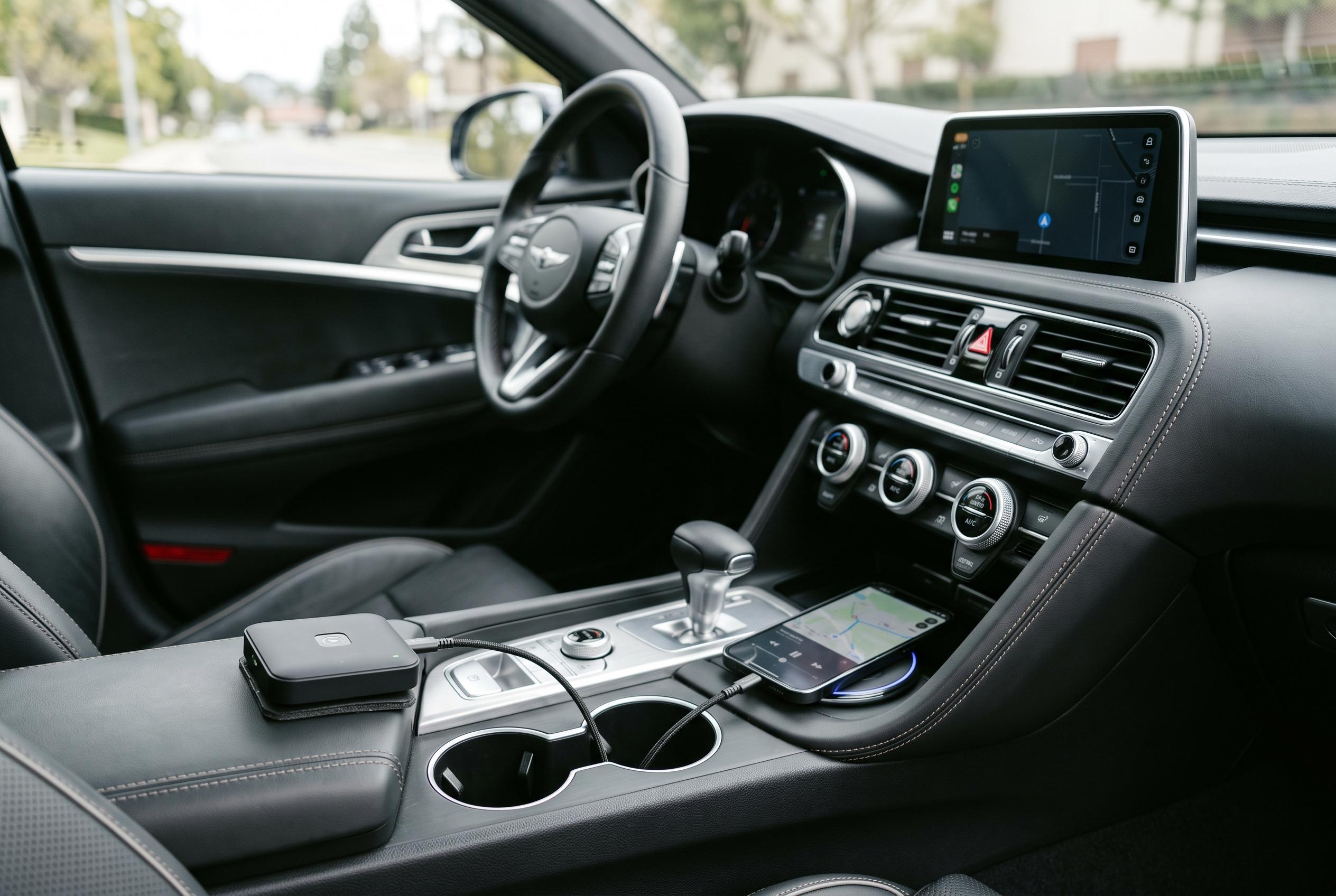

A range of new devices enhances the CarPlay experience, offering wireless connectivity, better charging solutions, and independent display options for cars of all ages, transforming in-car smartphone integration.
CarPlay remains one of the most useful ways to bring an iPhone into the car, but the experience is not uniform. In some vehicles it still depends on a cable, in older models it may be absent altogether, and longer journeys raise practical issues such as charging, heat and where to place the phone. According to Macitynet, the point of the right accessory is not to replace the car’s whole infotainment system, but to solve specific problems with a small, focused upgrade.
For cars that already support wired CarPlay, the simplest improvement is to cut the cable. The OTTOCAST Mini Slim 2026 converts a wired CarPlay connection into a wireless one, and it does the same for Android Auto. It uses USB-A and USB-C connections, is designed for plug-and-play use, and supports multiple users, which makes it suitable for shared vehicles. The key limitation, however, is important: it does not add CarPlay to a car that does not already have wired CarPlay.
Where CarPlay is missing entirely, a standalone display is the more substantial answer. The CARPURIDE W903Plus adds a 9.3-inch IPS screen with a 1600 × 600 resolution and supports wireless Apple CarPlay and Android Auto. It also runs its own Android system, with 4 GB of RAM and 64 GB of storage, so it can install apps from the Play Store and operate independently of CarPlay. The unit includes GPS with an external antenna, a mount that rotates 360 degrees, and an input for a rear camera.
Once CarPlay is wireless, charging becomes the next constraint. ESR’s OmniLock CryoBoost is a Qi2.2-certified magnetic car charger that provides up to 25 W and attaches to an air vent with 360-degree rotation. Its selling point is active cooling: the CryoBoost system is meant to reduce heat while the phone is charging. That matters in the car, where navigation, mobile data, music streaming and strong sunlight can all raise device temperatures quickly.
For drivers who only need to keep the phone visible, a charging cradle may be unnecessary. Lamicall’s MagSafe holder uses a vacuum suction cup for the dashboard or windscreen and a magnetic array of 24 N55 magnets to hold the device in place. It also rotates 360 degrees for portrait or landscape use. Because it does not charge the phone, it is a cleaner option for people using wireless CarPlay who do not need power on every trip.
Power can also be the limiting factor in older cars. Anker’s 323 Car Charger draws on the 12 V socket and delivers a combined 52.5 W, split between a USB-C port rated at up to 30 W and a USB-A port rated at up to 22.5 W. That allows two devices to be charged at once and leaves the infotainment USB port free, or unused if CarPlay is running wirelessly. On vehicles with weak built-in USB outlets, that can be the difference between maintaining charge and slowly losing it during navigation-heavy journeys.
Finally, not every CarPlay fault is caused by the car or the phone. If a wired connection drops out or fails to start, the cable is often the first thing to check. Anker’s 1 metre USB-A to USB-C cable is braided in nylon, supports data transfer and charging up to 18 W, and is presented as suitable for CarPlay use. In practice, that makes it a sensible replacement when a previously stable wired setup begins to fail.
Disclaimer: This content is intended for informational purposes only. Readers are advised to exercise their own judgement, conduct due diligence, or consult a qualified expert before acting on any information provided.