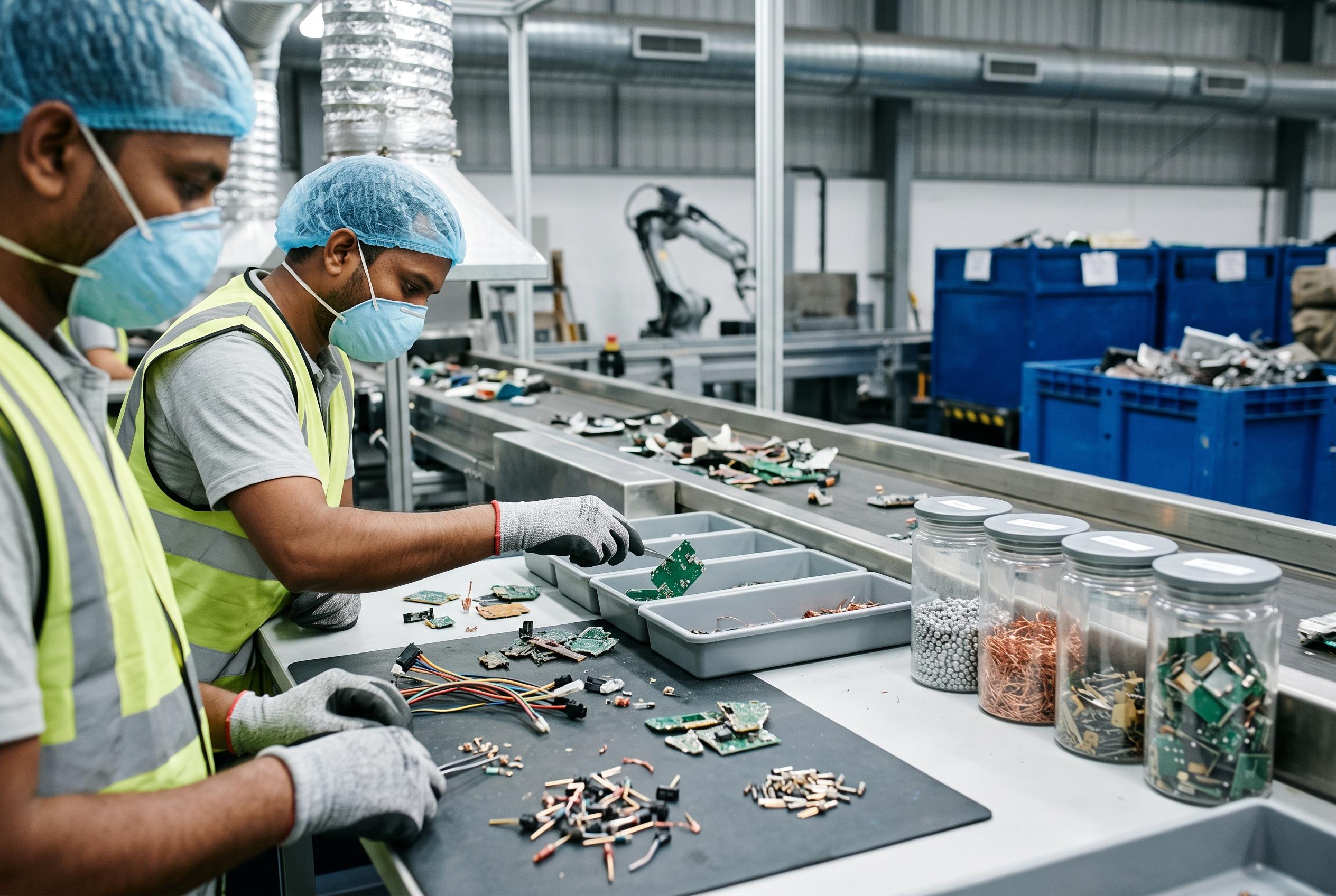

India’s rising e-waste levels now pose urgent challenges beyond disposal, underpinning issues of mineral security, industrial strategy, and public health, as analysts call for a shift in how the country values and recovers electronic materials.
India’s e-waste problem is no longer a narrow waste-management issue. It is also a question of mineral security, industrial strategy and public health. Statista data show that India generated about 13.97 lakh tonnes of e-waste in financial year 2024-25, up from 12.54 lakh tonnes a year earlier, while a PIB release said 70.71% of that volume was processed. Even so, the scale of the stream, and the fact that households remain a major source of discarded appliances, points to a system still struggling to keep pace with the waste it creates.
The central policy mistake is to judge disposal only by visible cost. That approach favours the cheapest immediate option, yet it ignores the embedded value of the materials inside old phones, computers, refrigerators and batteries. ForumIAS argues that e-waste should be assessed through two balance sheets: one covering the immediate bill for collection, transport and processing, and another covering longer-term gains and losses such as reduced import dependence, safer handling of toxins, data destruction, critical mineral recovery and stronger domestic manufacturing capacity. Seen this way, a recycler is not just a waste contractor but part of a re
The recovery gap remains wide because India’s formal recycling system captures only part of the value in discarded electronics. The ForumIAS analysis says current recovery systems focus heavily on a limited set of metals, while other useful materials are left unrecovered or are too costly to extract with existing technology. It also notes that lithium-ion battery demand is set to rise sharply over the next decade, which will make battery disposal a larger policy challenge. The longer that valuable material stays outside organised collection, the greater the loss to the formal economy and the higher the environmental risk.
Regulation has improved, but implementation still trails ambition. The 2022 E-Waste Management Rules were meant to strengthen producer responsibility and improve tracking, while the Central Pollution Control Board has also issued lifespan norms to help forecast future waste flows. Yet the ForumIAS piece says traceability remains weak, chemical composition is not always disclosed, and the informal sector still dominates collection without full integration into formal systems. That leaves a system where compliance can be reported without guaranteeing that the most valuable materials are actually recovered.
The practical response is to price e-waste on a life-cycle basis. Public procurement, corporate purchasing and recycler selection should all reflect not just the purchase cost of devices, but also recovery value, environmental damage avoided, data-security risk and supply-chain resilience. ForumIAS argues for wider extended producer responsibility coverage, stronger verification through linked systems, and better coordination between ministries and regulators. For India, the issue is ultimately strategic: decisions made at the point of disposal can either deepen dependence on imports and informal processing, or build a more secure and efficient material economy.
Disclaimer: This content is intended for informational purposes only. Readers are advised to exercise their own judgement, conduct due diligence, or consult a qualified expert before acting on any information provided.