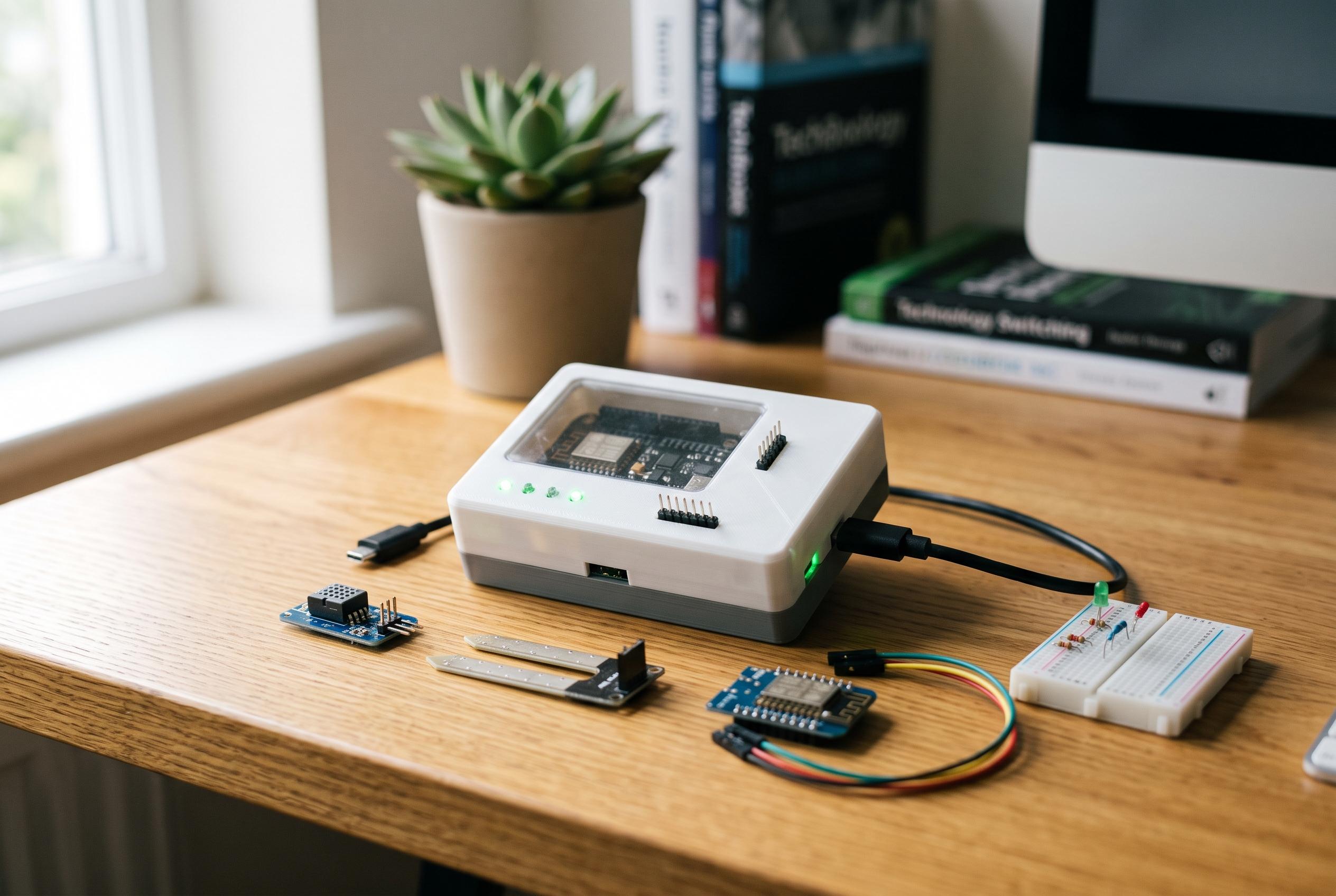

The ESPHome Starter Kit, developed by Apollo Automation, marks a significant step in bridging DIY home automation with professional, reusable hardware, supporting open-source initiatives while offering easier assembly and versatile networking capabilities.
After a preview at State of the Open Home in Utrecht in April and a wider release on 12 August 2026, ESPHome’s first official hardware product has moved from community talking point to retail item. The ESPHome Starter Kit, built by Apollo Automation, is now being sold directly and through regional distributors, including The Pi Hut in the UK. That is notable because ESPHome has become one of the main ways Home Assistant users turn inexpensive microcontrollers into fully local sensors, buttons, lights and controllers, yet its traditional starting point has been a loose development board, jumper leads and a text-heavy setup process. (esphome.io)
The timing is important as well as the hardware. SmarterKram noted that ESPHome Device Builder reached version 1.0 in June, and ESPHome’s 2026.6 release said the visual tool had replaced the older dashboard after first appearing as a public beta in May. On 4 August, ESPHome added desktop apps for macOS, Windows and Linux. The result is a more guided route into the platform: users can assemble a device, configure it visually and still inspect or edit the YAML underneath if they want direct control later. (esphome.io)
CNX Software’s technical summary helps explain why the kit is more than a toy. The main board uses Espressif’s ESP32-C6-MINI-1, bringing 2.4 GHz Wi-Fi 6, Bluetooth Low Energy and IEEE 802.15.4 radio hardware that can underpin Thread, while Zigbee remains possible at chip level for more advanced users. Apollo’s product listing specifies USB-C power, optional rechargeable LiPo support, two 14-pin FPC connectors and an onboard RGB LED. The bundled modules are also fairly concrete: an MH-SR602 PIR sensor rated up to 3.5 metres, an AHT20F environmental sensor quoted at ±0.3 °C and ±2% relative humidity, a “Casita” alert module with ten RGB LEDs and a piezo buzzer, and a separate button unit. SmartHomeScene added that this appears to be Apollo’s first product built around the C6 rather than the C3 or S3 parts used in much of its earlier line-up. (esphome.io)
Those choices support the central pitch: faster assembly without a breadboard. SmartHomeScene said the learning path ends with four working automations rather than four disconnected exercises, while Matter Alpha described the packaging as something between a developer board and a small building set, with most parts arriving on snap-apart PCB panels and linking by flat ribbon cable. In the Open Home Foundation launch post, Apollo co-founder Trevor Schirmer said, “One of the core requirements for the kit was that you had something useful at the end.” It is a deliberate attempt to make the finished result feel like a real device rather than a temporary classroom project. (smarthomescene.com)
The more interesting question is how far the hardware stretches once the tutorials end. Matter Alpha said it experimented with the kit as a Thread router inside an existing mesh to extend coverage for Matter-over-Thread devices, which underlines that the board has network uses beyond simple Wi-Fi automations. ESPHome’s own starter-kit page says two modules can run on the main board at the same time, allowing it to act as a basic multisensor. That does not amount to a promise of turnkey Matter or Zigbee for every buyer, but it does place the product closer to a reusable node platform than to a one-evening electronics demo. (matteralpha.com)
The commercial structure is unusual by smart-home standards. CNX Software traced Apollo’s role back to December 2025, when the company became the Open Home Foundation’s second commercial partner. The foundation now says Apollo and Nabu Casa are its two current commercial partners, and that each is required to contribute a majority of profit from licensed products to the nonprofit. Root Labs argued that this makes the kit a funding mechanism as well as a gadget. Apollo’s own listing says the majority of profit from every Starter Kit goes to the foundation, which supports ESPHome, Home Assistant and a wider group of open-source projects. The same listing also points buyers to public documentation, datasheets and GitHub design files, reinforcing the claim that the hardware is meant to be inspectable and modifiable rather than sealed off. (apolloautomation.com)
Availability has also shifted since the earliest launch coverage. Smart Home Assistant UK reported that UK access would depend on Apollo’s reseller network rather than a direct sterling price. As of 5 September 2026, Apollo’s store lists the kit at $40, while ESPHome’s official page gives a recommended European price of €41 and notes that regional pricing may vary. Apollo also lists distributors in California, the UK, France, Switzerland and the Netherlands, which suggests the company is trying to turn a niche community release into a more regular retail product rather than a one-off batch for enthusiasts. (smarthomeassistant.co.uk)
Taken together, the Starter Kit looks less like a novelty than a carefully timed packaging of the ESPHome model for a broader audience. The software no longer insists that newcomers begin with a blank YAML file, but YAML remains available when they are ready for it. The hardware no longer requires first-time users to decode pin maps and wiring diagrams, but it still exposes a radio-rich microcontroller with battery support and room for reuse. For a platform built on local control, open standards and user modification, that balance may be the product’s most significant achievement. (smarterkram.de)
Disclaimer: This content is intended for informational purposes only. Readers are advised to exercise their own judgement, conduct due diligence, or consult a qualified expert before acting on any information provided.