
Nvidia has launched a free, open-source Beta of Personal AI Router (PAIR), allowing users to turn multiple local systems into a flexible AI inference network, potentially reducing reliance on cloud services and enabling local AI workflows.
Nvidia has opened the public beta of Personal AI Router, or PAIR, a free tool designed to make several computers on the same local network behave like one place to send AI inference jobs. Unveiled at IFA in Berlin, the software is aimed at people running models on their own hardware rather than in the cloud, and Nvidia is distributing it as open-source software rather than a paid service.
The main problem PAIR is trying to solve is not raw model performance, but queueing. In the sort of multi-agent workflows now common in local AI setups, one lead assistant may split a research, coding or planning task into several smaller calls. Tom’s Hardware and TechTimes report that Nvidia’s pitch is simple: instead of letting those requests pile up on a single GPU, PAIR can send them to other compatible systems around the home that are not doing much at that moment. That, in turn, could reduce spending on cloud tokens while keeping prompts, files and context on the user’s own network.
What PAIR does not do is just as important. Network World and Computerworld both say Nvidia has been careful to present the product as routing software, not as a way to fuse several machines into one giant graphics processor. The systems can work in parallel, but they do not become a virtual GPU. In practical terms, that means PAIR cannot pool video memory, split one model across several PCs or speed up a single long prompt by slicing it between machines. Its benefit appears only when there are several independent requests that can be run side by side.
The software also sits above existing local AI tools rather than replacing them. TechTimes and Forbes say PAIR works with Ollama and LM Studio, the two local inference environments Nvidia is targeting first, and it preserves the same connection model for the calling application. That matters because users do not need to rebuild their agents around a new cluster API. Instead, PAIR presents a familiar local endpoint and decides behind the scenes which machine should handle each request, provided that system has the necessary model ready to go.
Setup and security have been built around explicit trust rather than automatic sharing. Hardware Busters reports that systems are discovered over mDNS, with a manual IP-address fallback if automatic discovery fails, and that every pairing must be approved before traffic can pass between nodes. Nvidia’s own documentation says the process uses a six-digit PIN and then shifts node-to-node traffic to mutual TLS. The endpoint an application talks to is still local to the machine on which PAIR is running, which limits the chance of it becoming an unsecured network-wide service by accident.
The support list is also wider than might be expected from a Nvidia tool. According to Hardware Busters and Forbes, the beta covers Windows, macOS and Linux, and it can use GeForce RTX 20-series cards and newer, RTX Pro workstation hardware from the Turing generation onwards, DGX Spark systems and Apple silicon from the M4 family upwards. Hardware Busters adds that Nvidia is offering both graphical and terminal interfaces, which makes the software usable on ordinary desktops as well as headless machines tucked away elsewhere on the network.
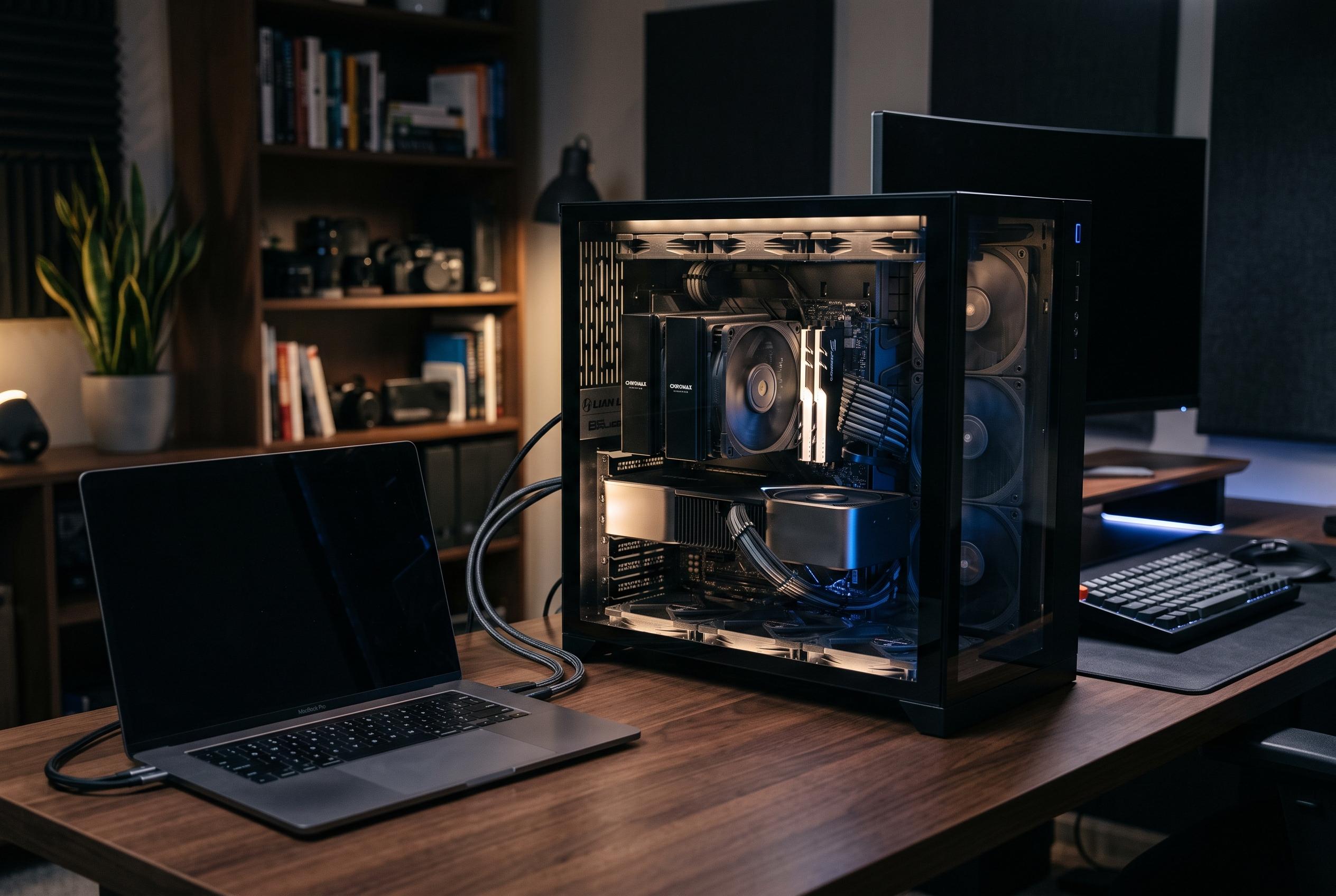
That broader compatibility matters because PAIR is fundamentally about concurrency, not magic scaling. Hardware Busters described it as workload-level parallelism rather than model sharding, and Nvidia’s own technical blog makes the same point. In the company’s demonstration, a five-subagent Hermes Desktop task running through Ollama averaged 18 minutes on a single RTX Spark laptop. The same workload, using a three-device PAIR cluster made up of an RTX Spark laptop, a DGX Spark and an RTX 5090 system, was said to complete in 8 minutes 48 seconds. Nvidia also stressed that this was an unofficial, configuration-specific demo, not a general benchmark.
That warning is necessary because PAIR is elastic. Tom’s Hardware notes that the software does not reserve other people’s GPUs as fixed capacity; it uses whatever spare compute is actually available at the time. If someone starts gaming, launches another AI job or shuts a machine down, the pool changes. That makes the approach less predictable than a dedicated cluster, and quality of service is not guaranteed. The trade-off is lower cost and better use of machines that would otherwise sit idle for much of the day.
The idea may travel beyond hobbyist home labs. Network World and Computerworld both suggest that offices with underused desktop GPUs could exploit the same model, especially where privacy, cost control or local data handling matter more than tightly managed performance. Forbes places the launch within Nvidia’s wider IFA effort to push local AI as a credible alternative to constant cloud usage, alongside its RTX Spark announcements and other software updates for agent-based workloads. In that sense, PAIR looks less like a novelty utility than an attempt to turn scattered personal and small-business hardware into a practical local inference fabric.
Disclaimer: This content is intended for informational purposes only. Readers are advised to exercise their own judgement, conduct due diligence, or consult a qualified expert before acting on any information provided.