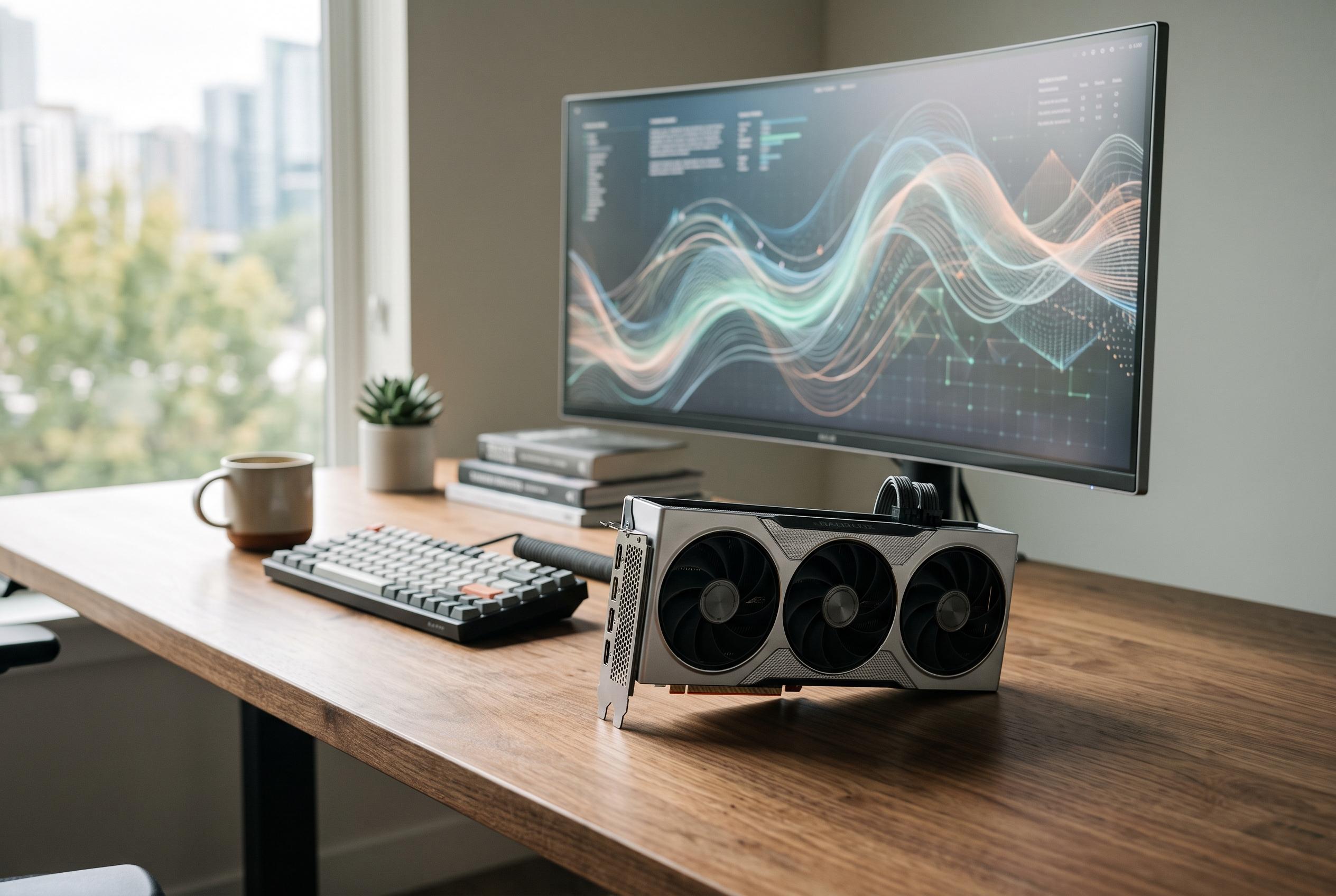

AMD’s Radeon RX 9070 XT emerges as a cost-effective rival to Nvidia’s GeForce RTX 5070 Ti, prompting a reassessment of value versus advanced features in the GPU market of 2025.
The strongest case for choosing AMD over Nvidia in 2025 was not that Radeon suddenly became the outright leader. It was that AMD narrowed the performance gap enough for many buyers to question whether Nvidia’s extras still justified the premium. Ars Technica and Engadget both found that the Radeon RX 9070 XT could run close to the GeForce RTX 5070 Ti in standard rasterised games while launching at $599, compared with Nvidia’s $749 starting point.
That shift mattered because AMD had spent years trying to undercut Nvidia without fully changing the market’s hierarchy. Engadget wrote that AMD had “finally done it” after earlier attempts with cards such as the Radeon 6700 XT and 7900 XT. Ars Technica was similarly positive, calling the RX 9070 and 9070 XT the first RDNA 4 cards and arguing that the architecture fixed “a lot of AMD’s problems”, especially in the volume part of the market built around 1440p play and occasional 4K use. The timing was also deliberate: AMD’s cards went on sale on 6 March 2025, a day after Nvidia’s RTX 5070.
Benchmarks suggest the appeal rests on how small the remaining gaps can be. GamersNexus found that at 4K in Starfield, the RX 9070 XT was ahead of the RTX 5070 Ti by about 2fps, which it called “measurable but irrelevant” because the more meaningful difference was cost. In Dragon’s Dogma 2 at 1440p, the site said Nvidia’s lead was only 3%. It went further, arguing that if the RTX 5070 Ti is effectively operating near RTX 4080-class territory in many games, then AMD’s new card is threatening performance once associated with much pricier hardware.
The calculation changes when the priority is feature depth rather than raw frame rates. TechRadar noted that both cards carry 16GB of memory on a 256-bit bus, but Nvidia couples that with GDDR7 memory and substantially higher bandwidth, as well as stronger dedicated hardware for AI and ray tracing. Engadget said AMD’s ray tracing had improved enough to make the 9070 series far more credible than earlier Radeon efforts, including in some 4K scenarios, yet still concluded that AMD’s Fluid Motion Frames was “not nearly enough at this point” against DLSS 4 multi-frame generation.
Software maturity is where Nvidia still looks hardest to dislodge. PC Gamer said the RX 9070 XT showed “great strides forward with both RT and AI processing” and judged that “FSR4’s ML algo looks good so far”. Ars Technica also reported that FSR 4 improved image quality over FSR 3.1, albeit with a small performance penalty at the same settings. Even so, Ars stressed that AMD was still closing a long-standing support and ecosystem gap rather than overtaking Nvidia outright. For buyers who want the broadest feature compatibility and the least uncertainty around new releases, GeForce still offers the safer bet.
Launch pricing, however, was only part of the story. TechRadar pointed out that neither Nvidia nor AMD offered a first-party card in this segment, leaving board partners to decide what shoppers would actually pay. That made street pricing more volatile than the official figures suggested. Tom’s Hardware reported that Nvidia’s RTX 5070 Ti, RTX 5080 and RTX 5090 had sold out almost immediately and that prices had risen by 50% or more above MSRP. PC Gamer warned that AMD’s value case could also unravel if add-in board suppliers inflated prices, saying the RX 9070 XT would be “a hugely consequential GPU” only if vendors kept “their worst pricing excesses in check”.
This is why the AMD option appealed most strongly to a particular sort of user rather than everyone. Buyers focused on high-refresh 1440p gaming, with some interest in 4K and less concern about absolute ray-tracing leadership, had a clear reason to look at Radeon. Ars Technica said the RX 9070 XT comfortably beat the RTX 5070 and remained close to the 5070 Ti in non-ray-traced workloads. TechRadar’s conclusion was broadly similar: AMD made the stronger argument for value-led gaming, while Nvidia retained the advantage for people who cared most about advanced features and software refinement.
The broader lesson is that AMD did not need to surpass Nvidia across the board to make switching plausible. It only needed to close its historical weaknesses enough that Nvidia’s remaining advantages looked expensive rather than automatic. Tom’s Hardware summed up the RX 9070 XT as offering “strong mainstream performance at a great price”, while GamersNexus treated it as a serious threat to Nvidia’s upper-mid-range line-up, not merely a cheaper fallback. That is the real reason the conversation changed. The question ceased to be simply which card was faster, and became whether Nvidia’s better ray tracing, AI tools and software polish were worth paying materially more for.
Disclaimer: This content is intended for informational purposes only. Readers are advised to exercise their own judgement, conduct due diligence, or consult a qualified expert before acting on any information provided.