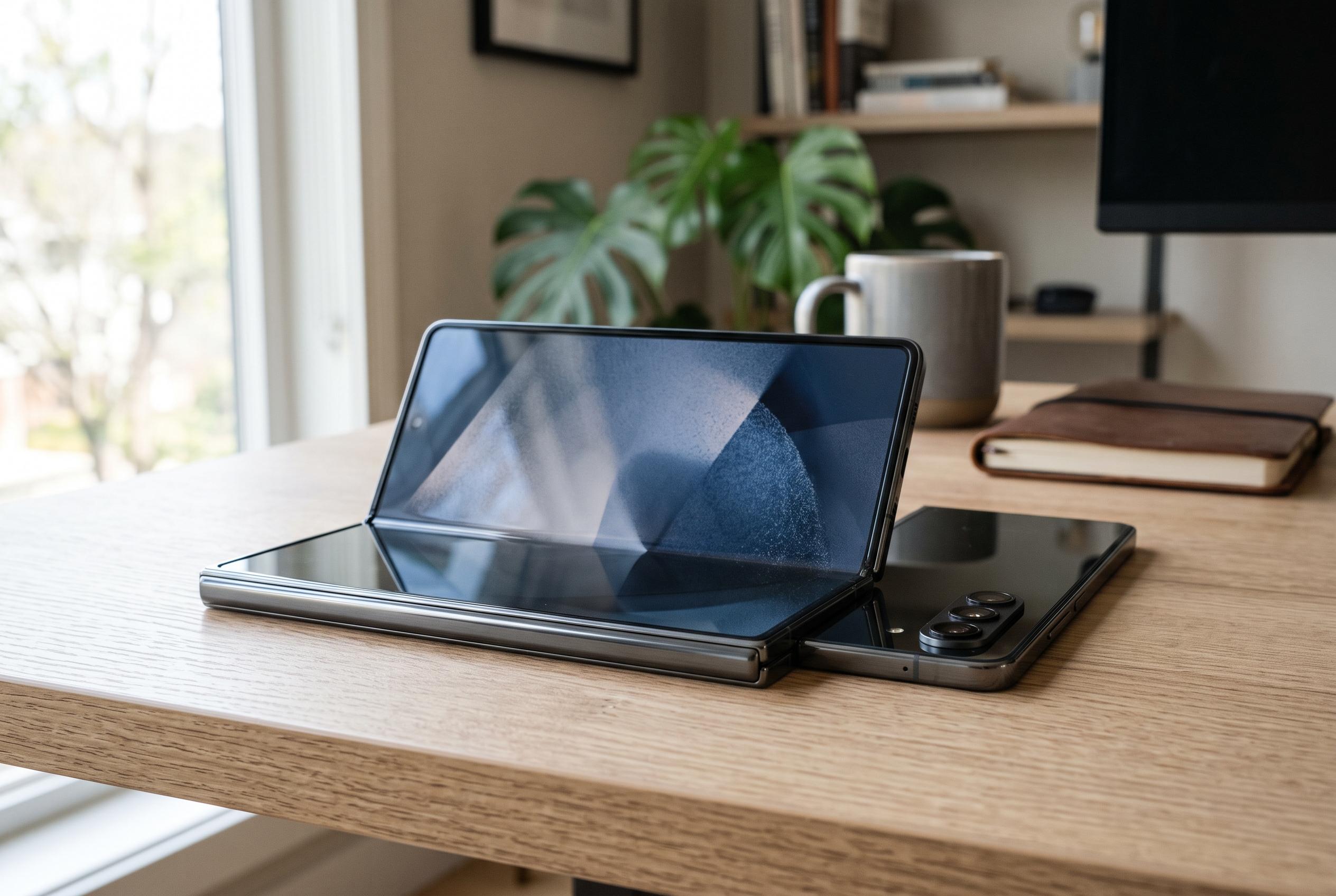

Samsung’s latest Galaxy Z Fold8 introduces a new hinge system prioritising ease of unfolding and a flatter profile, but at the cost of Flex Mode, highlighting a strategic shift in foldable design philosophy.
Samsung’s most consequential change to the Galaxy Z Fold8 is not the wider shape or the camera reduction, but a deliberate trade-off in how the handset opens. Across Samsung’s launch material and several early reviews, the standard Fold8 emerges as a device engineered to unfold more easily, sit flatter and show a less obvious crease, even though that means giving up the long-running Flex Mode found on the Fold8 Ultra and the Flip8.
That omission is more significant than a missing menu option. Flex Mode has been part of Samsung’s foldable identity since the original Galaxy Z Flip in 2020, because it lets the phone act like a small clamshell workstation for video, calls and media controls. SamMobile reported that the standard Fold8 no longer includes a Flex Mode settings page at all, while the feature remains present on the Fold8 Ultra and Flip8. There is some disagreement over what the new hinge can physically do: SamMobile says the phone can still rest at partially open angles, but Android Central and Tom’s Guide both say it is not really intended to hold a wide range of positions, particularly beyond 90 degrees.
Samsung has not presented the change as a feature removal so much as the result of a broader redesign. In its July 2026 launch material, the company said the Fold8 uses a new “Flex Titanium” structure that combines a titanium-alloy film with an enhanced titanium plate. Samsung said the display and hinge were tuned together by balancing hinge mechanics, display tension and magnetic force to “make unfolding feel smoother, lighter and more natural”. The same announcement also fixed the basic hardware position: the standard Fold8 has a 4,800mAh battery and dual 50-megapixel rear cameras, while pre-orders in selected markets opened on 22 July 2026.
A later Samsung Newsroom engineering interview gave a clearer picture of the thinking behind that design. Published on 30 July 2026, it said the company treated the foldable as a connected system rather than a collection of separate parts, redesigning the display, hinge, battery, thermal layout and internal architecture together. Samsung said the new display support structure had to protect the ultra-thin OLED panel while preserving enough flexibility for repeated folding. According to that interview, the display module was made 10% thinner, creating extra room for the battery, cooling system and camera hardware. Samsung also said the latest Galaxy Z range went through more than 100 reliability validation tests, including checks for drops, folding endurance, pressure, moisture and debris.
Independent teardown work broadly supports Samsung’s description, while also tempering the marketing message. iFixit said its disassembly and CT scans showed a redesigned hinge working with a titanium-reinforced display stack, including a perforated titanium support plate and an extremely thin titanium-alloy film beneath the OLED. The site said that film is about one-third the thickness of an average human hair, and cited Samsung’s claim that the material is “20 times stiffer than the polymer film used in previous folding displays”. Even so, iFixit said the crease remains visible and argued that foldables still carry an unavoidable mechanical weakness because dust and fine particles can still find paths into a device built around moving parts.
In day-to-day use, reviewers suggest the benefits of the redesign are real. Tom’s Guide said the 7.6-inch inner screen opens more easily than the previous generation and folds almost perfectly flat, with the crease still detectable by touch but much less distracting during viewing. It also said the 4:3 inner panel produces smaller black bars for video than the more square Fold8 Ultra. In its battery test, Tom’s Guide recorded 12 hours and 19 minutes of web browsing. Android Central, after two weeks with the phone, said the wider layout can comfortably handle three apps side by side and may be more practical than the Ultra for some software in either portrait or landscape.
Those gains do not fully answer the case for Flex Mode, especially for buyers who use a foldable on a desk rather than in the hand. Tom’s Guide said it missed being able to watch YouTube and take Google Meet calls in that half-open position, while Android Central called the missing panel support a missed opportunity for media use. SamMobile’s reporting sharpens that point by showing the removal is visible in software as well as hardware: the standard Fold8 lacks the settings controls that used to make half-open operation useful, even if the device can still pause at some angles. For buyers comparing models, the distinction is now straightforward. The Fold8 Ultra keeps the older style of adjustable foldable behaviour; the standard Fold8 does not.
That leaves the Galaxy Z Fold8 looking like a more opinionated product than its predecessor. Samsung appears to have concluded that the standard model should behave less like a miniature laptop and more like a compact tablet that opens quickly and lies flatter once open. At $1,899, with deliveries beginning on 7 August 2026 according to SamMobile, it is still a premium device. But the evidence from Samsung’s own engineering material, from iFixit’s teardown and from early reviewers points to a coherent trade: users who value easier access to the large screen, a thinner display module and better video framing may find the compromise worthwhile, while those who rely on hands-free half-open use will need to look at the Fold8 Ultra instead.
Disclaimer: This content is intended for informational purposes only. Readers are advised to exercise their own judgement, conduct due diligence, or consult a qualified expert before acting on any information provided.