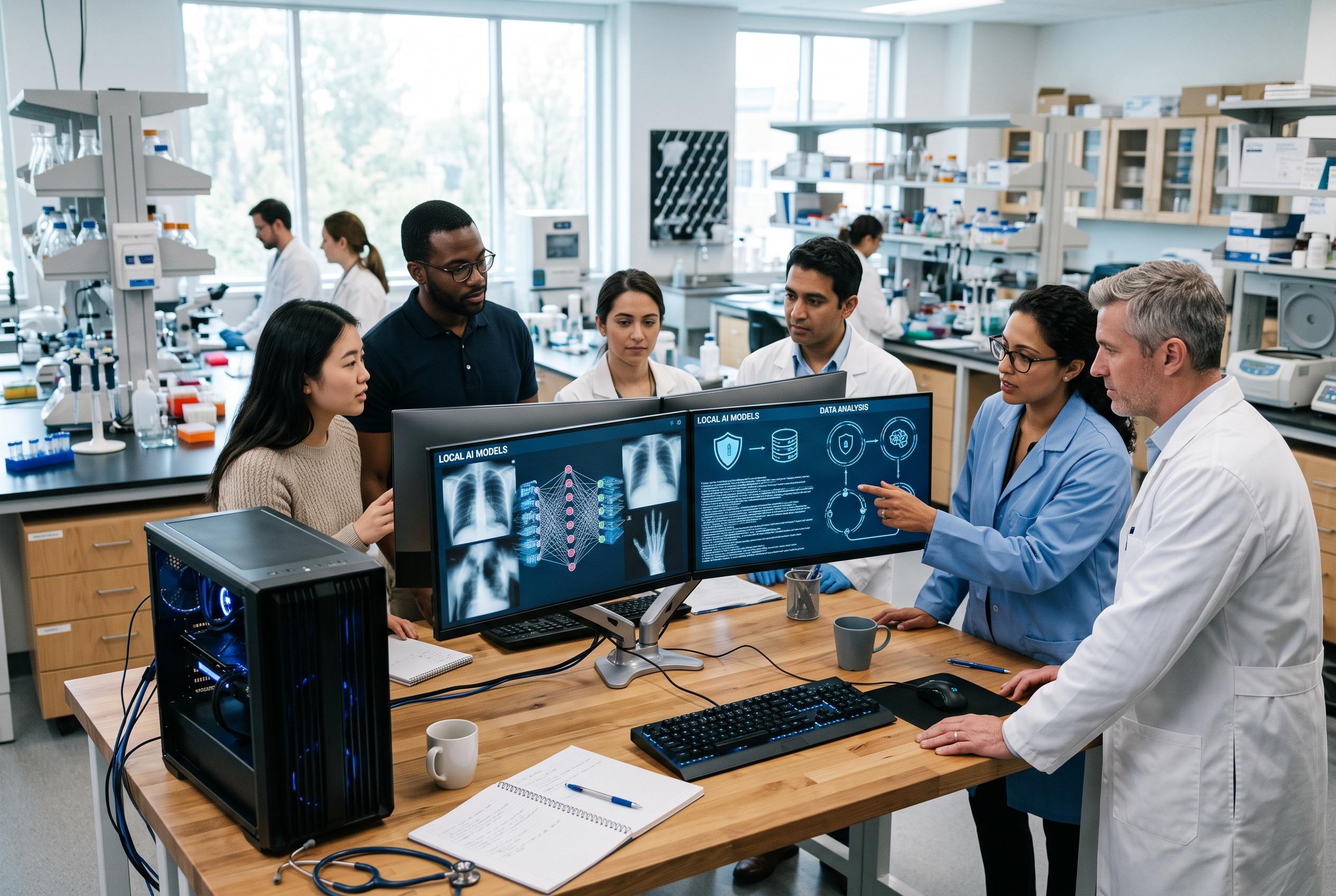

A growing movement in medical AI emphasizes offline, local deployment of research and diagnostic tools, prioritising privacy and operational resilience over cloud-based architectures. New prototypes demonstrate AI systems that operate solely on consumer-grade hardware, using monographs and images as knowledge bases, challenging conventional cloud-dependent approaches.
A personal proof-of-concept published on Habr makes a deliberately unfashionable argument about medical AI: that a useful clinical research assistant can be built without a cloud backend, a public API or specialist server hardware. The system is described as a fully local tool for literature search, built around roughly 2,500 indexed monographs, with pathology image retrieval and a DICOM viewer, and targeted at an Ubuntu laptop with 16GB of RAM and a 4GB graphics-memory budget rather than a data-centre machine. (habr.com) That claim lands into a broader local-first movement. A Surgical Information Assistant reported by medRxiv was also framed as an offline system deployable on consumer-grade hardware with a FAISS-based corpus, while CloudKites says its MedPodGP software runs on Windows or Linux, works on a CPU-only PC and needs no internet connection. (openreview.net)
What links these systems is not just cost control. It is a shared belief that privacy and operational resilience are architectural requirements. A 2021 arXiv paper describing a mobile assistant for lower-resource regions said its Android application “works with or without an active internet connection”, had been tested by dozens of primary care providers and was intended to help document encounters, collect signs and symptoms, and suggest diagnoses and prescriptions. (arxiv.org) PocketMed AI, listed on Google Play and updated on May 26, 2026, presents a lighter bedside version of the same idea, offering on-device dosage look-up, ABG interpretation, paediatric eGFR calculation, APGAR and GCS scoring, while stating that it does not collect or transmit patient data for its core offline features. GitHub’s Radiology AI Assistant makes an even harder local claim, saying “No patient data ever leaves the device” and binding its service to a loopback address by default. (play.google.com)
The Habr design becomes more controversial in its choice of knowledge base. Rather than centring protocols, guidelines or journal databases, it explicitly favours monographs, arguing that formal clinical protocols can lag breakthrough findings by 10 to 17 years and that books provide a more stable, less noisy basis for synthesis across disciplines. The author says that trade-off sacrifices freshness for coherence and auditability. (habr.com) However, recent protocol-oriented work points in the opposite direction. Researchers behind a pathology-laboratory RAG assistant wrote that static manuals and PDFs were outdated, fragmented and hard to search, creating workflow risks in a field where up to 70% of medical decisions depend on laboratory diagnoses. Their system used a corpus of 99 protocols, 323 question-answer pairs and 10 experiments, and reported stronger results from recursive chunking, hybrid retrieval and a biomedical embedding model, which lifted answer relevance to 0.74, faithfulness to 0.70 and context recall to 0.77. (arxiv.org)
On the engineering side, the Habr prototype is shaped by memory limits rather than by a pursuit of maximal model size. The article describes five specialist personas for general medical search, two pharmacology modes, biochemistry and a dedicated search engine, but says a full multi-agent orchestration layer and separate neural reranker were dropped to stay within the graphics-memory ceiling. Instead, the system reformulates a user query in simpler language, runs FAISS retrieval on both the original and rewritten prompts, and asks the local model to synthesise the overlapping evidence. (habr.com) That approach echoes, in smaller form, the DeRetSyn workflow described in the Surgical Information Assistant paper. There, a 3B Llama model paired with agentic decomposition and retrieval reached 63% top-1 accuracy across 14,500 synthesised surgical question-answer pairs, beating a non-RAG GPT-4o baseline at 42.5% and a conventional 8B Llama RAG set-up at about 53%. (medrxiv.org)
The most distinctive feature of the Habr system is that it tries to recover visual knowledge from text-heavy corpora without deploying a full multimodal model. The article says it uses PyMuPDF to locate images in indexed books, link them to captions and surrounding text, and return likely matches for MRI, CT and pathology-image queries. Its front end then places those results beside a local DICOM viewer showing axial, coronal and sagittal planes, although the author says an attempt at 3D manipulation in Python and JavaScript proved too slow and would need a C++ viewer to become practical. (habr.com) That puts it close to the radiology repository on GitHub, which couples local models with FastAPI, SQLite, a DICOM worklist, viewer, report editor, RAG and agent services, and defaults to a browser-accessible service on 127.0.0.1:8000. (github.com)
Where the Habr piece is weakest is evaluation, and the supporting sources make that gap plain. The author rejects board-style multiple-choice tests as contaminated because the corpus contains exam-preparation texts, and argues instead for “deterministic auditability”: the ability to trace an answer back to a named book and page. The article offers retrospective self-testing on de-identified historical records and a case study involving angiography software design, but not a formal benchmark. (habr.com) By contrast, the pathology paper publishes explicit retrieval experiments and the surgical paper reports a large synthetic benchmark. Yet the cautionary framing is consistent across almost every comparable system. The radiology project says it is “NOT a medical device” and not cleared for primary diagnosis, PocketMed says it does not replace clinical judgement or local prescribing guidance, and MedPodGP says the clinician still reviews, edits and signs every draft. (arxiv.org)
Taken together, these sources suggest that local medical AI is moving beyond simple novelty demos into a recognisable design category. One branch is becoming a quick-reference companion for wards and low-connectivity settings. Another is turning into workflow software for pathology, radiology and general practice. The Habr prototype pushes a third branch: a private, inspectable literature-synthesis engine that treats the ordinary laptop as the deployment target and the human clinician or researcher as the final orchestrator. Whether monographs prove a better foundation than protocols or fresher article collections is still unsettled, but the strategic direction is clear: keep sensitive data on the machine, narrow the tool’s remit and make its evidence trail visible. (arxiv.org)
Disclaimer: This content is intended for informational purposes only. Readers are advised to exercise their own judgement, conduct due diligence, or consult a qualified expert before acting on any information provided.