
Lenovo unveils the IdeaPad Vibe laptops and IdeaCentre AIO i desktops featuring personalised colours and AI capabilities, targeting style-conscious consumers at affordable prices, in a bid to challenge Apple’s MacBook Neo and redefine the mainstream PC market.
Lenovo has put firm dates and prices on the consumer PC range it showed at IFA 2026, with the new IdeaPad Vibe laptops due from October and the refreshed IdeaCentre AIO i desktop set to follow in November. Officially, Lenovo is guiding to a starting price of €799 for the 14-inch and 15-inch Vibe models and €999 for the 24-inch and 27-inch all-in-one. US launch coverage from Tom’s Hardware and Windows Central puts the Vibe at about $699.99, with AMD versions first in October and Snapdragon X configurations a month later; Tom’s Hardware says the all-in-one starts at $939 in November. (news.lenovo.com)
That timing matters because Lenovo is trying to enter a suddenly more style-conscious part of the mainstream PC market without moving into premium pricing. Reports from Tom’s Hardware and Windows Central both cast the Vibe as a direct response to Apple’s MacBook Neo, while Lenovo’s own launch materials say the announcement was made in Berlin on 3 September during Lenovo Innovation World 2026 as part of its wider Personal AI push. La Tercera likewise described the launch as a new consumer line built around artificial-intelligence features for everyday study, work and home use. (tomshardware.com)
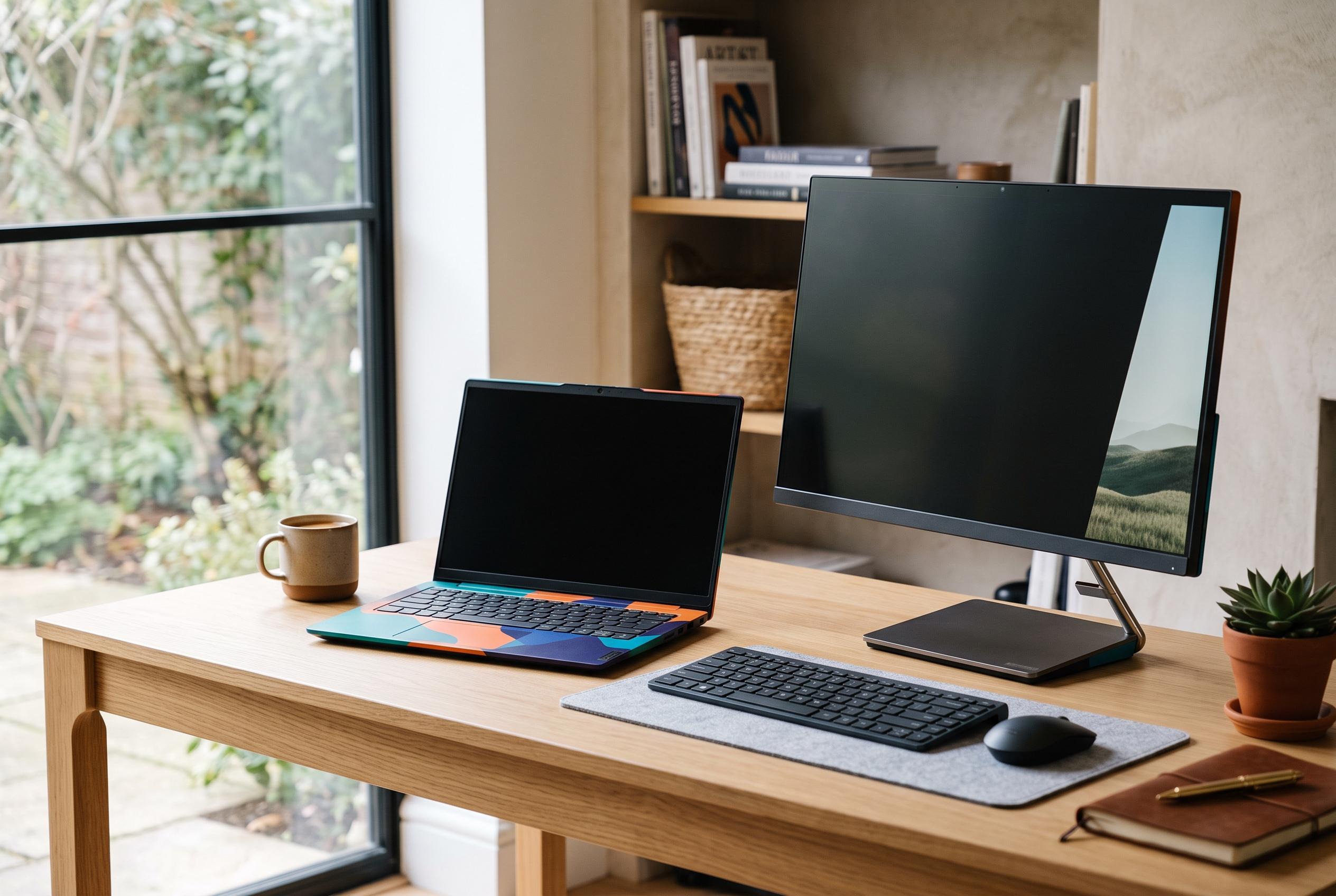
The clearest point of difference is colour. Lenovo says the seven finishes for the Vibe range were created with Pantone and inspired by shades people encounter in daily life, while Windows Central reported that the palette was meant to reflect “different moods, personalities, and lifestyles”. The colours are Dreamy Violet, Spicy Gold, Zen Green, Chill Blue, Radiant Coral, Moody Blue and Lowkey Grey, and Lenovo plans to sell swappable keycaps as an extra layer of customisation. In Lenovo’s words, the machine “wasn’t created for one type of user”. (windowscentral.com)
Under the surface, Lenovo is splitting the range by processor family rather than by a single fixed specification. The company is leading with Snapdragon X in the core design story, but says AMD Ryzen AI 400 versions will also be offered, with Intel models coming later. T3 reported that the OLED option is restricted to Moody Blue and Lowkey Grey, with optional touch on the 15-inch version, while Lenovo says those OLED panels can reach up to 100% DCI-P3 coverage; other variants use IPS panels with up to 120Hz refresh and as much as 100% sRGB coverage. Lenovo also says select configurations reach 24GB of memory, while AMD systems can be configured with upgradeable dual-slot memory up to 32GB and storage up to 1TB. (t3.com)
Hands-on reports suggest Lenovo has paid at least as much attention to practicality as to appearance. IT Pro measured the 14-inch model at 14.9mm thick and 1.3kg, and said it could be opened with one finger and used comfortably one-handed. The same report highlighted 1.3mm key travel and bright keyboard backlighting. Tom’s Guide, after brief hands-on time at Lenovo’s IFA event, said the Vibe felt sturdy despite its low weight and singled out the unusually broad port selection for a thin consumer notebook: two USB-A ports, two USB-C ports, HDMI, a headphone jack and a microSD reader. (itpro.com)
The desktop half of the launch is less eye-catching than the laptops, but arguably more unusual for Lenovo’s consumer line-up. Lenovo says this is the first time the IdeaCentre AIO i has been offered in multiple colours, adding Dreamy Violet, Radiant Coral, Zen Green, Chill Blue, Luna Grey and Cloud Grey, each paired with a matching Lenovo Essential Wireless Combo Gen 3 keyboard and mouse. The machine comes in 23.8-inch and 27-inch sizes, and Lenovo says the redesign removes the bulky central box traditionally found behind the display. According to Lenovo, the panels run at up to 120Hz, reach 350 nits, support up to 32GB of LPDDR5X memory and include dual SSD slots. (news.lenovo.com)
Lenovo is also trying to give the all-in-one a clearer AI identity. Its release says the IdeaCentre AIO i is built on Intel Core Series 3 processors with up to 40 platform TOPS of AI performance, and that the AI Turbo Engine will control a new Adaptive Lighting system with Boot-up, Default and Music modes. However, Lenovo adds in the small print that lighting controls are due in a future over-the-air update, so one of the headline features will not be fully present on day one. The desktop also gets a stand with 30mm of height adjustment and a -5 to 15-degree tilt range, plus options for a 5MP IR camera, a physical shutter, wireless charging and touch input. (news.lenovo.com)
The wider question is whether colour and personalisation are enough to distinguish these machines once buyers get past launch-week novelty. Lenovo is clearly betting that they are, but early coverage suggests the more durable selling points may be price and usability. IT Pro argued that the Vibe has “lots for business to like” despite its consumer positioning, while Tom’s Hardware noted that Lenovo’s own materials only promise up to 24GB of memory on select configurations and suggested the lowest-priced models may not be ideal for heavy local AI work. For now, though, Lenovo appears to have found a cleaner way to talk about mainstream Windows PCs: not just cheaper, but more individual. (itpro.com)
Disclaimer: This content is intended for informational purposes only. Readers are advised to exercise their own judgement, conduct due diligence, or consult a qualified expert before acting on any information provided.