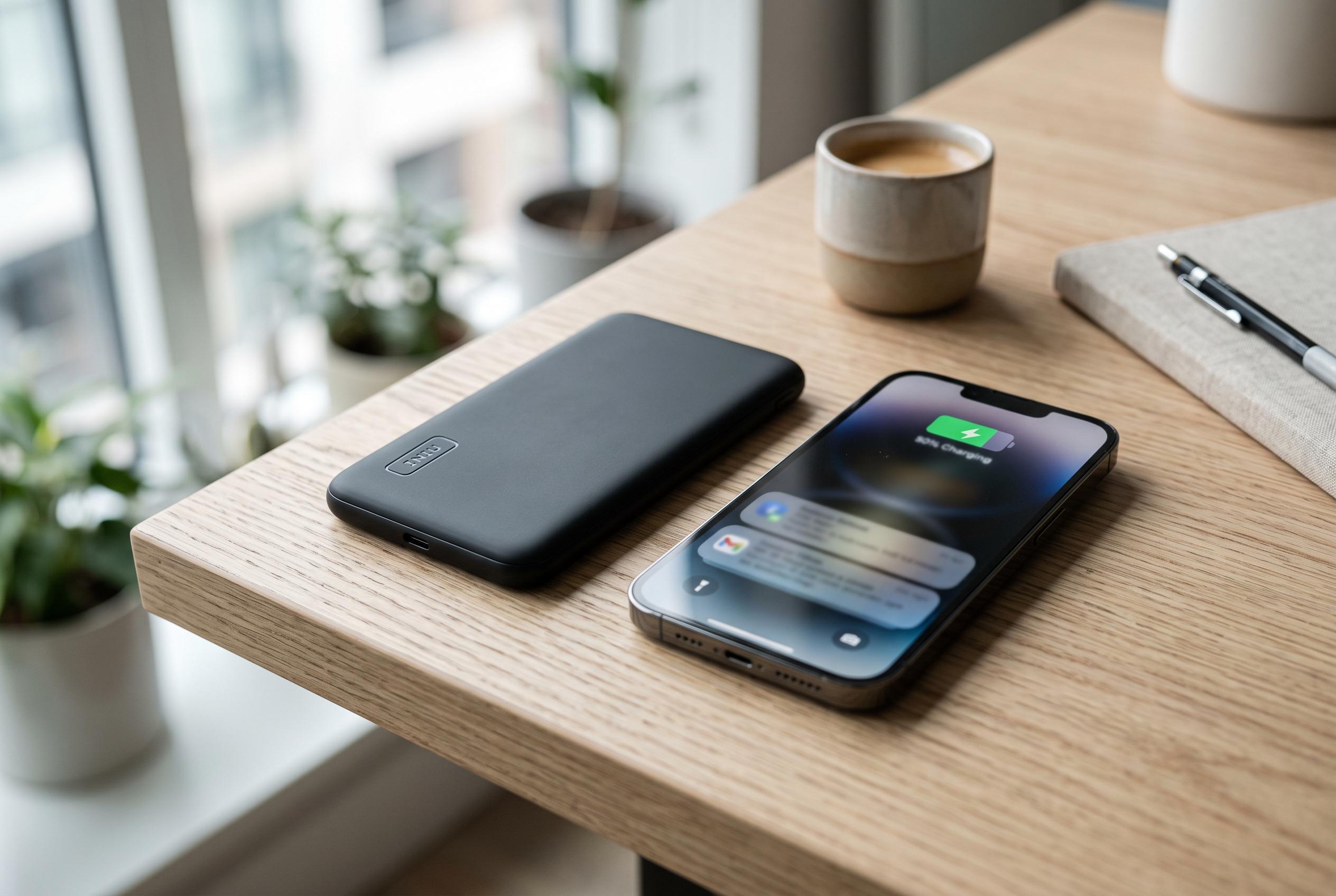

INIU’s new SnapGo Air power bank offers a sleek, Ultra-thin design with 25W wireless charging tailored mainly for Apple users, sparking debate on its Android compatibility and true charging speeds.
Across a cluster of early reviews, INIU’s SnapGo Air is emerging as a notably thin 10,000mAh power bank whose headline feature, 25W Qi2.2 wireless charging, is far more compelling for recent iPhones than for most Android handsets. Several publications found that the accessory’s real strength is its combination of compact design, clear battery readout and stronger wired charging, while device compatibility still determines how much of its advertised performance buyers will actually see.
TechRadar reported that the SnapGo Air launched on 15 May 2026 at $54.99, £49.99 or AU$69.99, placing it in the upper end of the mainstream power-bank market rather than the budget tier. The same review listed dimensions of roughly 10.7 x 7.1 x 1.38cm and a weight of 196g, while Expert Reviews described an anodised aluminium chassis offered in six finishes, including metallic orange, lilac and dark blue. Cult of Mac put the emphasis on the same physical proposition in simpler terms, calling it a 0.5-inch-thin pack that looks and feels more like a premium phone accessory than a generic battery brick.
A large part of that positioning comes from the built-in USB-C GoCord. Cult of Mac said the detachable cable also works as a strap, while Insider Gaming described it as a carrying toggle for people moving between events with phones, cameras, microphones, laptops and handheld consoles in tow. TechRadar noted that the cable is hidden within the body rather than bundled separately, and several reviewers highlighted the exact-percentage status display as a more practical solution than the usual four-light indicator. That combination gives the SnapGo Air a more considered design than most slim magnetic packs at this price.
The catch is that its most marketable feature remains selective. Reviewed said 25W wireless charging is supported only on the iPhone 16 Plus, iPhone 16 Pro Max and the iPhone 17 range, while iPhone 12 to iPhone 15 models top out at 15W provided they are running iOS 17.4 or later. The same outlet added that Samsung, Pixel and other Android phones will still charge wirelessly, but not at the full 25W rate. Magnetic attachment also appears uneven across platforms: Reviewed found the pack gripped firmly to an iPhone through MagSafe, but sat much less securely on a Samsung handset, where it could slide off if lifted.
Performance results underline that difference between specification and day-to-day use. Android Authority said an iPhone 17 Pro Max reached a full charge wirelessly in about five hours and 17 minutes, which the reviewer judged slower than the 25W headline suggested because of heat and conversion losses. Wired results were much stronger. Android Authority said the same phone charged fully in under two hours over cable, with 26% still left in the battery pack, while TechRadar said the GoCord could top up a 5,200mAh handset in 1 hour and 24 minutes. There are limits here too: CravingTech found that an Oppo Reno 12F 5G took around 2 hours and 13 minutes to charge from empty because the SnapGo Air uses standard USB Power Delivery rather than Oppo’s proprietary SuperVOOC system.
There is also some useful nuance around charging several devices at once. Android Authority reported that the unit could handle three concurrent loads, with one device charging wirelessly and two over USB-C, albeit with output shared between them. Expert Reviews, however, found more restrictive behaviour in testing: one USB-C connection and the Qi2 pad could operate together, but using both USB-C ports appeared to disable the wireless pad. The same publication said that when a laptop and phone were both connected by cable, the phone was drawing 8.9W, a reminder that nominal 45W output does not mean every attached device receives that level at the same time.
The SnapGo Air’s build quality also received an unusually strong endorsement for a lightweight charger. Android Authority said the pack survived a fall of about three metres from the second floor of a coffee shop, leaving only minor dents. That matters because portability is central to the product’s appeal. Insider Gaming framed it as a practical companion for people carrying several gadgets through long days away from sockets, rather than simply a bedside top-up battery. In that context, its low profile and integrated cable may matter more to buyers than laboratory charging peaks.
Taken together, the reviews point to a product with clear strengths and equally clear boundaries. For owners of the newest iPhones, particularly those already invested in magnetic charging, the SnapGo Air looks well judged: Cult of Mac gave it five stars and listed a lower street price of $49.49, while Expert Reviews called it “the perfect power bank accessory” for people with cutting-edge smartphones. For everyone else, the proposition is still solid but less transformative. Android users can use the wireless pad, and wired charging remains fast by general standards, yet the full 25W Qi2.2 promise and the most secure magnetic fit are still largely tied to Apple’s ecosystem. That makes the SnapGo Air less a universal breakthrough than a very polished, well-priced iPhone-first accessory that happens to remain useful for other devices.
Disclaimer: This content is intended for informational purposes only. Readers are advised to exercise their own judgement, conduct due diligence, or consult a qualified expert before acting on any information provided.