
A recent project to retrofit a flat’s electrical design reveals a strategic shift towards flexible, scalable smart home solutions integrating Matter controllers, advanced sensors, and reliable power infrastructure for enhanced household automation.
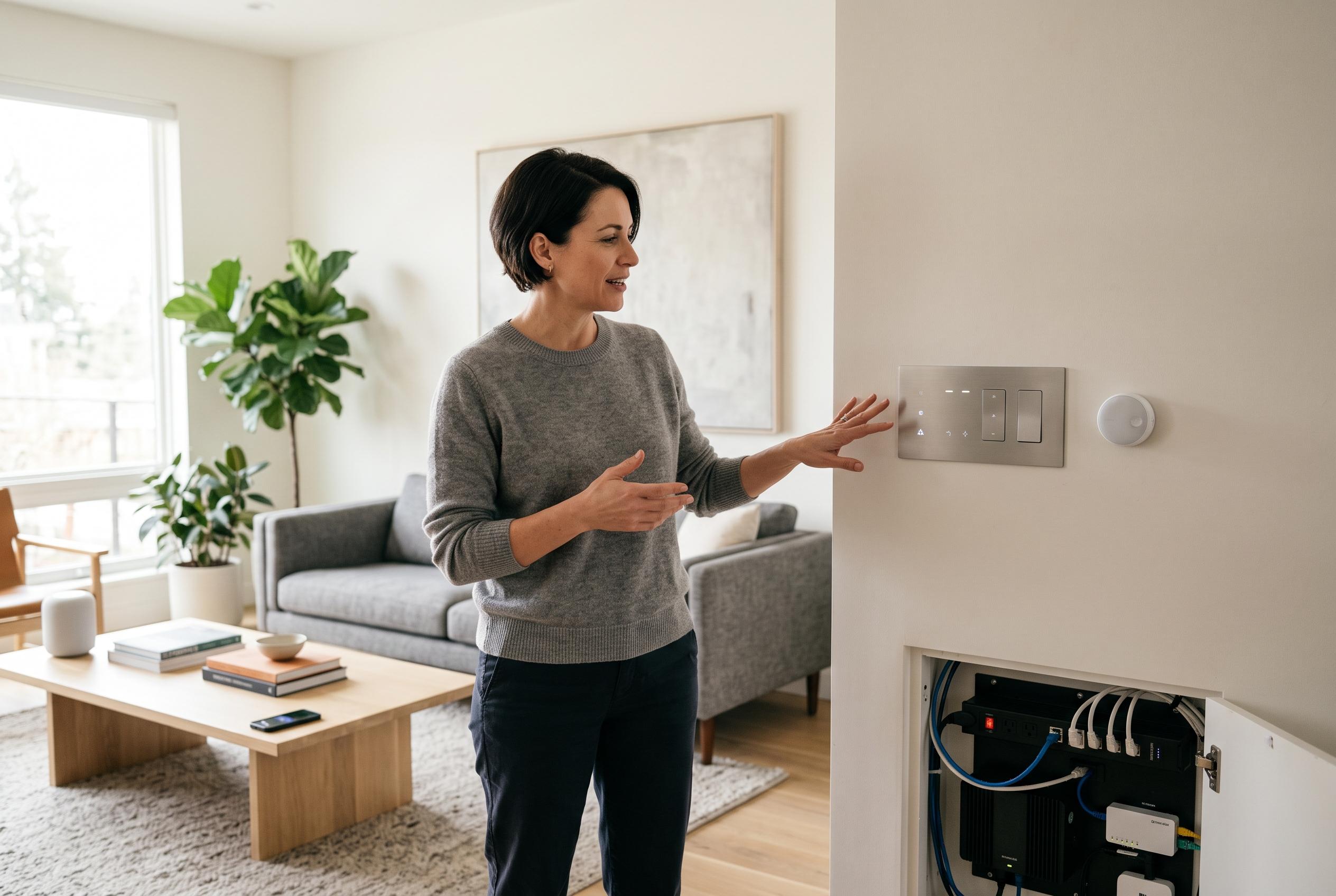
Writing on Habr as his new flat reaches the electrical-design stage, the owner describes a sharp shift away from the idea of a single-brand, fully wired smart home and towards a mixed system built around Home Assistant, centralised relays and a small number of flexible room controls. The clearest sign of that change is his willingness to replace banks of conventional switches with panels and dials. That is a more practical proposition than it once was: SONOFF sells its NSPanel Pro 120 as a Matter controller with Zigbee 3.0 onboarding, while Flic markets its Twist as a wireless smart dimmer that can trigger four different actions, from a simple press to a push-and-twist.
The most consequential technical decision is his preference for presence sensing over ordinary motion detection in rooms where people may remain still for several minutes. Reviews of Aqara’s FP300 suggest that this is not simply gadget enthusiasm. Matter Alpha’s Ward Zhou described the device as a battery-powered 4-in-1 sensor intended for places where continuous power is inconvenient, which is precisely the constraint in bathrooms, toilets and other finished spaces. Zhou’s judgement was that the product solves the power problem for radar-based occupancy sensing while still exposing Matter, although he added that he missed the “fancy features” of Aqara’s more advanced models.
That compromise matters because the automation plan depends on these sensors behaving more intelligently than a timer on a light switch. SmartHomeScene’s teardown and review of the FP300 strengthens the case for caution. Its value lies in testing the battery-powered mmWave idea in real conditions rather than repeating a specification sheet, and the broad lesson is that easier placement does not eliminate the trade-offs associated with battery operation and simplified sensing. In practice, that supports the owner’s split approach: presence sensors where lights must not cut out on a seated person, and faster motion sensors only in passing spaces such as the corridor.
Behind the visible controls sits an infrastructure plan that is unusually serious for a domestic flat. The Habr post envisages local automation, 10-gigabit cabling and a cupboard reserved for server and networking equipment, with the uninterruptible power supply used chiefly to protect a NAS and allow orderly shutdowns during power disturbances. Eaton’s specifications for the 5P Gen2 850 VA model show why it was shortlisted. The unit is a 1U, line-interactive UPS rated at 680 W, with automatic voltage regulation, clean sinewave output and hot-swappable batteries. Eaton also lists manageable outlet groups, communications ports and non-volatile logging, all features that matter more to a home server than headline runtime alone.
At the front door, interoperability appears to be trumping hardware glamour. The owner openly prefers Xiaomi’s more feature-rich lock design, especially the built-in viewing functions, but is leaning towards Aqara because the wider flat will be controlled through Apple Home as well as Home Assistant and voice assistants. That bias is supported by HomeKit News’ review of the Aqara A100 Zigbee model, which assessed the lock in everyday use inside Aqara’s own ecosystem and in a HomeKit setting rather than treating it as a standalone piece of hardware. For a flat whose automations will already span multiple protocols, that kind of ecosystem fit may prove more important than any single lock feature.
The same argument extends to the wall panels that are meant to replace many traditional switches. According to ITEAD, the NSPanel Pro 120 can do more than display scene buttons: it can act as a Matter controller, add Zigbee devices in batches, and integrate with cameras and thermostat-style control flows. The company also says it includes a microphone and speaker for phone-to-panel and panel-to-panel calling. In a family home, those details matter. They turn the panel from a decorative tablet into a shared control surface that guests, children and less technical household members can use without reaching first for an app.
Where a touchscreen is excessive, the fallback is a small number of wireless scene controls placed exactly where they are needed. Flic’s own product page makes clear why its Twist controller appeals in this design. It supports press, double press, twist and push-and-twist interactions; it attaches with a magnetic plate; and it is rated for up to two years on a replaceable AAA battery, with an indoor range of up to 50 metres. Those characteristics suit bedside lighting, blind control and quick scene changes. The limitation is equally important: Flic requires a hub, so each gain in flexibility introduces another dependency that has to remain powered, paired and maintained.
Taken as a whole, the Habr project is best understood not as a shopping list of clever devices but as an attempt to build a maintainable control layer before the walls are closed. The external sources broadly support that direction, while also sharpening its risks. Battery-powered presence sensors are easier to install but less capable than permanently powered flagships; a smart lock becomes more attractive when it fits the home platform already in use; panels only earn their keep if they simplify life for the rest of the household; and a switch-light design is only as robust as the hubs, relays and backup power behind it. If the owner tests those assumptions in Home Assistant before committing the wiring, the result could be a technically coherent smart flat rather than an expensive collection of isolated gadgets.
Disclaimer: This content is intended for informational purposes only. Readers are advised to exercise their own judgement, conduct due diligence, or consult a qualified expert before acting on any information provided.