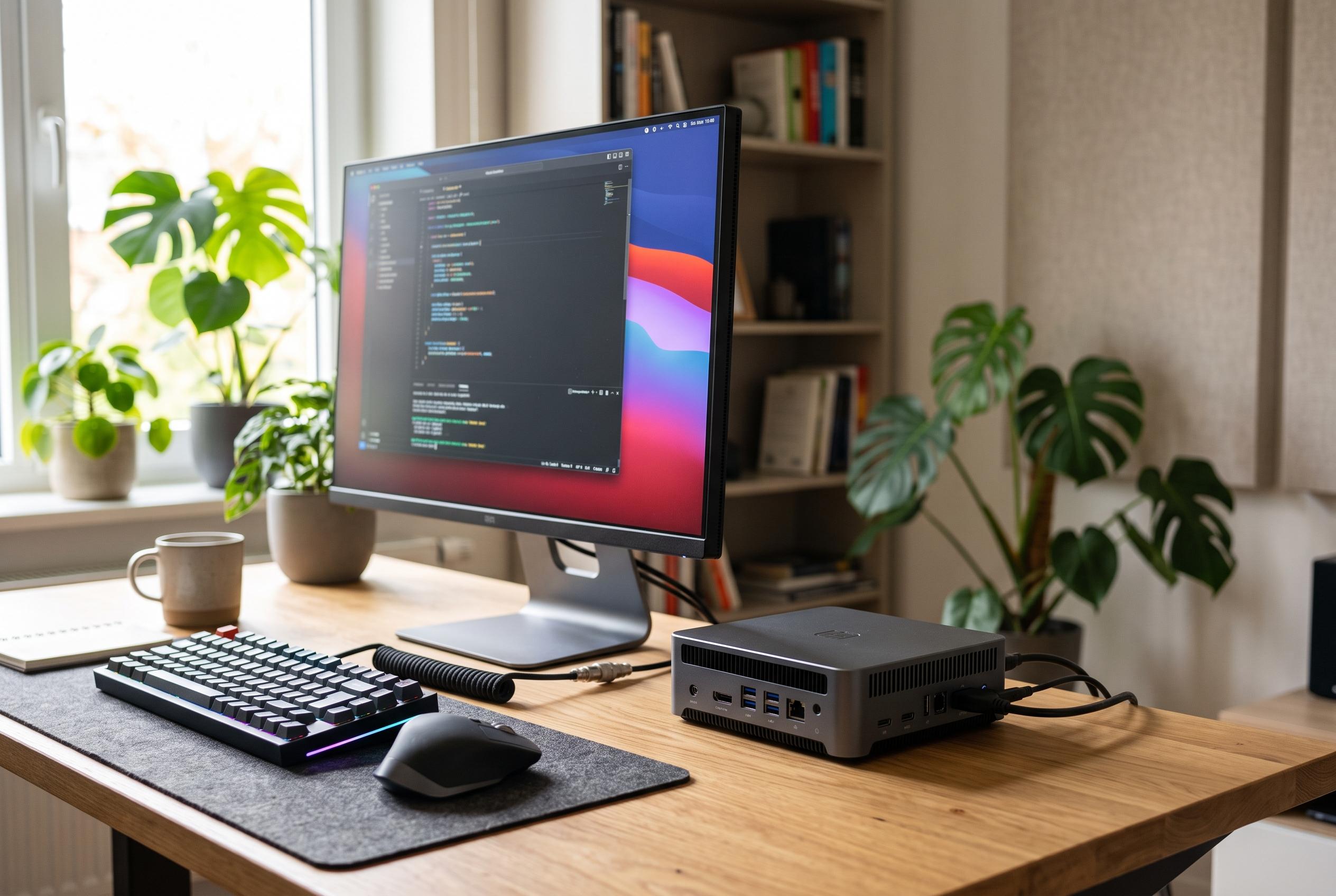

The mini PC market has split into space-saving office machines and powerful systems rivaling premium laptops, with new models setting high standards for performance, expandability, and connectivity in a compact size.
Mini PCs are no longer a single, bargain-basement category. Recent models show the market has split cleanly in two: compact office machines built to save space and power, and far more capable systems that now compete with premium laptops and small workstations. Reviews of Minisforum’s AI X1 Pro, built around AMD’s Ryzen AI 9 HX 370, describe a machine that sits well above earlier mini PCs in performance terms, while higher-end systems based on Ryzen 7 H 255 and Intel’s Core Ultra 7 256V show that buyers can now get serious computing power in a very small box.
That does not mean every small PC is a sensible buy. The stronger value case starts in the middle of the market, where systems using chips such as AMD’s Ryzen 5 7535HS offer enough headroom for everyday work, heavier multitasking and some creative workloads without drifting into workstation pricing. Independent testing by iXBT of Tecno’s Mega Mini M1 Lite AMD, also known as the ML01, places that machine in exactly this part of the market. The review compared it with other compact systems and ran video conversion and rendering tests in tools including MediaCoder, HandBrake, VidCoder, POV-Ray and Cinebench R20, giving it far more substance than a mere specification sheet.
That Tecno review also points to a wider problem for buyers: memory specifications on mini PCs are not always as straightforward as they look. iXBT noted that although the ML01 is advertised with DDR5-4800 memory, test utilities reported the memory clock at 3200MHz, adding that this can happen with LPDDR and that actual bandwidth should be measured directly rather than assumed from a product listing. That is a useful warning in a category where small differences in memory design can have a large effect on responsiveness, integrated graphics performance and long-term value.
At the Intel end of the market, CHUWI’s AuBox X 256V is a good example of how manufacturers are trying to balance performance, size and cost. TechRadar and Windows Central both say the system uses Intel’s Core Ultra 7 256V, and both note that the chip’s memory is integrated rather than socketed, which means RAM cannot be upgraded later. That limitation matters. Buyers may get a very compact machine with strong single-core behaviour, an NPU rated at 47 TOPS for on-device AI features and storage that Windows Central described as showing “stellar read and write speeds”, but they must accept that one of the most important components is fixed from day one.
The chassis design partly offsets that restriction. Both English-language reviews say the AuBox X has three M.2 slots in total, one reserved for the Wi-Fi 6E card and two available for storage, and that both storage slots take full-size 2280 SSDs. Windows Central adds that the bottom panel comes off with four captive screws, making access straightforward. TechRadar says the machine has very few direct rivals in the same processor class and points to GMKtec’s NucBox K13 as the clearest comparison point, at $669.99 with a 512GB drive or $719.99 with 1TB. Its conclusion is cautious: the CHUWI can look expensive against that competitor, even if the design details help explain part of the premium.
If the AuBox X shows where high-end Intel mini PCs are heading, Minisforum’s AI X1 Pro illustrates how far AMD-based compact systems have moved beyond the old idea of the mini PC as a light office box. PCWorld’s assessment is blunt: the AI X1 Pro aims at maximum performance and belongs in the same conversation as powerful ultrabooks and compact workstations. Notebookcheck reaches a similarly expansive conclusion, calling it an all-round machine for office work, multimedia, gaming and creative tasks. In other words, the format is no longer defined primarily by compromise; at the top end, it is defined by how much performance can be packaged into a serviceable, space-saving enclosure.
Expansion is the feature that most clearly separates the merely small from the genuinely versatile. Notebookcheck’s testing of the AI X1 Pro with an external GeForce RTX 4090 over OCuLink, alongside comparisons with USB4-based setups, shows why enthusiasts increasingly care about external I/O as much as CPU branding. OCuLink delivered stronger results in the published comparisons than USB4, reinforcing the idea that not all external GPU paths are equal. For buyers who want a compact machine today with the option of adding graphics performance later, that distinction is more important than many marketing pages suggest.
The Ryzen 7 H 255 platform occupies a useful middle ground between affordability and ambition. Heise’s review of the Minisforum AI X1 describes it as a high-quality, powerful mini PC with 2x USB4, quiet operation and Wi-Fi 7, and says the processor is sufficient for Full HD gaming. The same review also flags the compromises: only one LAN port and a price that is high relative to more basic models. That makes the H 255 less interesting as a bargain purchase than as a premium mainstream option for users who want a quiet, well-finished Windows 11 box without stepping up to the cost of a Ryzen AI 9 system.
Taken together, these reviews point to a simple buying rule. In 2026, the best mini PCs are not the cheapest ones, and they are not automatically the most expandable. The important questions are whether memory is fixed or upgradeable, whether storage access is easy, whether the machine offers modern connectivity such as USB4 or OCuLink, and whether the cooling system can sustain the advertised processor properly. Tecno’s ML01 shows the value of independent checks on memory behaviour. CHUWI’s AuBox X shows how much performance can now be squeezed into a very small system, provided you accept soldered RAM. Minisforum’s AI X1 Pro and AI X1 show that the upper tier has matured into a credible workstation-class segment. For buyers choosing between a tidy desk and a full tower, the mini PC is no longer a compromise by default; it is a category that now demands the same level of scrutiny as any other serious desktop purchase.
Disclaimer: This content is intended for informational purposes only. Readers are advised to exercise their own judgement, conduct due diligence, or consult a qualified expert before acting on any information provided.