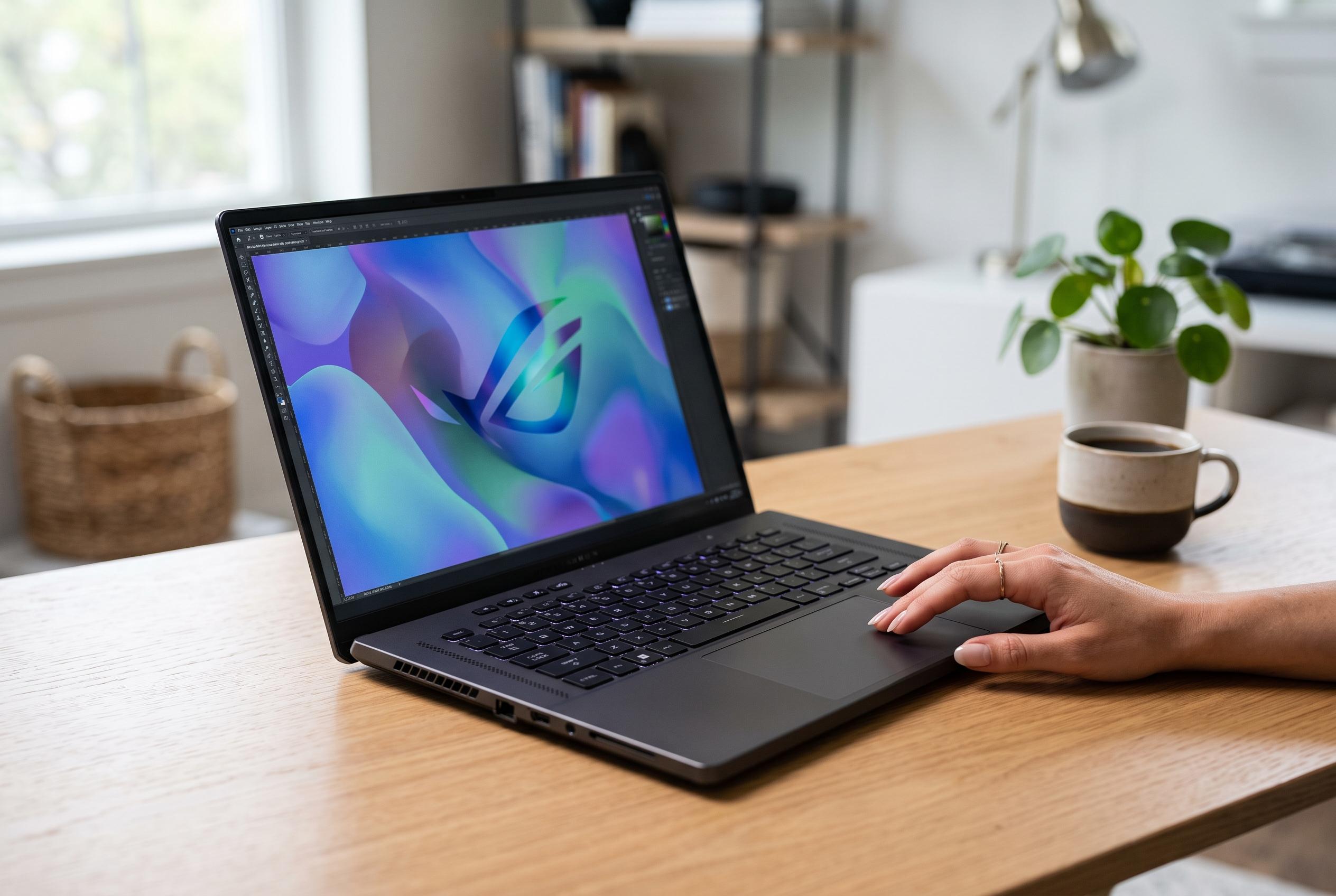

The 2026 ROG Zephyrus G16 garners praise for its slim design, powerful specs, and impressive battery life, but faces scrutiny over its steep pricing in the high-end market for gaming and creators.
Asus’s 2026 ROG Zephyrus G16 is drawing an unusual consensus from reviewers: it is one of the most convincing thin gaming laptops of the year, yet also one of the hardest to recommend without qualification because of its price. Across US, Canadian and Indian coverage, the machine is praised for combining high-end Nvidia graphics with a sub-2kg design and unexpectedly strong battery life, but the cost of better-equipped versions pushes it deep into luxury territory.
That positioning is not accidental. When Asus unveiled the new Zephyrus G14 and G16 line-up in Taipei on 6 January 2026, the company said the range was meant for creatives and professionals who need more power away from a desk. Independent reviewers have largely accepted that framing. 91mobiles argued that the G16 sits between Asus’s overtly gaming-focused ROG Strix family and its creator-led ProArt machines, describing it as a rare laptop that can handle “rendering videos, deadlines and AAA gaming” without forcing buyers into a much bulkier chassis.
Design is one of the least disputed parts of the package. PC Gamer listed the G16 at 1.95kg, while other reviewers simply described it as under 2kg, and several treated that weight as one of its main selling points. Hindustan Times said the chassis is entirely metal with no noticeable flex, while CGMagazine highlighted the CNC aluminium unibody and Asus’s customisable Slash Lighting strip on the lid. The display specification also appears to justify the premium billing: a 16-inch 2,560 x 1,600 OLED panel at 240Hz, with Hindustan Times adding Dolby Vision support, VESA DisplayHDR True Black certification, Pantone validation, Gorilla Glass protection and an anti-reflective coating. That publication also said peak HDR brightness reaches about 1,100 nits.
What buyers actually get, however, depends sharply on configuration. Tom’s Guide reviewed a Core Ultra 9 386H model with an RTX 5080, 64GB of memory and a price of $4,799, while saying the range starts at $3,699 with an RTX 5070 Ti and 32GB of RAM. PC Gamer tested a similar 64GB, RTX 5080 version and said it was listed at $4,800, with a 32GB, 1TB configuration shown at Best Buy for $4,400. In India, 91mobiles put the asking price at roughly Rs 4.5 lakhs for its review unit. That spread matters because the line is no longer a single easy-to-place product: 91mobiles compared the 2026 G16 it tested, based on the Core Ultra 9 386H and RTX 5070 Ti, with a 2025 G16 running a Core Ultra 9 285H and RTX 5080, underlining how much the exact value proposition shifts between regions and trims.
Battery life is arguably the machine’s most surprising strength. Tom’s Guide said the laptop lasted 14 hours in its testing, an unusually strong result for a premium gaming notebook carrying RTX 5080-class graphics. CGMagazine went further, noting Asus’s own estimate of 15 to 20 hours depending on usage, and added that the bundled 250W power adapter can charge the battery to 50% in 30 minutes. The same review cautioned that heavy gaming still cuts endurance dramatically, saying full-settings play sessions drained the battery in three to four hours. Even so, that is a materially different profile from the traditional slim gaming laptop, which often sacrifices unplugged use for portability.
Gaming performance itself appears to be strong rather than class-leading at any price. CGMagazine said Forza Horizon 6 ran at a stable 60fps on Ultra settings with ray tracing enabled, while Death Stranding 2: On the Beach also held 60fps at full settings. Hindustan Times reported solid results in Cyberpunk 2077, Forza Horizon 6, Pragmata, Stellar Blade, Doom Eternal and Shadow of the Tomb Raider, and said the thermal design uses a large bottom intake with rear exhaust vents to keep the compact body in check. On the software side, CGMagazine said users can choose between standard Windows behaviour, Performance mode, Turbo and Silent, while Hindustan Times judged Armoury Crate broadly useful but in need of decluttering.
The problem, repeated almost everywhere, is value. PC Gamer awarded the machine 78 out of 100 and called it a “fantastic 16-inch gaming laptop”, praising its “excellent chassis design, stunning 240 Hz OLED display, and superb portability”. But the same review said it was “simply too pricey” and pointed out that a Razer Blade 16 in RTX 5080 trim was about $400 cheaper. Tom’s Guide reached a similar conclusion from a more consumer-oriented angle, saying the 2026 model improves both performance and endurance over the previous version, yet remains “too pricey” despite gains in multithreaded workloads against the Razer. CGMagazine’s broader price range of $3,499 to $5,499 only reinforces the message that the Zephyrus G16 now competes as much on prestige as on specification.
Taken together, the reviews suggest Asus has succeeded technically and narrowed its audience commercially. The 2026 Zephyrus G16 seems to do exactly what Asus intended when it repositioned the line around mobile creators and premium buyers: it is thin, powerful, visually refined and flexible enough for work as well as play. But the more convincingly it bridges the gap between gaming laptop and creator workstation, the more directly it invites comparison with other premium 16-inch machines that may cost less. That is why the praise is so consistent, and why it is so often followed by a warning.
Disclaimer: This content is intended for informational purposes only. Readers are advised to exercise their own judgement, conduct due diligence, or consult a qualified expert before acting on any information provided.