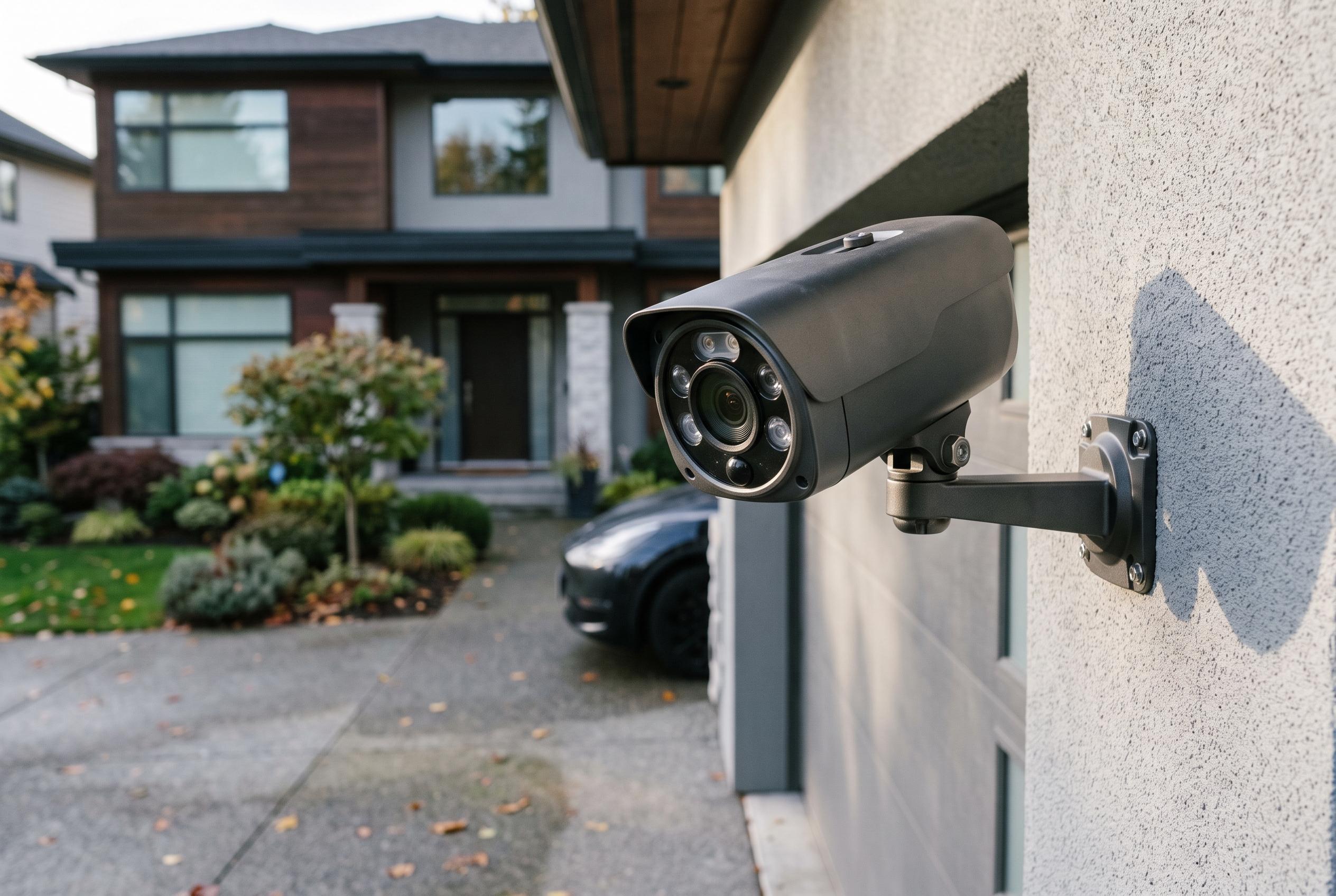

A detailed guide to navigating the crowded 2026 outdoor WiFi camera market, highlighting hardware differences, installation considerations, and the best options for various security needs.
The most useful way to read the crowded 2026 market for outdoor “360°” WiFi cameras is to ignore the label and look at the hardware underneath. Independent reviews of recent Ctronics models show at least three different interpretations of all-round coverage: conventional pan-tilt heads, twin-lens units that watch a wide scene and a tighter crop at the same time, and newer hybrids that combine a motorised body with two lenses and a 10x hybrid zoom. That distinction is more than marketing. It determines whether the camera is always observing the whole scene, whether it can close in on a moving subject, and how much useful detail remains once daylight has gone.
For a first installation, the low-cost CTIPC-380C still looks strongest when the job is simple driveway or garden monitoring rather than evidence gathering at distance. An Italian reviewer who used it to watch a car park near home described it as sturdy, about 800g, weather-rated to IP66 and backed by an app that was regularly updated, praising the colour night mode as “the icing on the cake”. The same review put the selling price below €70, which helps explain why this model has endured as an entry point rather than a premium choice.
What the bargain pitch hides is that the 380C is not especially plug-and-play in the smart-home sense. A Japanese setup guide shows an onboarding process closer to network kit than to a modern battery doorbell: the user powers the unit, waits for its self-check, holds the reset switch for about 10 seconds, joins a temporary Wi-Fi network named IPCAM-nnnnnn with the default password 01234567, and then scans the QR code in the CTRONICS app. That guide also notes three leads from the camera body – power, Ethernet and reset – which underlines that this is a mains-powered PTZ unit with optional wireless connectivity, not a truly cable-free device. In return, buyers get remote pan and tilt, infrared or colour night recording, motion alerts, auto-tracking, an LED light and two-way speech.
Move up a tier and the gains are practical rather than abstract. Robert Doudelain, writing for Avis caméra in December 2025, said the 990C-5MP offered enough definition at 2880 x 1620 to read faces and number plates at useful distances, with three night modes, dual-band 2.4GHz/5GHz Wi-Fi, AI classification for people, vehicles and animals, and eight preset positions. A separate iXBT hands-on review of the CTIPC-590C reported similarly easy deployment, saying wall mounting and app setup took no more than 15 minutes, and found the two-way audio loud and clear enough to speak to someone on the far side of a fence. Installed on the third floor of a residential block to watch a parking area, the 590C was judged strong enough day and night for routine vehicle monitoring.
Those better-specified models also expose a point that broad comparison pieces often smooth over: storage limits, recording formats and bundled hardware vary more than the headline claims suggest. iXBT lists the 590C as recording in H.265, with Wi-Fi or wired LAN and microSD support up to 256GB, while JusteGeek says the dual-lens 640C-4KSD also accepts cards up to 256GB and arrives with an unusually complete kit including a Wi-Fi antenna, Ethernet cable, sealing caps, a drill template and even tweezers for handling the card slot. If the plan is to record continuously or export footage to an NVR or NAS, those details matter as much as whether the sensor is advertised as 4K or 5MP.
The twin-lens segment, in particular, is now broader than the usual fixed panoramic-versus-rotating PTZ split. JusteGeek’s March 2026 update on the CTIPC-640C-4KSD describes a motorised outdoor camera with a wide 3.6mm lens, a second 8mm lens and a 10x hybrid zoom that switches from digital enlargement to the telephoto view at 6x. The reviewer found the changeover between the two viewpoints simple and smartphone-like. The same model adds AI filtering for people, animals and vehicles, four configurable detection zones, and a more forceful deterrent package than many entry cameras, with siren or barking sounds, user-recorded audio, and flashing red and blue lights when movement is detected. That is a materially different proposition from a basic pan-tilt camera that merely sweeps a scene.
The solar category remains attractive mainly because it solves one problem very cleanly: power. Electronikz’s review of Ctronics’ battery-and-panel outdoor camera says the unit pairs a 7,800mAh battery with solar charging, pans 355° and tilts 95°, reacts via a PIR sensor in around 0.2 seconds, and supports two-way audio and 4x digital zoom. But the same review is candid about the trade-offs. It requires 2.4GHz Wi-Fi rather than 5GHz, may still produce some false alerts from non-human movement, and offers more limited smart-home integration than wired rivals. It is better understood as a convenience camera for a gate, shed or distant frontage than as a direct substitute for a mains-powered tracker.
Taken together, the independent tests point to a simple buying rule. Choose the cheapest PTZ option only when broad visual coverage matters more than installation elegance and when mains power is available. Spend more for the 5MP or 4K class if reliable tracking, better filtering of vehicles and animals, NVR or FTP workflows and clearer night evidence matter more than price. Consider dual-lens hardware when a wide overview and a tighter follow shot are equally important. Keep the solar model for places where running a cable is the real obstacle. That is why Doudelain judged the 990C a serious alternative to dearer Imou and Reolink units, while the reviewers of the 380C and the solar model treated them as effective but more specialised tools.
Disclaimer: This content is intended for informational purposes only. Readers are advised to exercise their own judgement, conduct due diligence, or consult a qualified expert before acting on any information provided.