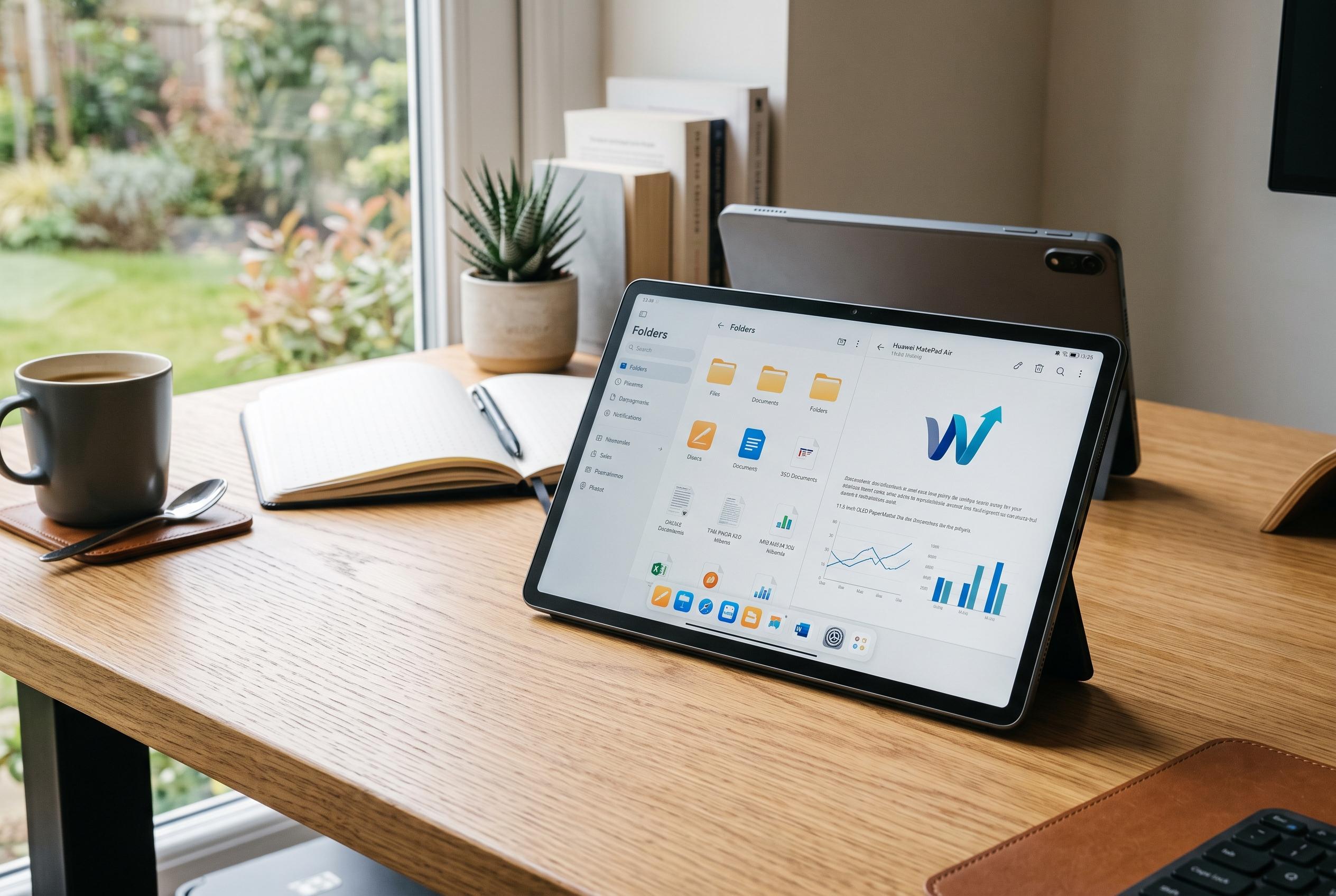

Huawei’s latest MatePad Air (2026) introduces a premium, lightweight tablet emphasising portability and productivity, featuring an OLED PaperMatte display and a refined design for work-focused users.
Huawei’s MatePad Air (2026) has arrived as a distinctly premium tablet rather than a cut-price compromise, with the company using its global launch in mid-July to pitch the device at people who want a portable machine for writing, sketching, meetings and general office work. Across several early reviews, the broad consensus is that Huawei has made a more convincing case for a lightweight productivity tablet than for a class-leading performance device. The appeal lies in the balance: a very slim chassis, a new OLED PaperMatte screen and a set of accessories that turn the tablet into something closer to a compact work tool than a media slate.
That hardware is central to the pitch. Reviewers broadly agree that the 12-inch form factor lands in a useful middle ground: large enough for split-screen work, but still light enough to carry without effort. Gizmochina reported that Huawei had reinforced the internal structure, claiming 17% better bend resistance than the MatePad 12X, while The Gadgeteer said the tablet felt comfortable both in the hand and on the lap with its magnetic case attached. At 5.3mm thick and 509g, it is not just thin on paper; in use, the reduced weight appears to be one of the device’s strongest practical advantages.
The most important upgrade is the display. Tablet News said Huawei replaced the previous model’s LCD panel with a 12-inch 2.8K OLED screen, while multiple reviewers singled out the optional PaperMatte finish as the feature that most clearly separates the MatePad Air from conventional tablets. The Gadgeteer found that the matte surface cut reflections effectively in bright rooms and sunlit spaces, and ComputerBase described it as more pleasant for both finger input and stylus work than a normal glossy panel. Digital Citizen, which took a more restrained view of the tablet overall, still identified the 3:2 OLED PaperMatte display as the standout element because it remains comfortable to view in almost any lighting condition.
That screen matters because Huawei is not selling the MatePad Air as a simple consumption device. The tablet is designed to be used with a keyboard cover and stylus, and the way those accessories are packaged varies by market. PhoneArena said European buyers can choose a standard glossy version for €849 or a PaperMatte bundle at €899 that includes either the keyboard or the M-Pencil. ComputerBase reported a more aggressive launch offer in Germany, where the tablet appeared at €749 after a €50 discount and was sold with either the M-Pencil Pro or the keyboard cover. The Gadgeteer added that the keyboard case provides two viewing positions and remains stable in use, even though it does not include a trackpad. That omission seems deliberate: Huawei’s approach relies on touch and pen input rather than trying to mimic a small notebook computer outright.
On software, the reporting is notably consistent. PhoneArena said the current HarmonyOS build will feel familiar to anyone who has used recent Huawei or EMUI products, while Gizmochina described the system as well tuned in daily use, with smooth app launches, task switching and multi-window behaviour. The Gadgeteer’s assessment was more conceptual: Huawei appears to be building a work-focused tablet interface without forcing a desktop imitation. That distinction matters because it explains why the MatePad Air may suit users whose day is spent between documents, note-taking, browsing and video calls, but not necessarily those who depend on specialist desktop applications.
Performance is where the tone becomes more mixed. Early coverage from Gizmochina noted that Huawei had not yet firmly identified the processor at the time of publication, but later reviews and launch reports converged on the Kirin T93C. PhoneArena characterised it as an upgrade over the T92 used in earlier Huawei tablets, and published Geekbench 7 scores of 1102 single-core and 4347 multi-core. ComputerBase added more architectural detail, saying the T93C uses an 8-core, 12-thread arrangement and pairs with a Maleoon 935B graphics unit, though it noted that Huawei had disclosed little beyond that. Yet Digital Citizen offered the clearest caution, arguing that the chip does not really compete with rivals at the same price. That view does not contradict the more positive reviews so much as qualify them: the MatePad Air appears fast enough for mainstream productivity and casual creative work, but it is not the performance leader in its bracket.
Memory and storage options also reinforce that positioning. Tablet News said Huawei offers 8GB or 12GB of RAM, but pairs both with 256GB of storage. ComputerBase reported that Germany initially received only the 8GB/256GB model, with a 12GB version listed but not yet available to order, and no microSD expansion. Gizmochina made a similar point from a creator’s perspective, arguing that the limited storage ceiling could become restrictive for heavier users working with large art files, video assets or extensive offline media libraries. In other words, Huawei is prioritising portability and simplicity over broad configuration choice.
Battery expectations are more encouraging. The Gadgeteer said Huawei rates the tablet for up to 16 hours of local HDR playback and about 10 hours of online video, backed by a 10,100mAh battery and 66W charging. Combined with the low weight and anti-glare display, that gives the MatePad Air a clear role: it is aimed at students, mobile professionals and stylus users who need a dependable device for long sessions away from a desk. The reviews do not present it as the obvious choice for gamers or for buyers chasing the strongest processor per euro. They present it instead as a carefully judged, highly portable tablet whose best features are its screen, ergonomics and everyday usability.
Disclaimer: This content is intended for informational purposes only. Readers are advised to exercise their own judgement, conduct due diligence, or consult a qualified expert before acting on any information provided.